
In the wake of the recent Bondi terror incident and the ongoing complexity surrounding Australians with alleged ties to the Islamic State group seeking to return from Syria, Australia’s migration policies have garnered renewed attention. The discourse is particularly heated between the Liberal and One Nation parties, both of which argue that controlling immigration is key to combating extremism.
Earlier this week, a stringent immigration proposal from the former Liberal leader Sussan Ley came to light. The proposal sought to significantly limit visa approvals from 37 regions across 13 nations deemed potential hotbeds for terrorism, and included a plan to reduce overall migration to 170,000 annually.
The suggested policy called for a three-year halt on visa applications from specific areas within countries like the Occupied Palestinian Territories, Afghanistan, the Philippines, Lebanon, Somalia, and others, including Libya, Niger, Mali, Cameroon, Egypt, Algeria, Nigeria, and Yemen. The aim was to target regions considered likely to harbor terrorist activities.
With the recent change in leadership, Angus Taylor, the newly elected head of the Liberal Party, has not yet clarified the party’s stance on immigration under his direction. However, he has emphasized the need for robust security screenings to ensure that migrants align with Australian values. He has not, however, supported the idea of excluding certain regions entirely.
In a statement to Sky News, Taylor underscored the importance of shared values: “If they reject our core beliefs, if they reject our focus on democracy, the rule of law, obeying the law, our basic freedoms, freedom of speech, freedom of religion, if they reject those things, the door must be shut.” His comments reflect an ongoing debate about how best to balance national security with the nation’s immigration policies.
“Now, if they reject our core beliefs, if they reject our focus on democracy, the rule of law, obeying the law, our basic freedoms, freedom of speech, freedom of religion, if they reject those things, the door must be shut,” he told Sky News on Wednesday.
The revelation of the policy document and Taylor’s comments came amid news this week that a cohort of 34 women and children with alleged links to the self-proclaimed Islamic State group are seeking to return to Australia from a displacement camp in Syria.
Additional powers should have been used to reject the women’s passport applications, Taylor said on Friday.
“It is truly tragic that we’ve seen people take children over to what is an ideological movement that promotes violence against innocent people,” he said, days after he said the government should use its powers to temporarily exclude the Australian citizens from reentering.
On Thursday, Home Affairs Minister Tony Burke confirmed the government did issue one of the cohort with a temporary exclusion order.
One Nation leader Pauline Hanson — whose policy platform includes cutting visas to a flat 130,000 target — said this week there were no “good” Muslims as she threw her support behind the leaked proposal.
With a heated debate around slashing migration — and who enters Australia — experts have weighed in on current levels and whether cuts could curb extremism.
What is net migration? Key terms and figures
Net overseas migration (NOM) is how much the Australian population has grown or reduced each year due to people leaving and arriving here.
NOM calculates the number of immigrants that have arrived and stayed for 12 months or more within a 16-month period, subtracting departures over the same period.
The figure has been under scrutiny in recent years, by some conservative politicians critical of a perceived spike, which actually may read as more of a levelling out, with numbers reaching close to where they were before 2020. NOM had plunged to negative 94,000 at the height of the COVID-19 pandemic in March 2021, but then rose sharply as borders reopened.
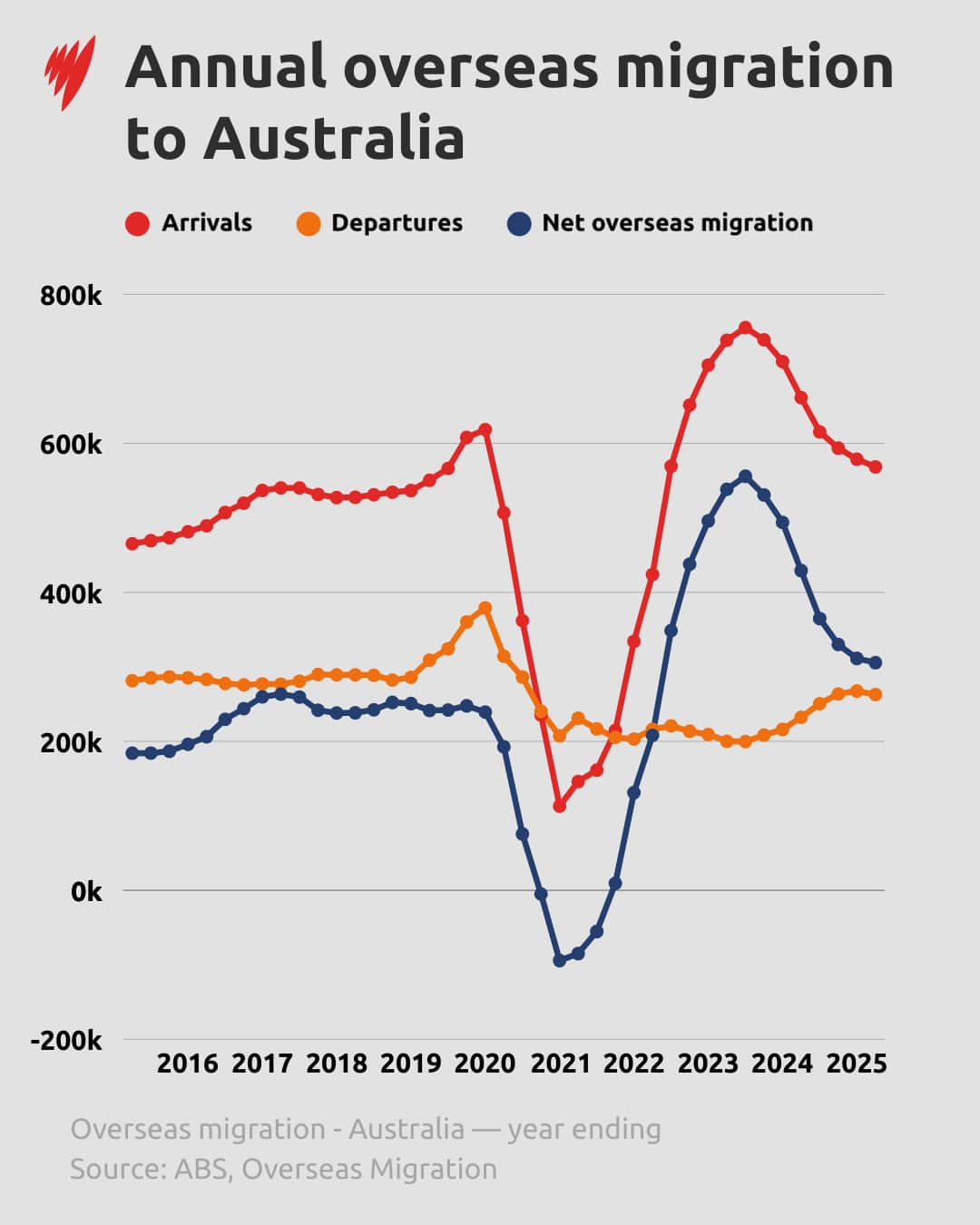
It peaked at 555,000 in September 2023 and has slowly been reducing. It was 306,000 in the 2024-25 financial year, according to data released by the Australian Bureau of Statistics.
The boom was partly the result of migration settings tweaked by the Coalition government before the May 2022 election. It removed working restrictions for students and allowed certain visa extensions in response to labour shortages. Labor capped working hours in June 2023.
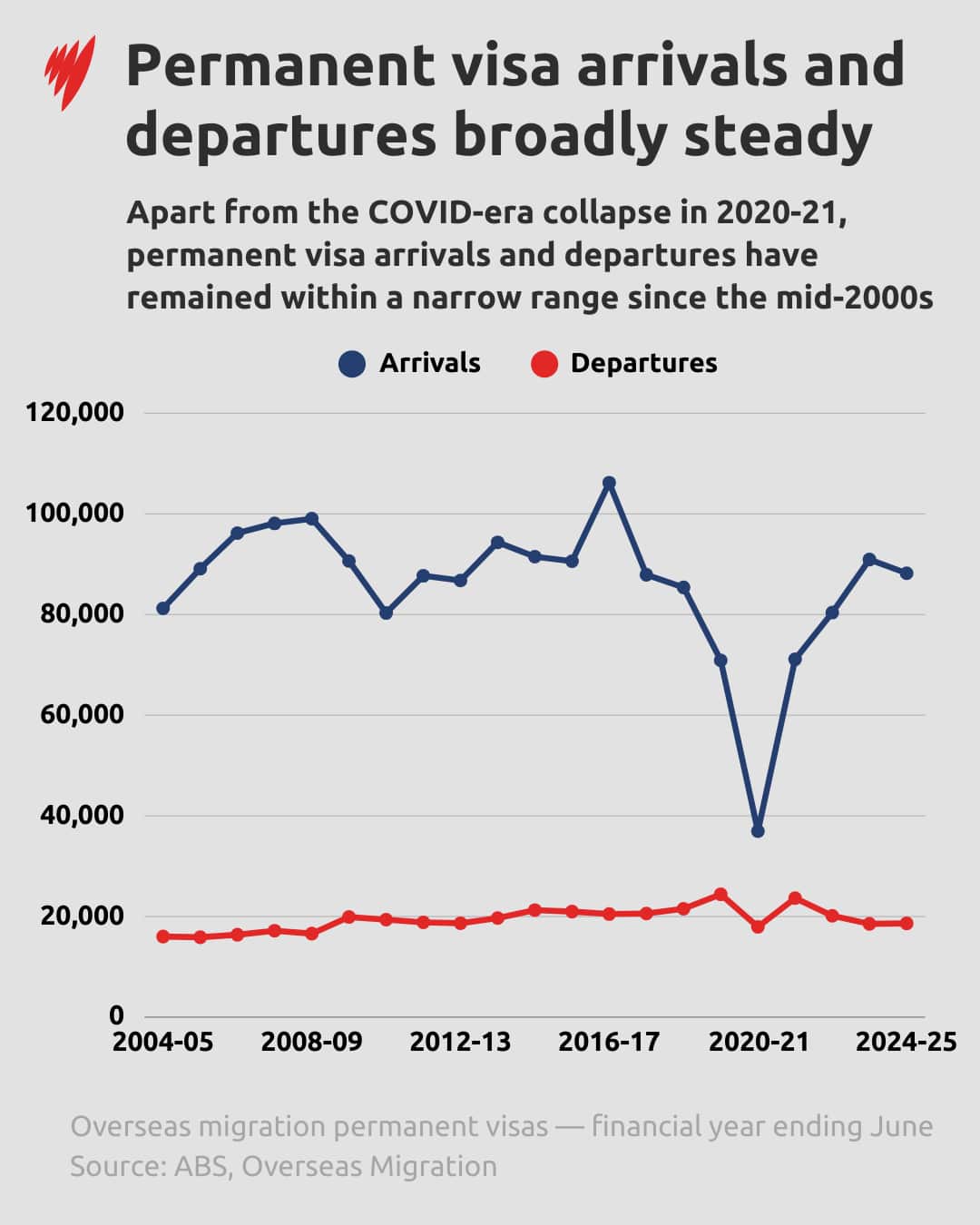
The most recent Home Affairs migration trend report identified that before pandemic disruptions, NOM was largely affected by “rapid increases in international student numbers (since 2012) and visitors (since 2016)”.
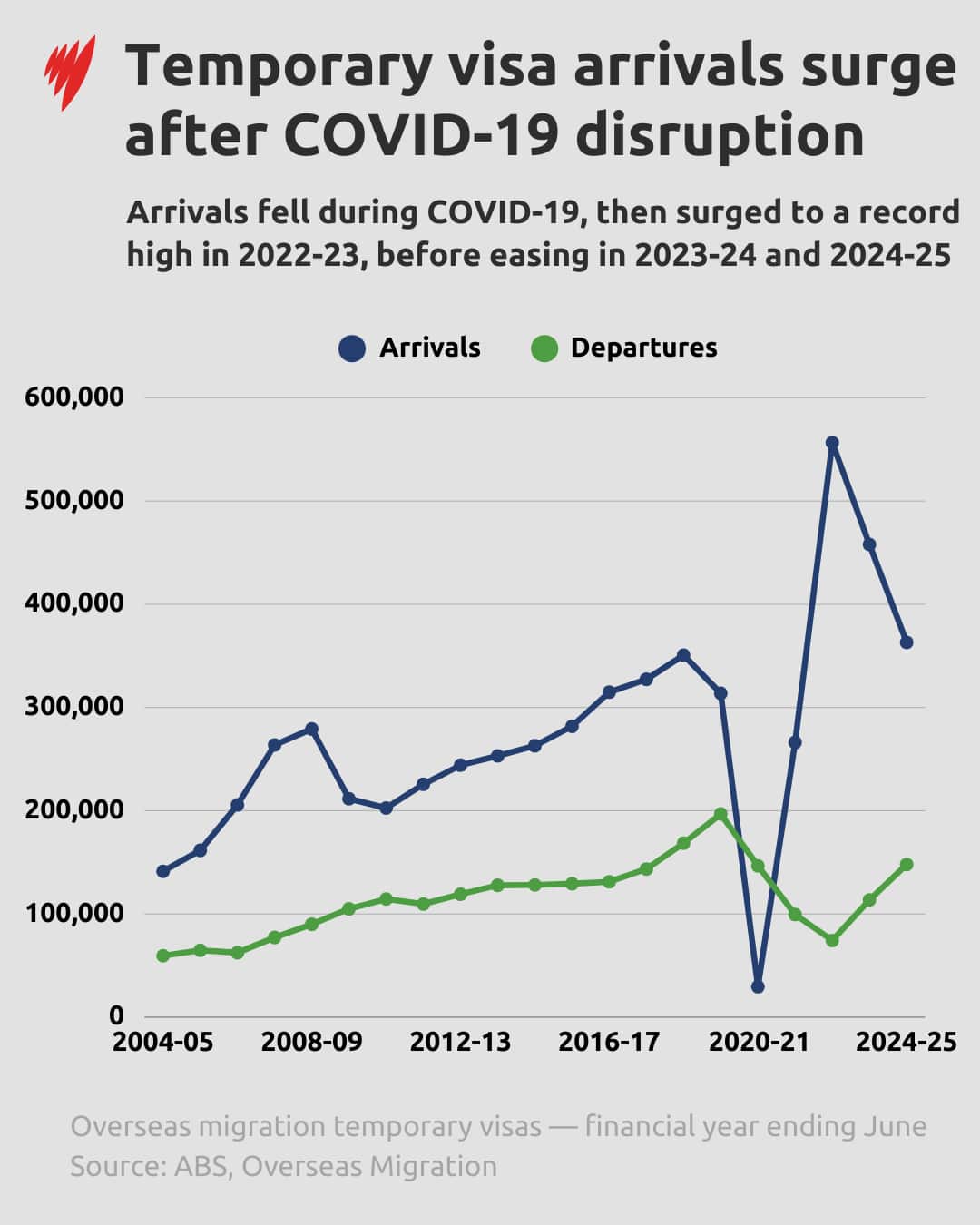
Australia’s visas fall under one of two categories: temporary or permanent migration.
Permanent migration includes people on skilled or family visas, as well as a separate humanitarian program. This figure has remained steadier over the past decade.
Temporary migration is more reactive to economic demands. It includes international students, visitors, temporary skilled visas and working holiday makers.
What’s within government control?
In its 2025 Population Statement, Treasury revealed it estimates that NOM will fall to 260,000 in 2025–26, 225,000 in 2026-27 and eventually stabilise to near pre-pandemic levels of 235,000.
Alan Gamlen, director of the Migration Hub at the Australian National University, told SBS News that while arrivals are more tightly managed, “in a liberal democracy, you can’t control when people leave”.
“It’s a very important measure of population change, but you can’t fully control it,” he said.
Abul Rizvi — a former deputy secretary at the Department of Immigration from the early 1990s to 2007 — disagrees.
He compares that approach to inflation; while the government does not control it, it can change the policy settings to manage the flow better.
“It doesn’t have any more control over net migration than it has over inflation, but it could do the same thing with net migration, you could set a range and say, we will try to manage it within that range,” he told SBS News.
He said the government will always need to respond to circumstances, but that a plan would give “clarity and confidence” to a variety of sectors.
“You still should try to stay on that long-term trajectory because that lets people plan things like infrastructure, housing, service delivery. It lets people plan their businesses.”
Is there a ‘sweet spot’ for migration?
Gamlen says the “sweet spot” to counteract the ageing population is somewhere between 160,000 and 220,000.
“Migration within that bandwidth is economically optimal for Australia,” he said.
“What that means is that for every person in a week who leaves the workforce through retirement, of which they’re increasing number, there’s enough workers entering the workforce to look after them.”
He explains that it can’t be lowered much more “without doing catastrophic harm to the economy, to businesses who need workers”.
Rizvi argues any number below 200,000 would mean Australia’s labour market suffers, with domestic workers struggling to fill skill shortages.
Conversely, anything around or above 250,000 would lead to infrastructure and services struggling to keep up.
“Things just clog up when it gets to those levels, because the intake is faster than what people were anticipating,” he said.
Will banning visas from certain regions curb extremism?
Setting aside the difficulties of implementing bans on certain regions within a country, Rizvi doubts the leaked Liberal proposal would curb extremism.
“I suspect it would probably have the opposite effect. It would just make people angry,” he said.
“There are always going to be extremists in any group. And if you make the group angry, the extremist will become more angry than the rest of the group.
“I think excluding people from certain countries in that way would just be not very helpful.”
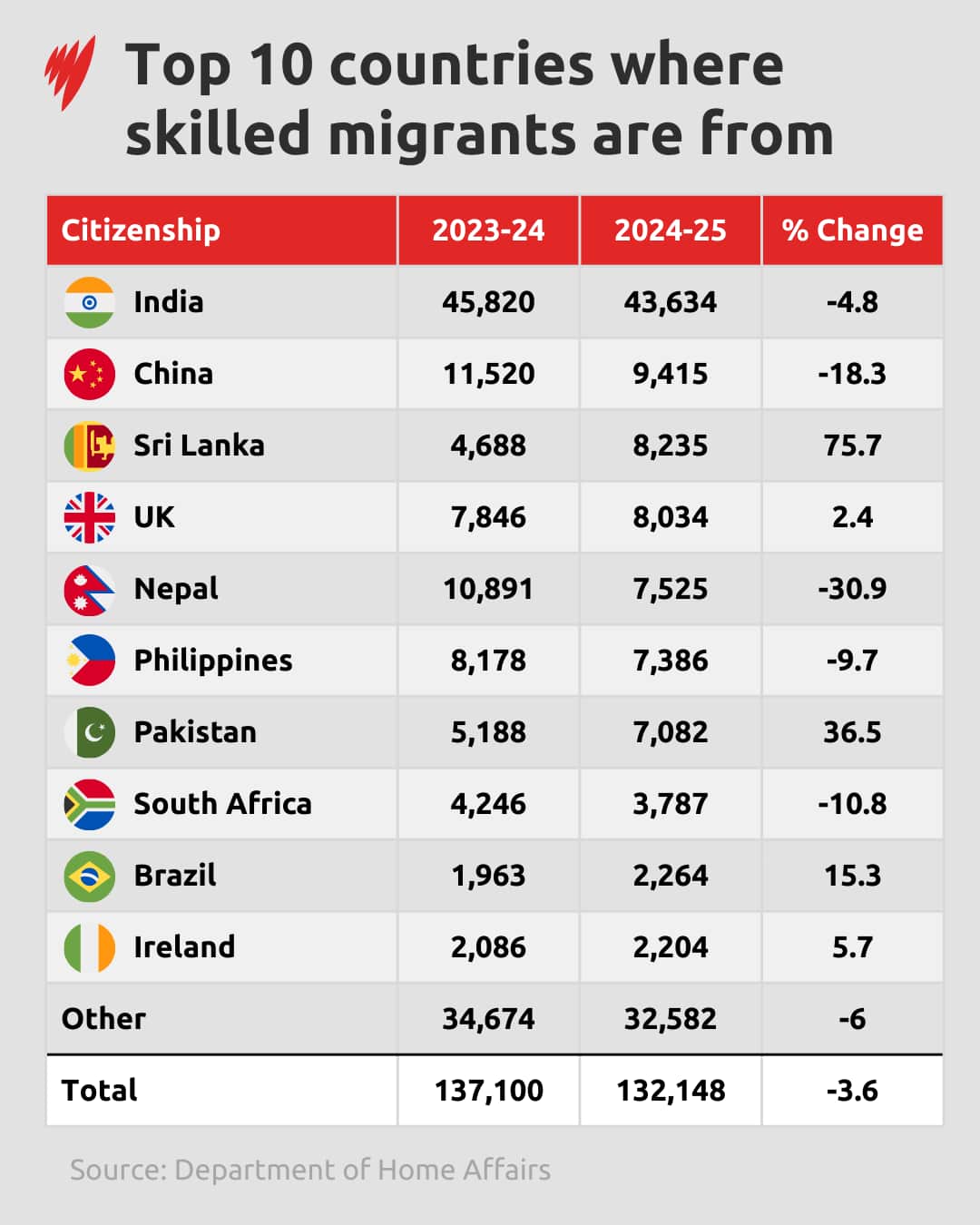
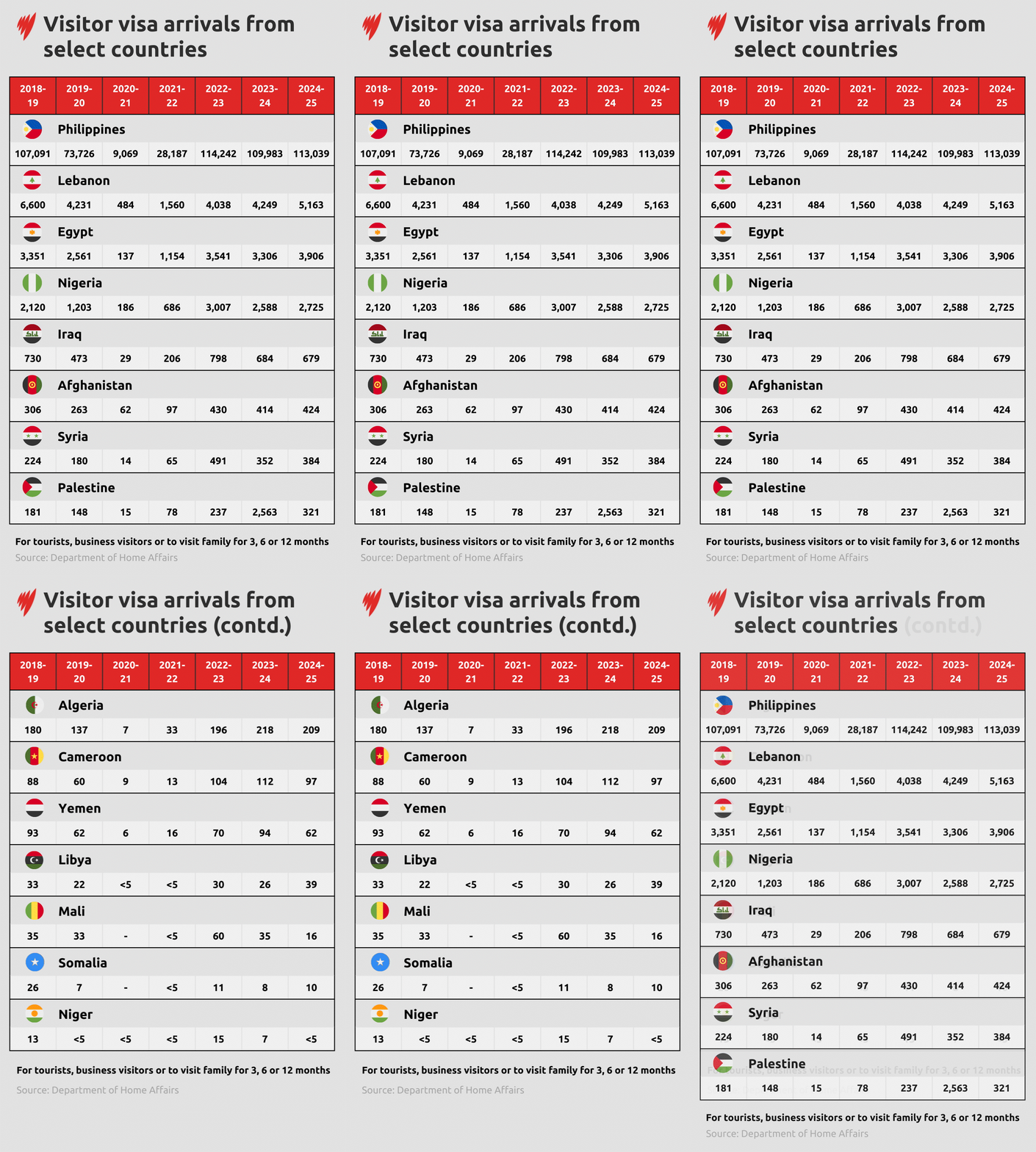
Of the 13 countries with regions covered under the proposal, the largest number of visitor visas is issued to the Philippines, with 113,000 visitors in 2024-25, according to the Department of Home Affairs.
The country places sixth as a source for skilled migrants — plugging gaps across aged care and nursing sectors — particularly in regional areas.
Meanwhile, visitor numbers from several countries — Cameroon, Yemen, Libya, Mali, Somalia and Niger — are less than 100 annually.
Gamlen says the extremism and radicalisation that the government needs to focus on is “domestic in nature”, arguing the Liberal policy would not have prevented Bondi.
“When something like Bondi happens, it’s un-Australian in a moral sense, absolutely but geographically, it’s domestic.”
He noted that one of the alleged gunmen, Naveed Akram — now before the courts — was born in Australia and is an Australian citizen.
Akram is charged with 15 counts of murder, among other offences, over the terror attack in which he and his father Sajid allegedly opened fire on a Jewish Hanukkah event at Sydney’s Bondi Beach on 14 December.
Gamlen said Sajid Akram, who was shot dead by police during the attack, moved to Australia from India decades ago: “from an area where there was no risk of radicalisation”.
Sajid legally owned six legal firearms. The 2023 licence was granted four years after his son had been investigated by the Australian Security Intelligence Organisation because of his connections with two people who both subsequently went to jail, but there had been “no evidence” Naveed had been radicalised.
“No amount of migration policy change and who we let into the country is going to address that,” he said.
“That requires difficult social work at home to understand the experiences that people in Australia are having that are turning them into monsters who would do us harm.”
For the latest from SBS News, download our app and subscribe to our newsletter.


