Share this @internewscast.com
Cambodia has accused Thailand of engaging in “inhumane and brutal acts” following a series of aggressive actions. Despite these claims, Cambodia emphasized its decision not to retaliate. Meanwhile, Thailand justified its air strikes on military targets, stating that these were in response to Cambodia’s mobilization of heavy weaponry and repositioning of combat units.
In response to the tensions, Thailand announced the relocation of 380,000 individuals to safe shelters. Simultaneously, Cambodian officials reported that 1,157 families were being evacuated from the province of Oddar Meanchey.
This resurgence of conflict marks the most severe confrontation since a five-day skirmish in July, characterized by exchanges of rockets and heavy artillery. That previous conflict, which was the most intense in recent memory, resulted in at least 48 fatalities and the displacement of 300,000 people until a truce was facilitated by former U.S. President Donald Trump.
Thailand has accused Cambodia of laying new landmines, demanding an apology before considering the resumption of de-escalation measures. Cambodia, however, has consistently denied these accusations.
In October, a peace agreement was successfully brokered by U.S. President Donald Trump. This deal was signed by Thailand’s Prime Minister Anutin Charnvirakul and Cambodia’s Prime Minister Hun Manet. The signing took place on the sidelines of the 47th Association of Southeast Asian Nations (ASEAN) summit in Kuala Lumpur, Malaysia. Source: AP / Mohd Rasfan
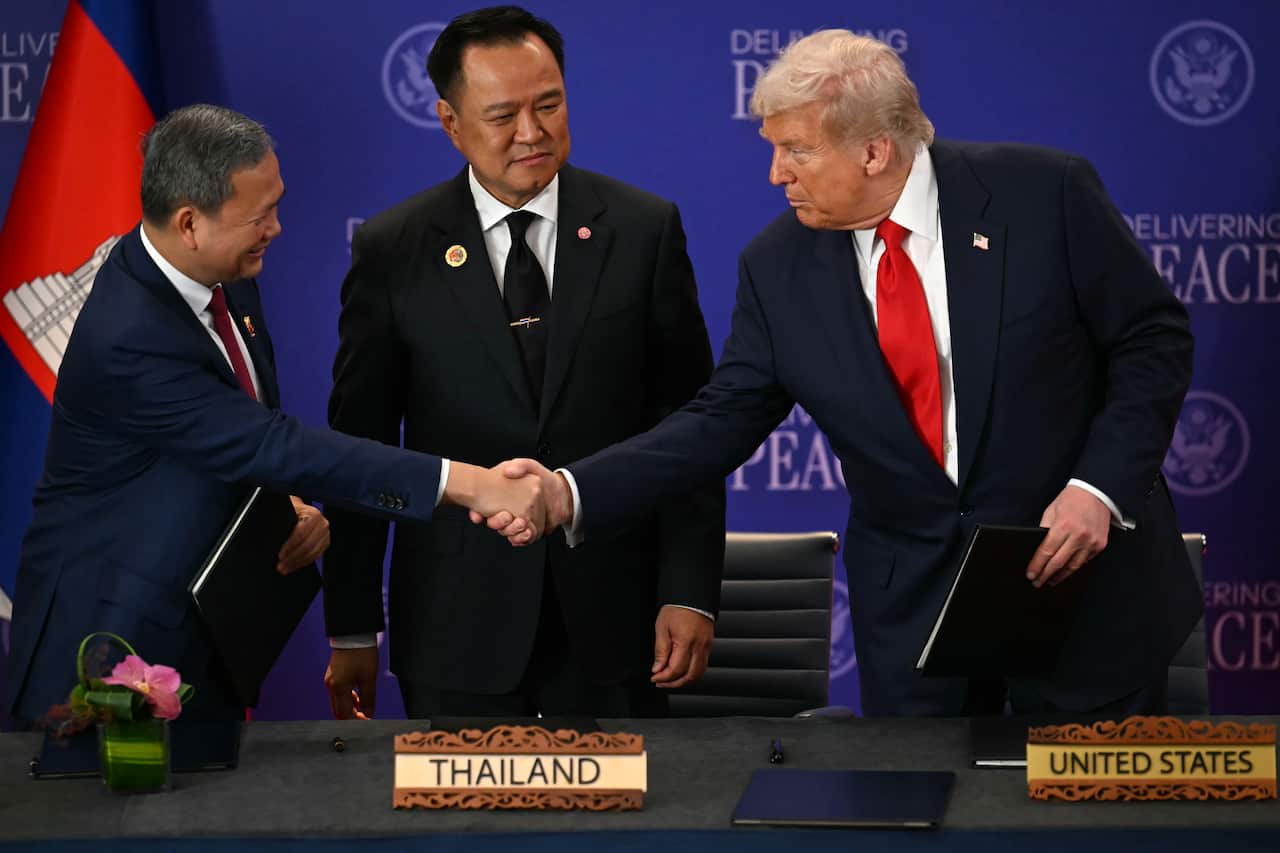
US President Donald Trump (right) brokered a peace deal signed by Thailand’s Prime Minister Anutin Charnvirakul (centre) and Cambodia’s Prime Minister Hun Manet (left) in October. Source: AP / Mohd Rasfan
Trump, who Cambodia nominated for the Nobel Peace Prize, had made calls to leaders of both countries last month, urging them to stick to the ceasefire.
How do the two countries compare militarily?
Thailand has a large and well-funded military that dwarfs that of Cambodia, with triple the active armed forces personnel and a 2024 defence budget allocation that was four times bigger than its neighbour’s.
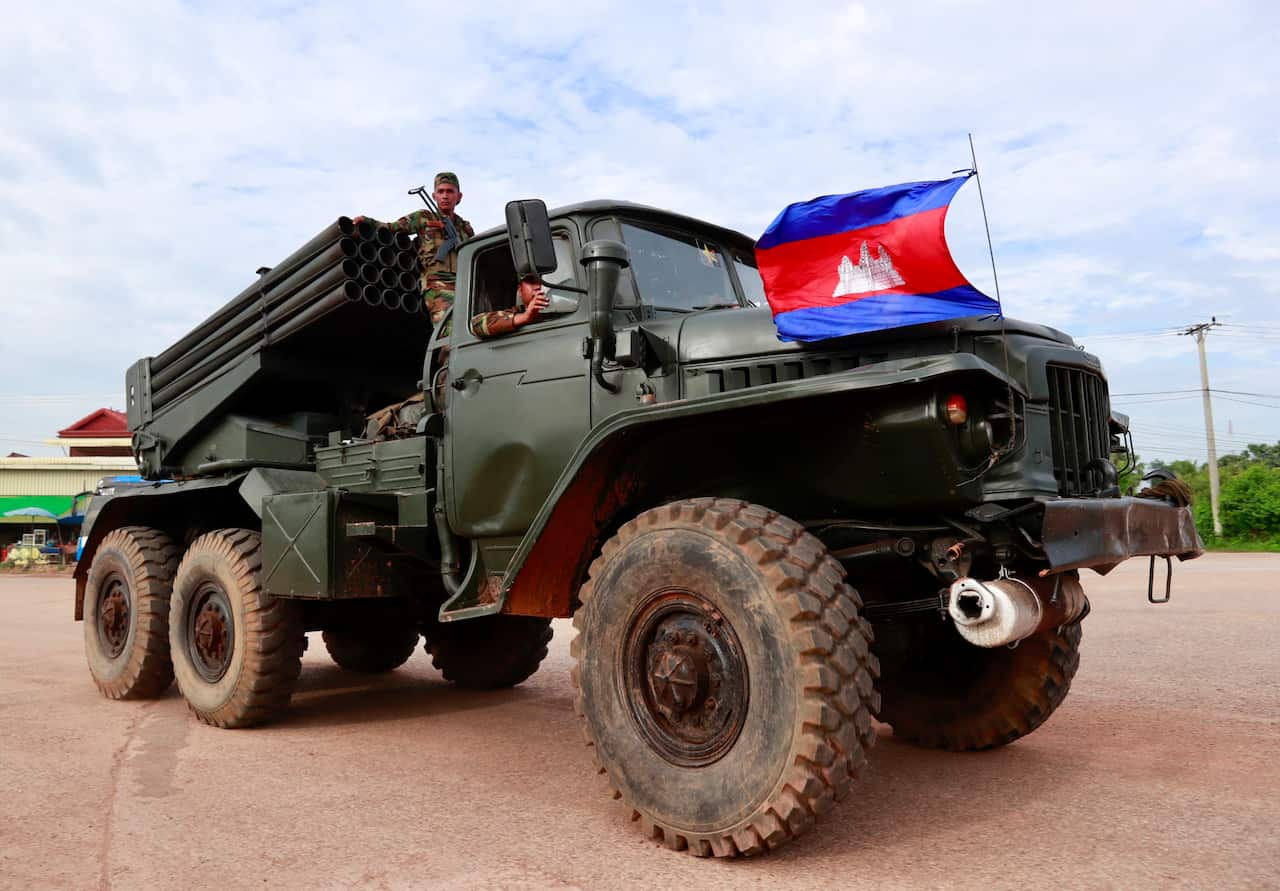
Cambodia’s military budget is a quarter the size of Thailand’s. Source: EPA / Kith Serey
Cambodia’s army has 75,000 soldiers, more than 200 battle tanks and around 480 pieces of artillery, compared to the Thai army’s 245,000 personnel, around 400 tanks, more than 1,200 armoured personnel carriers and 2,600 artillery weapons.
Thailand’s air force has nearly 40 fighter jets and dozens of helicopters, while Cambodia has 16 multi-role helicopters but no fighter aircraft.
Where does the dispute originate?
In 2000, they agreed to establish a commission to peacefully address overlapping claims, but little progress has been made.
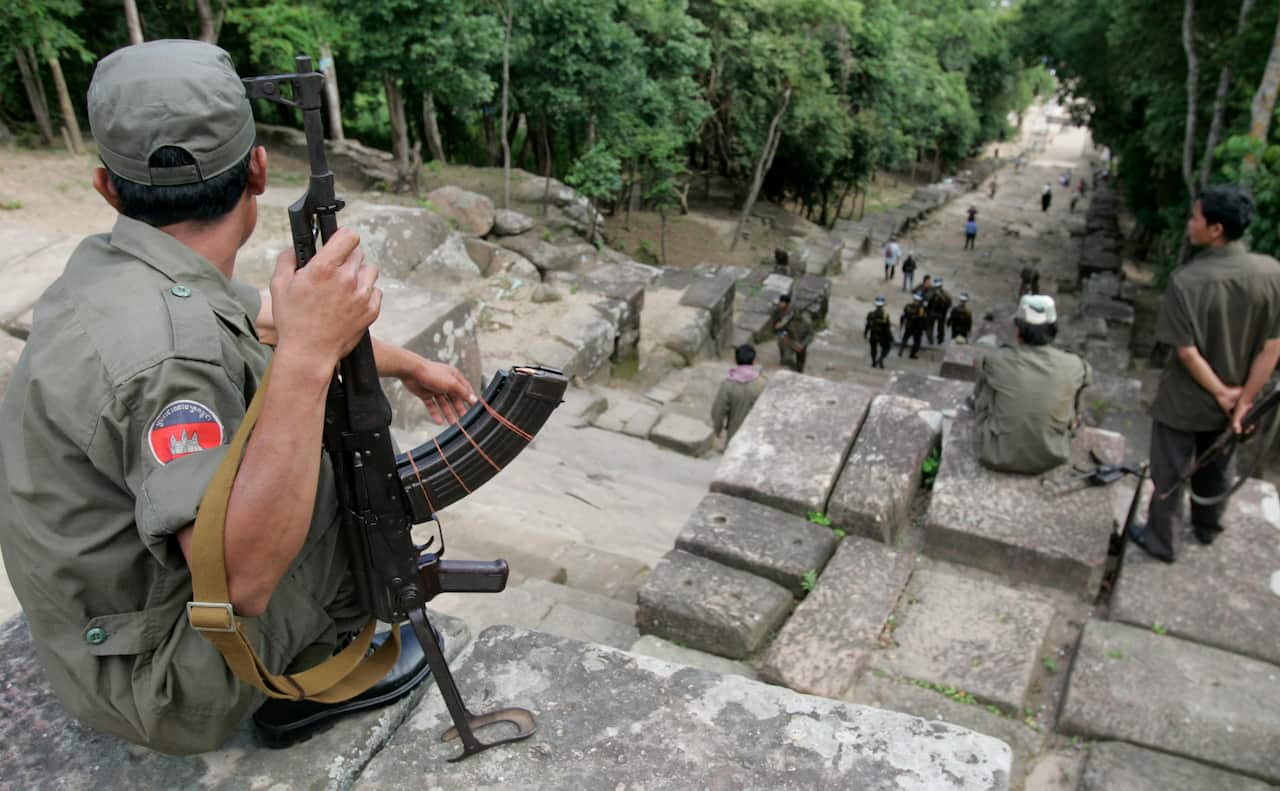
Cambodian soldiers on guard at Preah Vihear temple near Cambodia’s Thai border in July 2025. Source: AP / Mak Remissa
Claims over ownership of historical sites have raised nationalist tension, notably in 2003 when rioters torched the Thai embassy and Thai businesses in Phnom Penh over an alleged remark by a Thai celebrity questioning jurisdiction over Cambodia’s World Heritage-listed Angkor Wat temple.
The International Court of Justice awarded the temple to Cambodia in 1962, but Thailand continued to lay claim to the surrounding land. Tension escalated in 2008 after Cambodia tried to list Preah Vihear as a UNESCO World Heritage site, leading to skirmishes and at least a dozen deaths, including during a week-long artillery exchange in 2011.