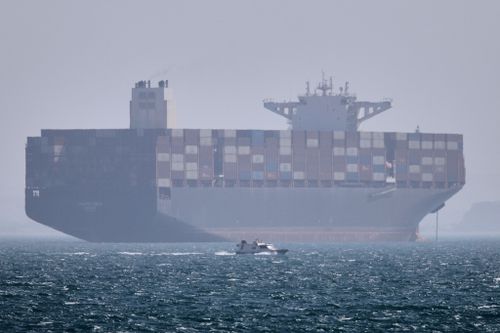

The United States military has announced that two merchant ships flying the American flag have successfully navigated the Strait of Hormuz, following the implementation of a new strategy aimed at re-establishing maritime traffic in the region.
This initiative, spearheaded by President Donald Trump, is designed to counteract Iran’s efforts to control the vital waterway and has intensified the ongoing tensions between the two nations. The US military has refuted Iranian claims that an American Navy vessel was attacked.
Since February, Iran’s near-blockade of the strait has led to a surge in global fuel prices and has unsettled the worldwide economy. As part of Trump’s recent approach to reopen the passage, the US-led Joint Maritime Information Centre has recommended that vessels navigate through Omani waters, where an “enhanced security area” has been established.
Despite these measures, there remains uncertainty about whether shipping companies and their insurers will be willing to take the risk, given Iran’s history of targeting vessels in the region and its commitment to continue such actions. The standoff has left hundreds of ships stranded in the Persian Gulf for several weeks.
Iran has criticized the US’s latest move as a breach of the tenuous ceasefire that has been in place for over three weeks. The strait represents a significant strategic advantage for Iran, allowing it to exert pressure on the global economy despite its military disadvantages.
According to the US Central Command, the two American-flagged merchant vessels are “safely continuing their journey” after passing through the Strait of Hormuz. The US Navy’s guided-missile destroyers stationed in the Persian Gulf are playing a key role in efforts to resume normal maritime operations.
The US military’s Central Command said the two American-flagged merchant ships were “safely headed on their journey” after transiting the Strait of Hormuz. It said Navy guided-missile destroyers in the Persian Gulf were helping to restore traffic.
Its statement on X said that US destroyers had also transited the strait. It did not say when the Navy ships arrived or when the merchant vessels departed.
Trump’s announcement on Sunday (early Monday AEST) that the US would “guide” ships out of the strait warned that Iranian efforts to block them “will, unfortunately, have to be dealt with forcefully”.
He described “program Freedom” in humanitarian terms, designed to aid stranded seafarers, many on oil tankers or cargo ships, who have been stuck in the Persian Gulf since the war began.
Crews have described to The Associated Press seeing drones and missiles explode more than the waters earlier in the war as their vessels run low on drinking water, food and other supplies.
Iran’s state-run IRNA news agency called the effort part of Trump’s “delirium”.
Iran stands firm on its grip of the strait
Iran’s military command on Monday said ships passing through the strait must coordinate with them.
“We warn that any foreign military force â especially the aggressive US military â that intends to approach or enter the Strait of Hormuz will be targeted,” Major General Pilot Ali Abdollahi told state broadcaster IRIB.
The disruption of the waterway has squeezed countries in Europe and Asia that depend on Persian Gulf oil and gas, raising prices far beyond the region.
Trump has promised to bring down gas prices as he faces midterm elections this year.
The US has warned shipping companies they could face sanctions for paying Iran for transit of the strait.
The Joint Maritime Information Centre urged mariners to coordinate closely with authorities in Oman, an Arab state that shares the strait with Iran, “due to anticipated high traffic volume”.
It warned that passing close to usual routes “should be considered extremely hazardous due to the presence of mines that have not been fully surveyed and mitigated”.
The head of security for the Baltic and International Maritime Council, a leading shipping trade group, said no formal guidance or details about the US effort had been issued to the industry. Jakob Larsen questioned whether the effort was sustainable and said there is a “risk of hostilities breaking out again” if it goes ahead.
The United Arab Emirates accused Iran of targeting a tanker linked to its main oil company with two drones as it passed through the strait. It did not say when the attack took place. No injuries were reported.
ADNOC Logistics & Services, an affiliate of the oil company, said on X that the ship was not carrying any cargo when it was hit off the coast of Oman.
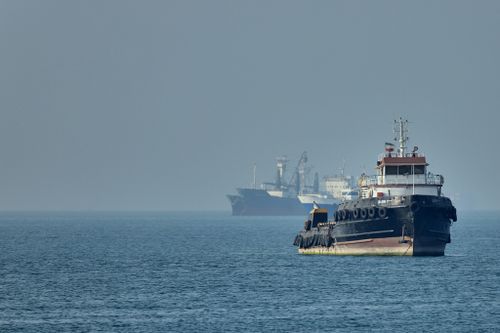
US military denies that Iran struck one of its ships
Iranian news agencies, including the semi-official Fars and ILNA, reported on Monday that Iran struck a US vessel near an Iranian port southeast of the strait, accusing it of “violating maritime security and navigation norms”. The reports said the vessel was forced to turn back.
US Central Command said on X that “no US Navy ships have been struck”.
The US has enforced a naval blockade on Iranian ports since April 13, telling at least 49 commercial ships to turn back, according to Central Command.
The blockade has deprived Tehran of oil revenue it needs to shore up its ailing economy. US officials have expressed hope that the blockade forces Iran to make concessions in talks to end the war.
NEVER MISS A STORY: Get your breaking news and exclusive stories first by following us across all platforms.