Share this @internewscast.com
In Brief
- Victoria’s public transport users will get free travel for a month amid the ongoing fuel crisis.
- NSW, Western Australia, Queensland and South Australia said the states were focusing on other forms of cost of living relief.
Australia finds itself divided over the prospect of free public transport as the Middle Eastern conflict sends fuel prices soaring. Victoria and Tasmania are taking action by suspending fares, whereas New South Wales, Western Australia, Queensland, and South Australia have decided against similar measures.
Residents of Tasmania and Victoria can look forward to a temporary break from transport costs, offering some relief from the ever-increasing prices at the gas stations.
New South Wales Transport Minister John Graham has expressed that his state prefers to reserve resources for an extended crisis, which he predicts will last beyond a single month. Meanwhile, South Australia is opting to concentrate on alternative cost-of-living strategies.
Both Queensland and Western Australia have announced they will not be implementing a fare-free period.
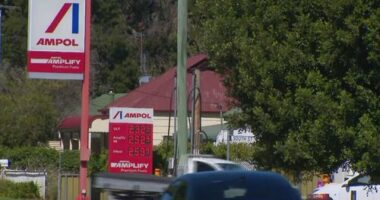
The ongoing conflict in Iran has led to a disruption in oil supplies, causing prices to rise and resulting in fuel shortages at several service stations across the country.
Victoria goes fare-free for April
Starting Tuesday, Victorian travelers will experience a month-long respite from fare charges. Myki cardholders can enjoy unrestricted access as the state opens all train, tram, and bus services for free throughout April.
The state government has added thousands of extra services to handle the expected surge in demand.
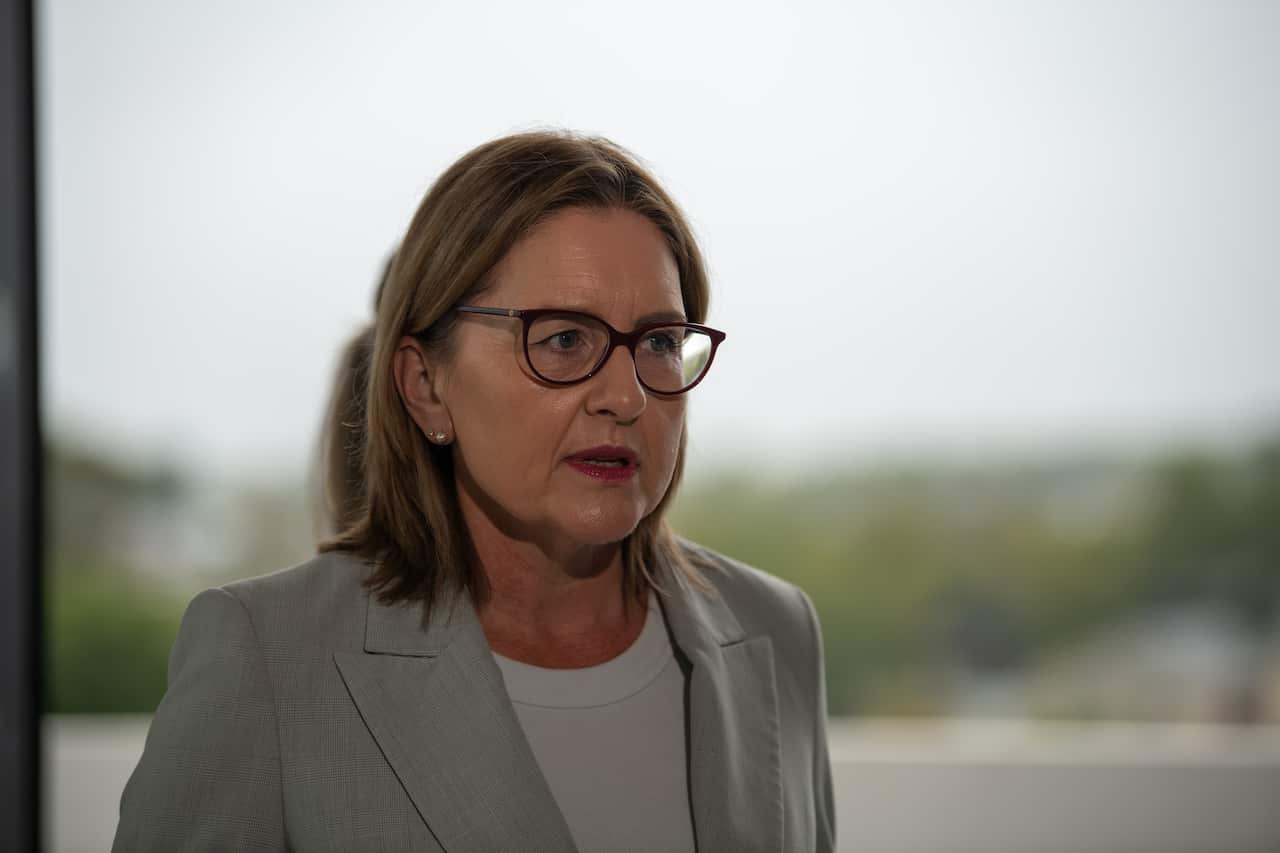
“This is a temporary measure to help with the cost of living; it will take pressure off the pump and help you save,” Premier Jacinta Allan said.
The move was welcomed by Victorian Farmers Federation president Brett Hosking.
“Every commuter who leaves their car at home frees up fuel for the essential, time-critical work that keeps Victorians fed, whether that’s ensuring livestock are fed and cared for, or getting crops in the ground,” he said.
Tasmania follows with a longer reprieve
Tasmanians will benefit from a longer period of free public transport, with free travel on buses and ferries running from 30 March until 30 June.
“For an adult catching the bus from Dodges Ferry into Hobart for work each day, they’ll be spending $88 less a week than if they were paying the full fare,” Transport Minister Kerry Vincent said.
Tasmania won’t be putting on more services, but will “carefully monitor capacity”.
The scheme replaces the state’s half-price fare initiative, which began in June 2024 and had been set to run through to June 2026.
Neither the Victorian nor Tasmanian governments have indicated the measures will become permanent, with Victoria’s initiative ending in April and Tasmania’s wrapping up at the end of June.
NSW, SA, Qld and WA rule out free fares
Four states have ruled out fare-free months, including NSW, South Australia, Western Australia and Queensland.
Graham ruled out free public transport, saying NSW needed to keep its options open for a crisis that would last longer than a month.
“The New South Wales government isn’t going down the path of free public transport for a couple of days or for a month — this situation will last more than a month,” he said during a Sunday press conference.
Graham said public transport use was already rising, with the train system up around four per cent and the Metro recording some of its “biggest days on record”. He estimated about a quarter of trips were now being avoided on NSW roads due to fuel costs.
“We need to keep our powder dry to be able to assist the broader economy,” he said. “It’s far less likely that we’re going to have fare-free transport for a couple of days.”
The NSW Liberals and Nationals have called for free public transport over the Easter long weekend and said the Minns government needed to do more.
“We have been urging the Minns Labor government to back calls for a cut to the fuel excise, to support our legislation on fuel price transparency, requiring retailers to publicly report and lock in maximum daily fuel prices, and to deliver free public transport over the Easter long weekend,” NSW Liberal leader Kellie Sloane said.
NSW Nationals leader Gurmesh Singh said regional communities were being hit hardest.
“If the Minns Labor government backflip and adopt our proposal, XPT and Trainlink coaches must be included so that regional towns can access essentials like medical appointments and groceries,” he said.
South Australia’s Infrastructure and Transport Minister Joe Szakacs stopped short of announcing free fares, but said the state government had a “broad suite of policies” aimed at relieving cost of living pressures.
“The South Australian government has made public transport free for seniors and cheaper for school students,” Szakacs told SBS News.
“We will also be expanding the Seniors Card, which will provide a further 80,000 South Australians with free public transport, while absorbing the increases to fuel cost across our network.”
WA Premier Roger Cook also shut down that possibility of free public transport initiatives, saying the state’s fares were already at a “historically low” level.
“Rick Astley was top of the charts when fares were this low in Western Australia back in the 80s,” he said on Sunday.
Queensland also won’t be cutting its already low 50 cent fares.
“The introduction of the Queensland government’s permanent 50 cent fares in February last year has made travelling by train, bus or ferry in Brisbane more accessible and affordable than ever,” a spokesperson for Queensland’s Department of Transport and Main Roads told SBS News.
What are ACT and NT doing?
Australian Capital Territory Senator David Pocock and the Greens have been calling for free nationwide public transport during the fuel crisis.
“Now is the time to be introducing 50 cent or free public transport in our cities,” Pocock said in a Facebook video.
“To be doubling down on travel infrastructure, ensuring that people who live in cities and can use public transport or ride to work can do that so that we can actually save fuel for the regions.”
Australia already has one other jurisdiction offering free public transport: buses in the Northern Territory have been free across the Greater Darwin Region and Alice Springs since 1 July 2024.
SBS News has contacted the territories for comment.
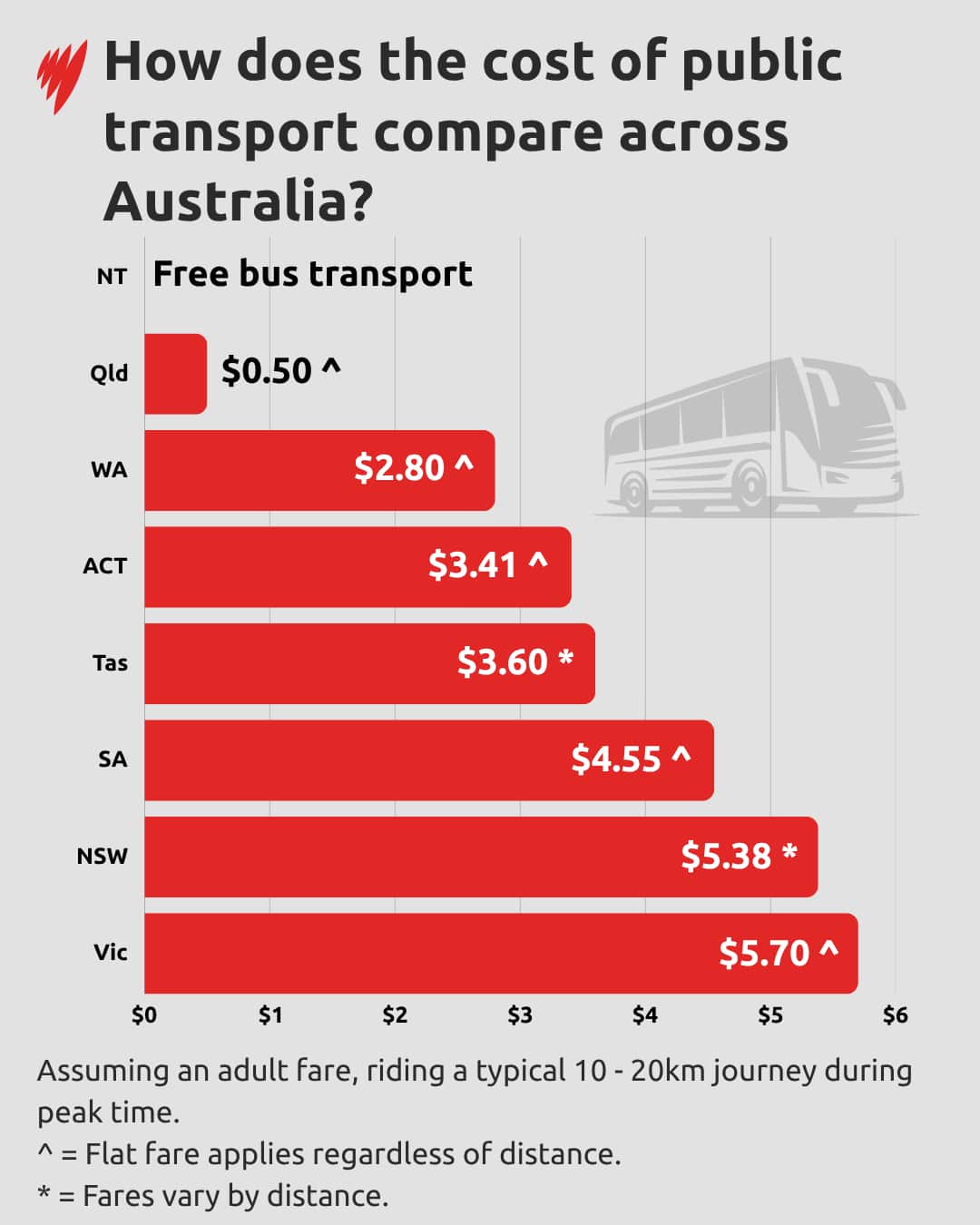
How do public transport fares compare across the country?
With fuel costs biting across the country, here’s what commuters in each state and territory normally pay to get around, priced for adults.
- Queensland: A permanent 50 cent flat-fare for Translink services across the state, including buses, trains, ferries and trams, regardless of distance.
- NSW: Distance-based fares vary by mode and time of day — a 10–20km train trip costs $5.38 at peak and $3.76 off-peak, while the maximum bus fare is $5.77 at peak. A daily cap of $19.30 applies Monday to Thursday, dropping to $9.65 Friday to Sunday.
- Victoria: Flat fares, with Zone 1 + 2 costing $5.70 per trip, with a daily cap of $11.40. Free transit in the CBD.
- Western Australia: A flat rate cap of $2.80 per trip with SmartRider. Free transit zones in the CBD and free travel on Sundays.
- ACT: $3.41 peak fares and $2.70 off-peak fares. Based on travel time, not distance.
- South Australia: $4.55 flat fare during peak travel time. $2.60 during off-peak times.
- Tasmania: Distance-based fares with the max distance costing $3.60 per trip.
- Northern Territory: Buses are free in the Greater Darwin Region and Alice Springs.
What’s the federal government doing?
As public transport is a state matter, the federal government’s direct levers are limited.
But it is moving to introduce emergency legislation allowing it to underwrite fuel suppliers purchasing international stocks.
The opposition has proposed halving the 52.6 cents a litre fuel excise, as well as the heavy vehicle road user charge, to provide immediate relief for households — but the government has ruled this out, along with mandated rationing or work-from-home orders.
Prime Minister Anthony Albanese said on Saturday Australia’s supplies remain stable, with the country holding 39 days of petrol, 30 days of diesel and 30 days of jet fuel.
He urged people not to stockpile, saying: “People need to take what they need and no more.”
“I don’t want things to be mandated but common sense should apply.”
Albanese also pointed to behaviour changes already underway, noting more people are working from home and catching public transport.
“There are more people working from home who are able to do so, that makes sense. There are more people catching public transport than before [and] that also makes sense.”
State and territory leaders are set to hold an emergency meeting on Sunday to address the worsening fuel crisis and coordinate a national response, with National Cabinet also convening on Monday.
— With additional reporting by the Australian Associated Press.
For the latest from SBS News, download our app and subscribe to our newsletter.