Share this @internewscast.com

NSW Police have come under fire from human rights organizations and experts who claim that officers used undue force during a protest against the visit of Israeli President Isaac Herzog to Sydney on Monday.
In the aftermath of the event, social media was flooded with videos allegedly showing NSW Police officers engaging in aggressive tactics. The footage appeared to depict officers pinning down and repeatedly striking protesters, dispersing individuals engaged in prayer with excessive force, and charging at and pepper-spraying civilians sprawled on the ground.
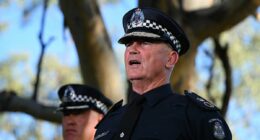
Following the incidents, police reported that scuffles had erupted, resulting in the arrest of 27 individuals who were taken to various police stations across Sydney. NSW Police Assistant Commissioner Peter McKenna defended the officers’ actions, describing them as “justified” and expressing pride in their conduct. “I saw the restraint of police tonight. They took more than their time before they utilised any of their powers,” he stated.
The controversy has sparked discussions among experts and public figures, some of whom told SBS News that the police employed “kettling”—a contentious crowd-control tactic. However, an academic cautioned that this term might not accurately describe the situation at the Sydney protest.
As further protests are anticipated throughout Herzog’s visit, concerns are mounting over whether NSW is moving towards a pattern of increasingly harsh responses to demonstrations. These developments have prompted a broader debate on the balance between maintaining public order and respecting the rights of protesters.
As more protests around Herzog’s visit are expected this week, questions have been raised about whether NSW has been building towards a trend of harsher treatment towards protesters.
‘Militarisation’ of police
In a statement issued on Wednesday, Human Rights Watch declared the police used “excessive force” against protesters, and said its use was a “further erosion” of rights in Australia.
“The New South Wales authorities’ adoption and use of unnecessary restrictions on legitimate protest doesn’t increase safety but opens the door to abuse,” said Australia researcher at Human Rights Watch Annabel Hennessy.
When asked whether he condemned the actions of the police on Tuesday, NSW Premier Chris Minns said he refused to “throw police under the bus” as they were placed in an “impossible situation”.
However, experts say the violence was natural in an increasingly militarised police force.
Civil disobedience and social justice expert at Edith Cowan University, Piero Moraro, said while the police reaction was “completely over the top”, it was consistent with what he saw as a trend in the policing of protest, which has been “getting more and more violent and less inclined to negotiation”.
For Moraro, the actions of NSW Police were symptomatic of a “general, global trend” towards the militarisation of police.
“To some extent, what we saw in Sydney was an escalation of what we’ve seen happening over the years, both in Australia and overseas.
“The US, of course, has set the trend for this, and we are following step-by-step,” he told SBS News.
As evidence for this, he cited the increasing use of weapons to control crowds, including horses and pepper spray, which he said was “disproportionate and unjustifiable” at peaceful protests.
In general, what’s happening (globally) is the police are less used as a public order measure, and more as a measure to fight the alleged enemy, which is, of course, the protester.
“As a result of [anti-protester changes to NSW laws], what the police did in Sydney on Monday is actually legal, because the law now allows the police to use this extreme force against peaceful protests, which was not the case 10 years ago.”
Protest organisers Palestine Action Group launched legal action against the NSW government after Herzog’s visit was declared a major event, granting police extra powers and fines for noncompliance during his stay.
However, that challenge was dismissed in the NSW Supreme Court on Monday afternoon.
The protesters had earlier insisted they would gather at Sydney Town Hall before marching to NSW parliament, while police urged them to move the event to nearby Hyde Park.
Professor of law at the University of Sydney Simon Bronitt, said the policing in such a situation was “really challenging” and a fair assessment was difficult, especially without the broader context of the altercations often missing from social media videos.
“You’re dealing with a large crowd of people with diverse intentions, some will be desperately wanting to peacefully exercise their legal and constitutional rights to protest freely and peacefully. Others may have different agendas. And so policing in that context is really, really challenging,” he told SBS News.
“Just because the police have the powers to clear people, even to arrest, doesn’t always mean that they must.”
But the sweeping protest-free laws enacted by the Minns government for Herzog’s arrival didn’t render those same spaces “human rights-free zones”, Bronitt said.
“Things can look different from behind the police line or in front of it.
“But police are held to a standard of restraint, and use of force is the last resort, and that’s probably the most important message.”
Was kettling used on protesters on Monday?
Kettling is a controversial crowd tactic used by police where a ring of officers forms a human cordon around a group of protesters, often for hours at a time. A small gap is left, and people who try to escape from there are arrested.
Moraro said it was a counterintuitive method to calm a crowd: “You have a group of peaceful people, but you keep them locked there for hours, and of course, the pressure builds up, and then you have violence.”
Kettling has been challenged legally as a violation of civil liberties, but courts have upheld its legality.
NSW Greens MP Sue Higginson, who attended the protest and has called for an inquiry, said kettling was “very clearly” used.
“At the end of the day, that is a police tactic that is entirely incompatible with parts 14 and 15 of the Police Powers and Responsibilities Act.”
Higginson said she was concerned about the “sudden and violent” police response to a group of Muslim worshippers praying — police were filmed picking up and dragging several men, disrupting their evening prayer.
“I think there’s a significant question: What was the motivation for that apparent urgent dispersal of people?” she said.
However, Bronitt questioned the use of the term kettling, saying he didn’t believe it was a strategy that was used in NSW.
“There are situations where you see police confronted by a large crowd, and it’s hard to tell who’s circling who. But as for kettling, it’s hard to say that there was any systematic use of any strategy like that,” he told SBS News.
When asked whether kettling was a tactic ever employed by NSW Police, in training or in real-world situations, a spokesperson said attendees were at no point forced into an area.
“During the event at Town Hall on Monday, police gave multiple opportunities for attendees to leave the area safely.”
“Police deployed multiple crowd management techniques during the event to maintain public security.
“Attendees were at no point forced to remain in the area and were always afforded the opportunity to leave the event.”
Increased police powers
Under the major event declaration, those who failed to comply with NSW Police directions on Monday were facing penalties including fines of up to $5,500.
Moraro said it was very unlikely the laws would be peeled back.
“The police are now saying: ‘We made it illegal to protest in this place and people tried to enter those places, so we had to use force’.
“But can the police make it illegal for people to peacefully protest in a public place?
“Unfortunately, that question is hard to address.”
Higginson said she was calling for legal charges to be laid for police implicated in the unlawful assault of civilians, and called on Minns to take accountability.
“I have no doubt that there are clear cases of excessive force, and in fact, criminal assault. There are cases there where the police have just outright assaulted members of the community,” she told SBS News.
She said increased powers given to police under the “major event declaration” were “the cause of the violence”.
“This is a cause-and-effect situation,” she said.
Minns’ office has been contacted for comment.
For the latest from SBS News, download our app and subscribe to our newsletter.