
Share this @internewscast.com
On Sunday, many Australians will lose an hour of sleep as daylight saving time kicks in.
This marks the approach of summer and offers the prospect of longer daylight hours — ideal for basking in the sun after finishing work.

However, the clock change can also challenge your body’s routines and circadian rhythm as they adapt to a new schedule. Here’s what you need to know.

When does daylight saving start in 2025?

Daylight saving time will start on Sunday 5 October at 2am AEST.

At 2am, clocks will roll forward one hour to 3am, stealing an hour of sleep in the process.

Daylight saving time generally begins each year on the first Sunday of October, continuing until the first Sunday of April, when clocks are set back one hour.

Wait, are clocks rolling forward or backwards?

In doing so, you’ll gain an extra hour of sunlight in the afternoon, with the sun setting an hour later on your watch.
It means that in the evenings, you’ll have more daylight time to enjoy that summer sun.

But on the other hand, it will mean your mornings will have a lot less light than usual, which could make early morning wake-ups more difficult.

Which states and territories observe daylight saving?

Not every Australian state and territory adopts daylight saving time. Over the past 50 years, several Australian jurisdictions have voted for or against using it in their region.
NSW, Victoria, South Australia, ACT, and Tasmania all observe daylight saving.
But Queensland, Western Australia and the Northern Territory don’t.

Professor Tim Bedding from the School of Physics at The University of Sydney, an expert in stellar oscillationsemphasized that geography plays a crucial role in these decisions.
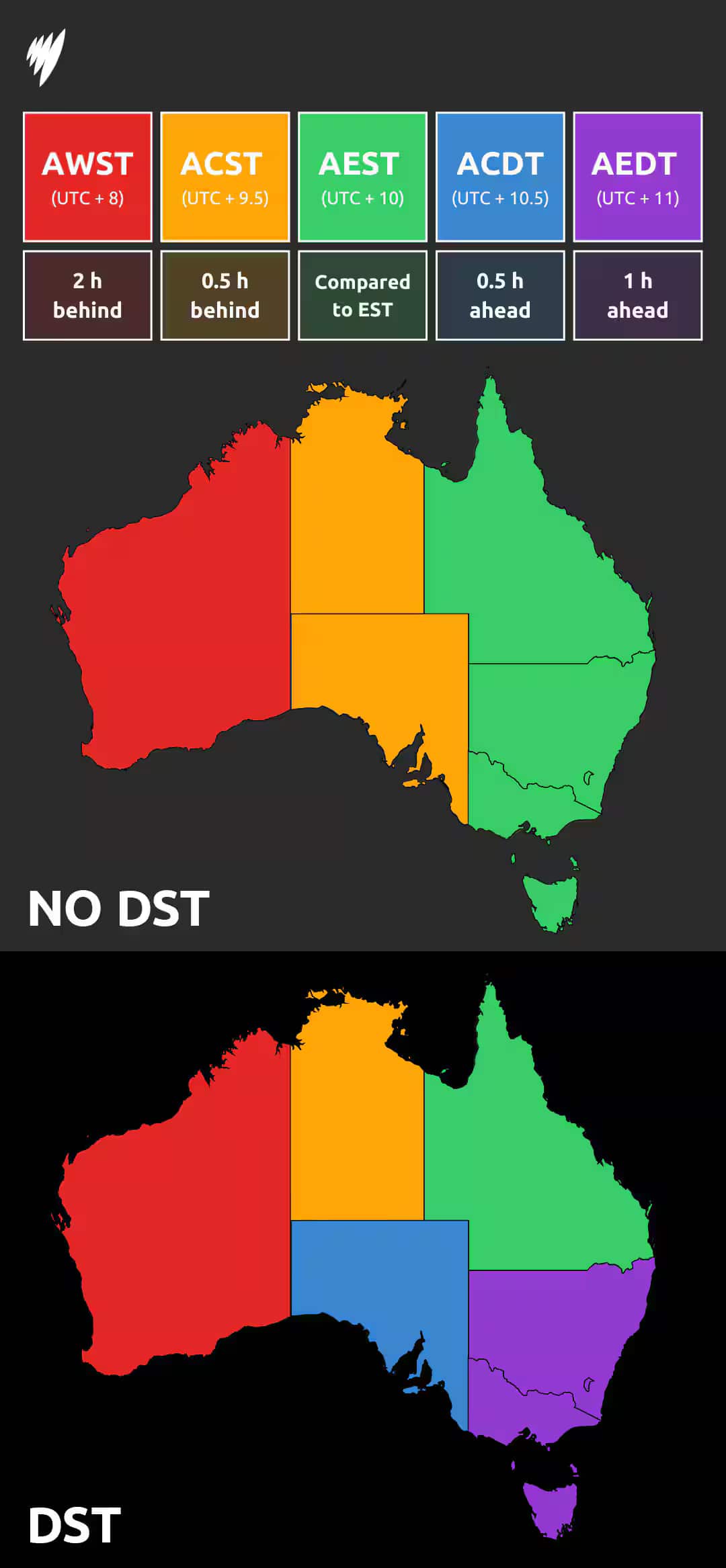
A map showing Australian time zones before and after daylight saving.

Daylight saving time is not observed in Queensland, Western Australia, or the Northern Territory. Source: SBS News

“The effect of DST becomes less as you move towards the equator, which is presumably why Queensland decided not to adopt daylight saving,” Bedding said.

“In a large geographically and climatically diverse country, one size does not necessarily fit all and should not be imposed upon all.”

Once daylight saving time kicks in, Australia goes from having three time zones across the nation to five.

Is daylight saving bad for your body?

When daylight saving time kicks in, we lose an hour of sleep. It might not sound like much, but the shift also risks putting stress on our bodies.
The Sleep Health Foundation says losing an hour of sleep in October can be more challenging to adjust to than gaining an hour in April. That’s because our circadian rhythm — or our internal body clock — is timed to match light and darkness and can be thrown out of sync when the clocks change.

“Our internal body clock or 24-hour circadian rhythm will need time to adjust to the shift,” according to its website. “While most people manage this adjustment without major issues, there is an increased risk of sleepiness as the body adapts to the new schedule.”
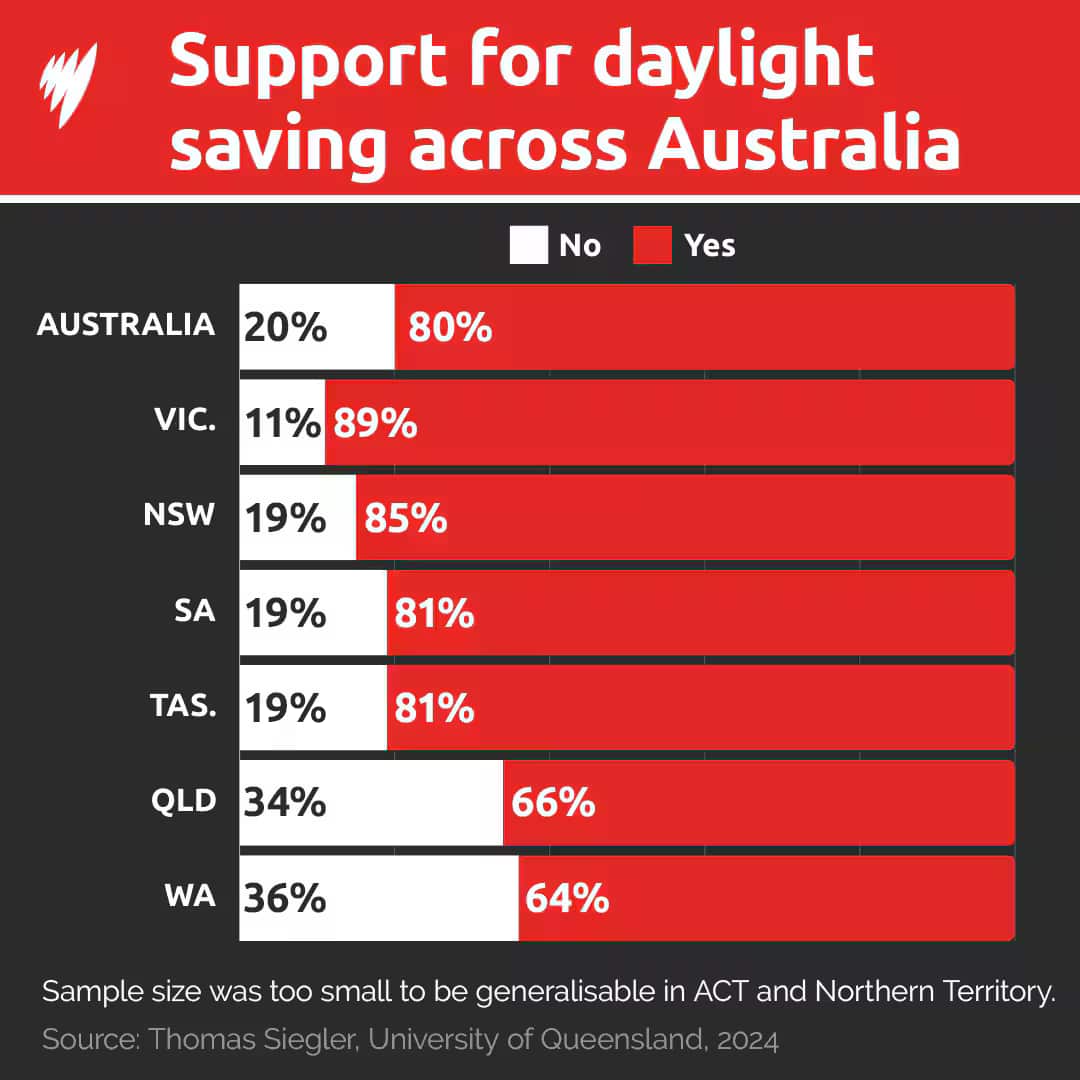
A graph showing support and opposition to daylight saving time.

A 2024 survey found overwhelming support for daylight saving time across Australia. Source: SBS News

The foundation recommends adjusting your bedtime earlier for three to four nights before the transition, which should help reduce the risk of sleep loss.

But other research suggests the change in times is a good compromise between early and late risers.
Research from Flinders University also found no significant evidence daylight saving time resulted in long-term sleep loss or impaired sleep health and daytime functioning.

Report author and sleep specialist emeritus professor Leon Lack noted: “Our studies indicate that although the initial transition into DST might be challenging, any adverse effects tend to diminish within one to three months at most.”

How can you adjust?

To help adjust to daylight saving time, there are a few easy changes you can make, according to Lack and his research partners.

– Start your day with sunlight. Especially in the mornings leading up to and after the clocks move forward.

– Limit afternoon caffeine. Try and avoid coffee or tea after midday so it doesn’t keep you up at night.

– Consume a nutritious breakfast and exercise consistently. A good breakfast can help stabilize your wake-up routine, while regular physical activity (not too late in the day) can enhance sleep quality.

– Reduce screen time before bed. Put the phone away and dim the lights about two to three hours before bed to support your circadian rhythm.

– Plan for post-daylight saving rest. Expect a slight disruption after the clock change, and if needed, take a 15-minute power nap to recharge.


When does daylight saving end?

On Sunday 5 April 2026, when clocks roll back to 2am AEST.

Share this @internewscast.com
You May Also Like
Kyle Sandilands and Jackie O Henderson

Network Faces Legal Battle as Sandilands’ Alleged Profanity-Laden Rant Sparks Controversy

Radio network ARN has brought to light a series of controversial comments…

UK Plans New Legislation to Prohibit Cigarette Sales for Those Born After 2008

In brief A rolling age ban means children and anyone born in…
Jade Elston

Adelaide Family Turns to Crowdfunding for Son’s Urgent Cancer Treatment: A Community’s Call to Action

An Adelaide family has found themselves seeking help from the kindness of…
The Australian soldiers who fought epic battle in the 'forgotten war'

Heroic Australian Soldiers Recall Epic Battle in the Overlooked Korean War

Anzac Day falls 75 years after Australian soldiers fought a bloody battle…

Woolworths Executive Announces Price Reductions Amid Evolving Inflationary Challenges

In brief: The supermarket giants are before Federal Court over accusations of…
Ed Sheeran's LOOP world tour got off to a flying start, raking in a staggering £5million per show during its opening leg

Ed Sheeran’s LOOP Tour: Unveiling the £5 Million Per Show Phenomenon!

Ed Sheeran’s LOOP world tour has started with remarkable success, earning an…

Ben Roberts-Smith’s Relocation Plans Uncovered in New Court Documents

In brief: Court documents released Thursday show Roberts-Smith investigating opportunities overseas. A…
Treasurer Jim Chalmers handed down the Budget on Tuesday night, boasting of a $9.3 billion surplus driven by a strong labour market and increased commodity prices

Budget 2024 Unveiled: $300 Cash Boost for Australians, Student Debt Forgiveness, Tax Cuts, and New Travel Policies by Albanese Government

In a strategic move to garner voter support ahead of elections, the…

Unpacking the Key Issues in the NDIS Overhaul

In Brief Roughly 160,000 Australians are set to lose access to the…
Alexander Philogene and his uncle Chris Jarmer

Tragic Passing: 21-Year-Old Zander Succumbs to Sudden Illness Mid-Flight

Australians have been warned against a severe strain of meningococcal B circulating…
Ahead of the Budget delivery on Tuesday evening, Greens housing spokesman Max Chandler-Mather slammed the $9.3billion surplus as evidence of 'how little Labor cares about the housing crisis'

Budget 2024: Albo’s Challenger Unveils Key Oversight by Jim Chalmers

For the second consecutive year, Treasurer Jim Chalmers has announced a budget…

Australia Boosts Fuel Reserves to Pre-Middle East Conflict Levels

In brief: Australia’s fuel reserves are now greater than before the US-Israeli…