
Share this @internewscast.com
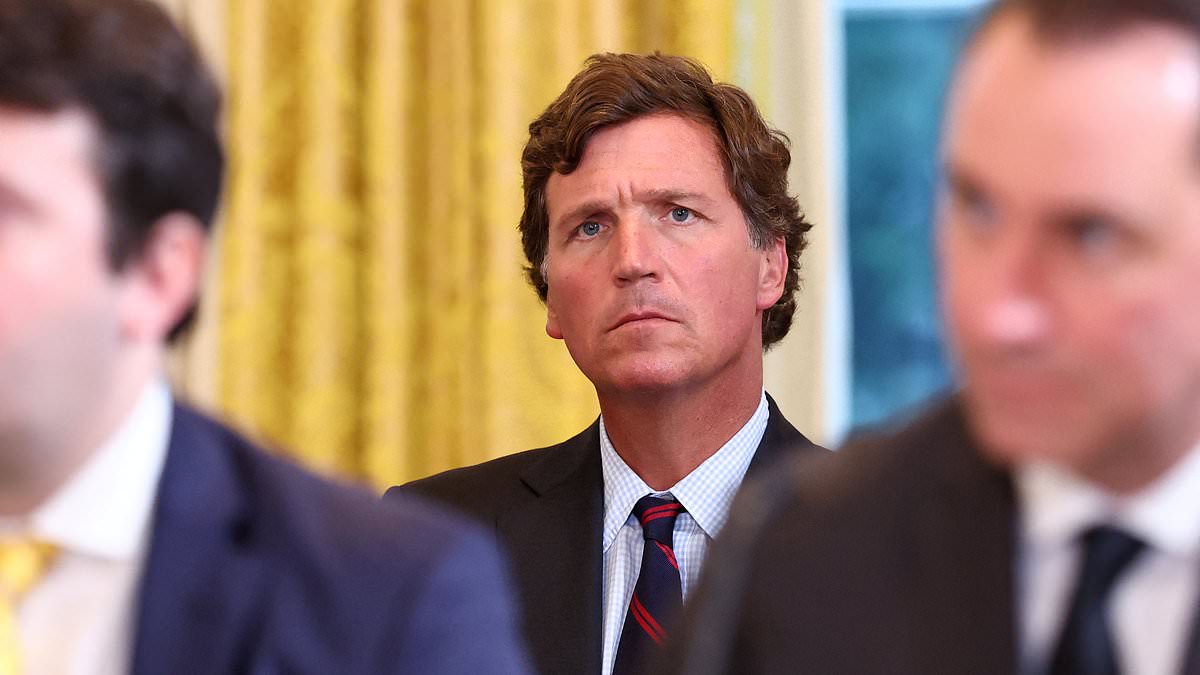
Tucker Carlson often professes a deep admiration for America, frequently speaking with reverence about its history and achievements. However, his recent comments reveal a more conditional affection for the nation.
In a March 19 interview with Economist Editor-in-Chief Zanny Minton Beddoes, Carlson sat confidently, declaring that the era of American dominance has come to an end. He argued that the unipolar world is a thing of the past and asserted that Taiwan is indefensible. Surprisingly, the man who has long positioned himself as a staunch patriot now suggests that the United States should yield to the rising influence of China rather than challenge it.
This stance is particularly unexpected from someone known for his vocal criticism of the Chinese Communist Party and his reputation as a straight-talking truth-seeker.
To fully grasp Carlson’s suggestion, consider the nature of the power he believes America should accommodate.
For years, the Chinese government in Beijing has been strategically working to undermine the United States. By 2021, Chinese entities had reportedly acquired personal information on approximately 80 percent of the American population. It is likely that this figure has only increased since then. China’s intelligence operations have infiltrated the US Office of Personnel Management, securing sensitive files on 22 million Americans.
Chinese operatives have also breached major telecommunications networks, embedding themselves within the systems that facilitate private communications across the nation. They have thoroughly mapped the US power grid, potentially identifying opportune moments to disrupt it. Meanwhile, American companies have witnessed their innovations and research siphoned off in a pattern described by senior officials as one of the most significant forced wealth transfers in history.
Jacob Helberg, the Trump Administration’s Under Secretary of State for Economic Growth, Energy and the Environment, has spent years studying the technology dimensions of this rivalry. He describes the content between China and the US as a long-running battle being fought on two fronts: the visible layer of modern systems and the hidden infrastructure beneath.
One side competes in markets and platforms; the other works on the pipes and foundations that make them possible. In Helberg’s telling, the trajectory of this contest ends somewhere most people would rather not imagine.

Tucker Carlson has long claimed to love America, but a recent interview in The Economist suggests that love has reached its limits

China’s government in Beijing has spent decades plotting America’s undoing (Pictured: Parade in Tiananmen Square on September 3, 2025)
A Chinese victory would not stop at trade balances or diplomatic realignments. The world that followed would be more rigid, more stratified, organized around deference to Beijing rather than any principle of mutual interest.
Beyond the cyber intrusions and economic predation lies something even more unsettling for a man of Carlson’s stated convictions: China’s sustained persecution of Christians. Churches are shuttered. Crosses are torn down. Pastors are detained. Congregations are driven underground or absorbed into state-controlled institutions where independent belief is no longer tolerated.
For a man who has devoted so much airtime to the supposed persecution of Christians in Israel, a charge that has not survived scrutiny, the silence on China is difficult to explain.
Finally, context matters. Carlson’s conclusions from the status quo appear to make him side with America’s current enemies. China stands alongside the radical Islamic Republic of Iran, a state currently in direct conflict with American interests.

Ayaan Hirsi Ali is a Research Fellow at the Hoover Institution, Founder of AHA Foundation and Contributor to the Restoring the West Substack
Beijing maintains close ties with Russia and North Korea, regimes that have long defined themselves in opposition to the United States. Its hostility toward Israel underscores where its strategic sympathies lie. And yet Carlson appears to believe that the United States should find terms with a regime and an ideology that treats Christianity as a threat to be managed and counts America’s closest Middle Eastern ally among its adversaries. It is worth asking, seriously, how sharing power with such a rival produces stability or serves American interests. Carlson, one imagines, is aware that it doesn’t.
The argumentative sleight of hand he performs is worth discussing. China is powerful. China is not going away. Both statements are true. But from those two true statements, he leaps to a conclusion that doesn’t follow: that America and Western Civilization must therefore accept a diminished role in the global order.
The gap between the diagnosis and the prescription is considerable. Acknowledging an adversary’s strength and surrendering to it are entirely different propositions, yet Carlson treats them as one. He is not a naïve man. The more unsettling possibility is that he has simply decided the cost of greatness is no longer worth paying.
What strikes me about his position is not the strategic miscalculation, though that is real. Serious analysts can disagree about Taiwan, about the architecture of American alliances, about which instruments of power matter most. What strikes me is the moral emptiness at the argument’s center.

Beijing maintains close ties with North Korea, a regime that has long defined itself in opposition to America. (Pictured: Russia’s President Vladimir Putin, China’s President Xi Jinping and North Korean leader Kim Jong Un in Beijing in 2025)

For a man who has devoted so much airtime to the supposed persecution of Christians in Israel, Carlson’s silence on the persecution of Christians in China is difficult to explain (Pictured: Tucker Carlson with his business partner Neil Patel in Israel in February)
Carlson has spent years defending Western civilization with what sounds like genuine passion. He speaks of its founding promise, its singular achievement in building societies where people can speak, worship, and organize freely. The regime he proposes to accommodate surveils its own population at industrial scale, exports that model to willing autocrats abroad, and demands political deference from every nation within its reach.
He sees what Beijing is. He simply thinks the sensible response is negotiation rather than resistance.
I did not leave the world I was born into to watch the West bargain away the things that make it worth defending. Multipolarity sounds neutral, even elegant. In practice, it describes a world where Beijing writes the rules for artificial intelligence, for global telecommunications, for the international institutions that govern trade and security. Those who have never lived under such rules tend to underestimate how much the existing ones matter.
American power is imperfect. But imperfect is not the same as expendable. The postwar order, with all its flaws, produced the longest period of great-power peace in modern history, lifted billions from poverty through open trade, and kept sea lanes free for the commerce that feeds the world. Without American power underwriting those conditions, none of it holds.
Carlson’s argument offers nothing in place of what it abandons. Retreating power leaves a space, and history is unambiguous about what tends to fill it.
There is another option, a superior one that takes the challenge seriously.
Through my friendship with the founders of Acts 17 and the Hill & Valley Forum, I have spent time with a generation of Americans who looked at this same challenge and responded with ferocious energy rather than resignation.
These are technologists, founders, policy thinkers who understand China’s capabilities in full and have decided, deliberately, not to be intimidated by them. They grasp something Carlson appears to have lost. The contest with China is a contest of will. The answer to a powerful enemy is not to make room for it, but to become harder to defeat.

Along with North Korea, China is particularly cozy with Russia, another regime at odds with US interests. (Pictured: Chinese President Xi Jinping and Russian President Vladimir Putin in Moscow in 2023)
America has won such contests before, not through invincibility, but through the refusal to accept defeat as inevitable. That refusal remains available. Carlson speaks as though the verdict is already in. The people I have described, the people I have actually spoken with, do not see it that way at all. Neither do I.
The path forward is not the restoration of 1990s dominance through military posturing. Nobody serious advocates that. But between nostalgia and capitulation lies a great deal of ground worth occupying.
It involves building technological strength in semiconductors, artificial intelligence, and advanced manufacturing, constructing alliances deep enough to withstand Beijing’s habit of applying bilateral pressure, and operating always from a position of demonstrated strength rather than managed decline.
America remains the greatest nation on earth. Beijing is not interested in sharing power. It never has been. Its ambition is not equilibrium but dominance, not a seat at the table but the table itself. The young people I have described understand this, and so do the millions of brilliant minds coming up behind them. Carlson might disagree, but America’s future is theirs to shape, not his to surrender.
Ayaan Hirsi Ali is a Research Fellow at the Hoover Institution, Founder of AHA Foundation and Contributor to the Restoring the West Substack.