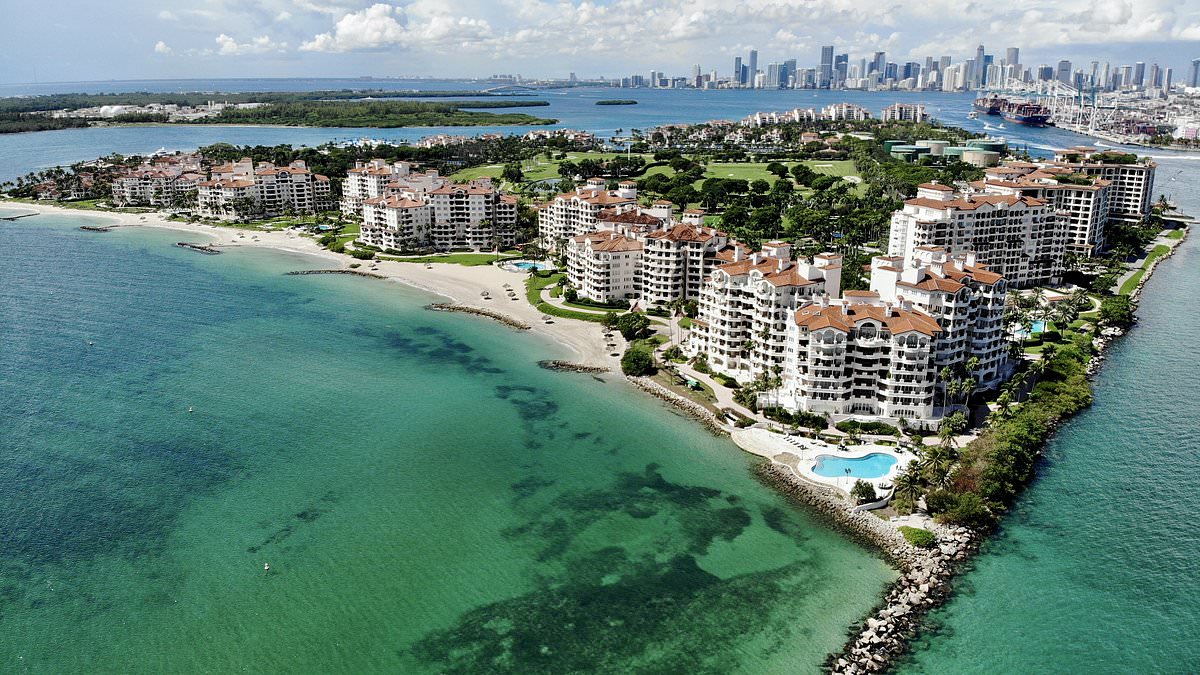

In the glittering heart of Miami, a dramatic face-off is unfolding between the city’s elite and local authorities over a seemingly inconspicuous patch of land that plays a crucial role in the region’s economy.
Renowned as the richest ZIP code in the United States, Fisher Island hosts a collection of billionaire developers, influential county figures, and major cruise lines. Yet, this haven of opulence is now embroiled in a heated dispute concerning a coveted 10-acre plot.
The crux of this conflict lies in a marine fuel terminal that has been the lifeblood for cargo and cruise ships at PortMiami for nearly a hundred years.
Residents of the island, where homes command an average price tag of $12 million, have long campaigned for the removal of this facility. They argue that the sprawling fuel tanks are both an environmental risk and a blight on the island’s luxurious landscape.
In a twist that seemed to favor the homeowners, last year saw a joint venture, involving HRP Group, Related Group, and Raycliff Capital, purchase the land for $180 million. They proposed an ambitious redevelopment plan to transform the aging fuel depot into ultra-luxurious condominium towers, with penthouses priced to soar up to $100 million.
However, this grand vision comes with a significant obstacle.
PortMiami generates an estimated $61 billion in annual economic activity, and cruise operators warned that losing the fuel terminal could threaten one of the region’s most important economic engines.
The controversy also put fresh scrutiny on county officials, who faced criticism for failing to step in before the property was sold.
Fisher Island is often dubbed the wealthiest ZIP code in America and is home to billionaire developers, cruise lines and influential county leaders. Now, the exclusive enclave finds itself at the center of a growing battle over a 10-acre parcel of land
PortMiami generates an estimated $61 billion in annual economic activity, and cruise operators warned that losing the fuel terminal could threaten one of the region’s most important economic engines
But wealthy residents who view the fuel port as an eyesore are determined to push ahead with redevelopment, welcoming the $180 million purchase by a joint venture group that has floated plans to build luxury condo towers with prices reaching $100 million
The battle has also exposed growing tensions between Miami’s wealthy elite and the workers and small-business owners who rely on the port for their livelihoods. Critics fear the loss of the fuel depot could ultimately weaken the port’s competitiveness and drive business elsewhere.
The concerns spilled onto the streets recently when opponents of the luxury condo project staged a protest, waving banners that read: ‘Miami Yes, Billionaires No.’
‘We will be the only port in the country without its own fuel depot, which is insane,’ Joe Garcia, a former Democratic congressman who organized the rally, told the Wall Street Journal.
‘It happens to be located in this billionaire paradise,’ he added.
The fuel terminal has been open since 1920, with the big money that poured in after the area was built up arriving sixty years later and gaining the moniker of the ‘wealthiest ZIP code’.
But the facility’s century-long run was put at risk starting in 2024 when TransMontaigne Partners, which owned and operated the terminal, decided to sell the site.
It reportedly took a full year for Miami-Dade County to realize the prized asset was even up for sale, after officials learned of a potential purchase through a media report, according to a senior county source cited by the Wall Street Journal.
Then, in January 2025, TransMontaigne confirmed it had agreed to sell the terminal for $180 million to HRP Fisher Island, with plans to demolish the fuel depot and replace it with two luxury condo towers featuring penthouses expected by 2027.
The fuel terminal has been open since 1920, with the big money that poured in after the area was built up arriving sixty years later and gaining the moniker of the ‘wealthiest ZIP code’
But the facility’s century-long run was put at risk starting in 2024 when TransMontaigne Partners, which owned and operated the terminal, decided to sell the site
When county official realized what had happened a year after the sale, Miami-Dade County Mayor Daniella Levine Cava attempting to play her ultimate trump card: seizing the land through eminent domain to get the land back
Alarmed by the potential loss of a key revenue driver, county officials explored alternative fuel supply options, including barging fuel in, transporting it by rail, or building a new terminal nearby – but each was deemed prohibitively expensive or impractical.
In a last-ditch effort to keep the fuel depot, the county attempted to negotiate with HRP to try to take over as the buyer, but the development group made offers that were also way too expensive for the county.
This triggered the battle, with Miami-Dade County Mayor Daniella Levine Cava attempting to play her ultimate trump card: seizing the land through eminent domain.
‘Miami would be at an extreme competitive disadvantage if we were to lose access to fuel,’ she told commissioners at a September 2025 special county commission meeting.
She was backed by senior cruise industry figures, including Royal Caribbean Group chief Jason Liberty, who stressed that no major US port operates without its own dedicated fuel supply.
‘It’s a matter of strategic economic security for Miami-Dade and for Florida,’ he said.
But some county commissioners voiced frustration at only learning of the potential crisis at such a late stage, questioning why the administration had not moved sooner to secure the fuel terminal.
‘To sit here now in an emergency meeting and say we’re going to take someone’s property… it’s a tough pill to swallow,’ said Commissioner René García.
She was backed by senior cruise industry figures, including Royal Caribbean Group chief Jason Liberty, who stressed that no major US port operates without its own dedicated fuel supply

Earlier this week, the Fisher Island Community Association filed its second lawsuit in state court seeking to block HRP from selling the land to the county
The board ultimately directed the mayor to pursue negotiations for the facility, but stopped short of immediately authorizing eminent domain. Approval to seize the land came at a later meeting – just one day after the sale of the terminal to HRP closed.
But the enclave didn’t take this overhanded land grab lying down. The Fisher Island Community Association, which represents property owners, and Fisher Island Club, a country club, sued Miami-Dade in federal court in January, seeking to block the county from exercising eminent domain.
In court filings, they argued that using eminent domain would be unconstitutional and criticized the fuel storage tanks as ‘decrepit.’
They also claimed that under an October agreement with HRP, Fisher Island entities secured rights to about four of the parcel’s 10 acres in exchange for supporting the project and providing millions of dollars in club memberships to future condo buyers.
They argued this gave them veto power over any sale of the property. In response, the county filed a motion to dismiss, saying the property rights being claimed were conditional and had not been met. Then the labor unions jumped into the fray, strongly backing the county’s push to regain control of the fuel depot, including a maritime workers’ union that also attended a recent rally.
Negotiations between the county and HRP have continued since October, and a senior county official said talks have been productive and could lead to a resolution soon – an outcome that has alarmed Fisher Island interests.
Earlier this week, they escalated the fight again, filing a new lawsuit in state court seeking to block HRP from selling the land to the county. They claim the move would violate an earlier agreement and allege that HRP has agreed in principle to a $200 million sale, plus another $200 million in payments over 20 years.
Neither Fisher Island Community Association, HRP, Miami-Dade County or Garcia immediately responded to the Daily Mail’s request for comment.


