
The House has narrowly approved an extensive $70 billion immigration package, championed by Donald Trump, which aims to bolster resources for border patrol and immigration enforcement agencies. This significant legislative move now awaits the President’s signature to become law, following a contentious Senate vote that overcame notable GOP internal conflicts.
In a show of political maneuvering, Republican Speaker Mike Johnson successfully rallied his party to pass the bill with a tight 214 to 213 vote margin, despite several members being absent due to primary elections occurring on the same day. The legislation secures funding for Immigration and Customs Enforcement (ICE) and Border Patrol through September 2029, marking a considerable victory for Trump on a key policy front.
The path to approval was fraught with challenges, particularly from GOP dissenters in the Senate who initially threatened to derail the bill unless it contained provisions to eliminate Trump’s controversial $1.8 billion ‘Anti-Weaponization Fund.’ However, these rebels ultimately conceded.
Earlier in the week, Acting Attorney General Todd Blanche informed GOP senators that the administration planned to drop the contentious fund. Yet, Trump maintained a different stance, describing the fund as “a beautiful thing,” indicating a potential ongoing debate within party ranks on this issue.
GOP rebels in the Senate, who threatened to kill the bill unless it included language explicitly banning Trump’s $1.8 billion ‘Anti-Weaponization Fund,’ ultimately backed down.
The administration was dropping the fund, Acting Attorney General Todd Blanche told GOP senators this week, but hours later Trump declined to echo that commitment, instead calling it ‘a beautiful thing.’
Rebels decided in the end that it was more important to see the bill pass unhampered and protect their Republican allies from politically toxic votes ahead of the November midterms.
‘I’m taking the cue from my colleagues that are in cycle’ this year, Senator Thom Tillis of North Carolina said last week when the bill passed through the Senate. Tillis’ Senate vote came after an hours-long amendment marathon known as a ‘vote-a-rama,’ a chaotic process allowing lawmakers to force votes on politically sensitive issues before final passage.
Last week’s Senate vote came after an hours-long amendment marathon known as a ‘vote-a-rama,’ a chaotic process allowing lawmakers to force votes on politically sensitive issues before final passage.
US House Speaker Mike Johnson addresses a weekly press conference at the US Capitol in Washington, DC, USA, on June 3rd 2026
Senate Majority Leader John Thune (R-SD) speaks to reporters as the Senate votes on amendments to a reconciliation package, at the U.S. Capitol in Washington, DC on June 4
President Donald Trump gestures as he steps off Air Force One, early Tuesday, June 9, 2026, at Joint Base Andrews, Maryland
The package follows a record 76-day shutdown of the Department of Homeland Security (DHS) earlier this year, when Democrats refused to support new money for immigration enforcement after the deaths of anti-ICE protesters in Minneapolis.
Republicans rejected those demands, instead choosing to fund ICE and Border Patrol through the fast-track ‘budget reconciliation’ process, which allows them to bypass Democratic opposition if they can keep their own members united.
Trump sparked chaos two weeks ago when his Justice Department floated the fund for his political allies, just as the Senate was preparing to vote on a reconciliation package before the Memorial Day recess.
Acting AG Blanche went to Capitol Hill to try to talk senators off the precipice but was ultimately shouted down in a ferocious behind-closed-doors summit.
Even Trump’s most ardent Republican allies had objected to the fund, which was branded the ‘most corrupt political act in history’ by Democrats.
The timing couldn’t have been worse, with Trump having upset his senators by endorsing rival candidates of establishment, moderate conservatives in ongoing primary battles.
Senator Bill Cassidy of Louisiana, who lost his primary last month after Trump backed his opponent, introduced an amendment last week to block the $1.8 billion fund.
The proposal would have repurposed the fund for police officers who were injured during the January 6, 2021, riot.
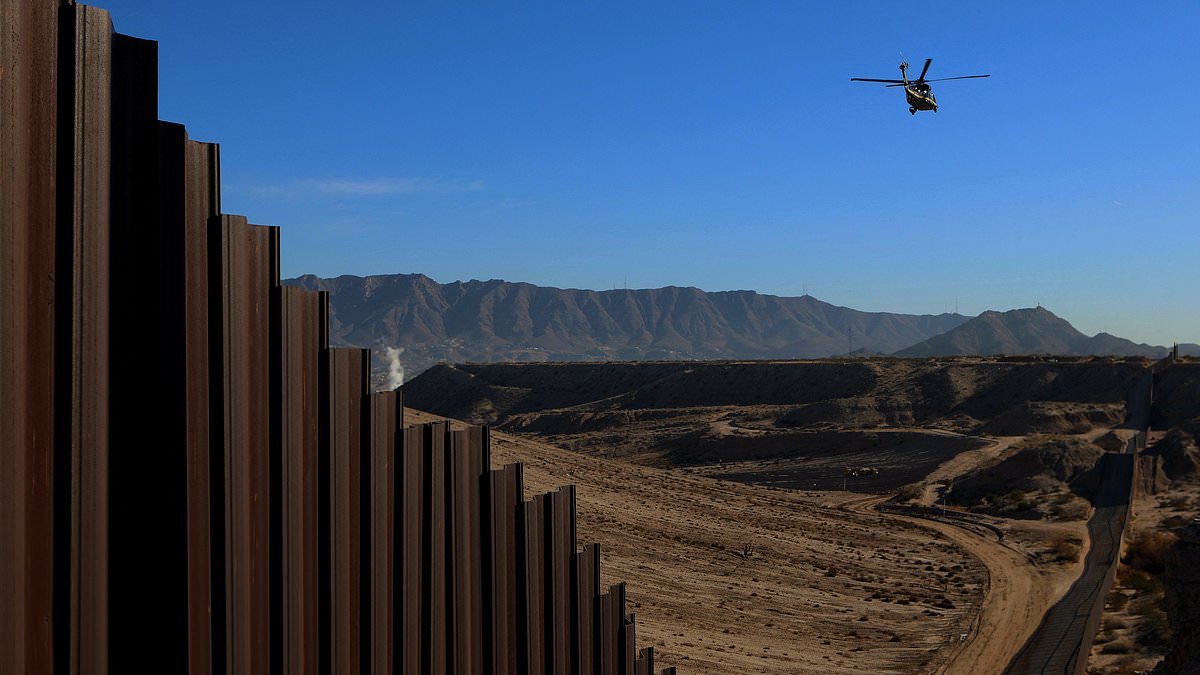
An US Air and Marine Operations (AMO) helicopter patrols the US-Mexico border at Santa Teresa, New Mexico, US, as seen from Ciudad Juarez, Chihuahua state, Mexico on January 14, 2026
Shutdown Charlotte, mass mobilization for immigrant rights outside Manolo’s bakery to drive out Border Patrol of the Queen City in Charlotte NC, United States on November 21, 2025

Migrant people try to get to the US through the Rio Grande as seen from Matamoros, state of Tamaulipas, Mexico on May 10, 2023
Democrats also used the process to try to redirect immigration enforcement money toward housing and other affordability concerns, arguing that Republicans were prioritizing Trump’s deportation agenda over the cost of living.
And in what was seen as a separate rebuke of Trump policy, several Republicans also backed a Democratic effort to circumvent House leadership with a vote to impose sanctions on Russia and provide $8 billion in military financing loans to Ukraine.
Republicans countered that the money was needed to restore immigration enforcement funding after the earlier DHS shutdown left the issue unresolved.
The earlier stopgap measure funded much of Homeland Security through September 30, including the Federal Emergency Management Agency, the Coast Guard, the Transportation Security Administration and the Secret Service.
But it excluded ICE and Border Patrol, setting up the separate fight that ended with last week’s vote.
The result gives Trump a major legislative win on immigration while underscoring that divisions remain within the Republican Party over the President’s other priorities.