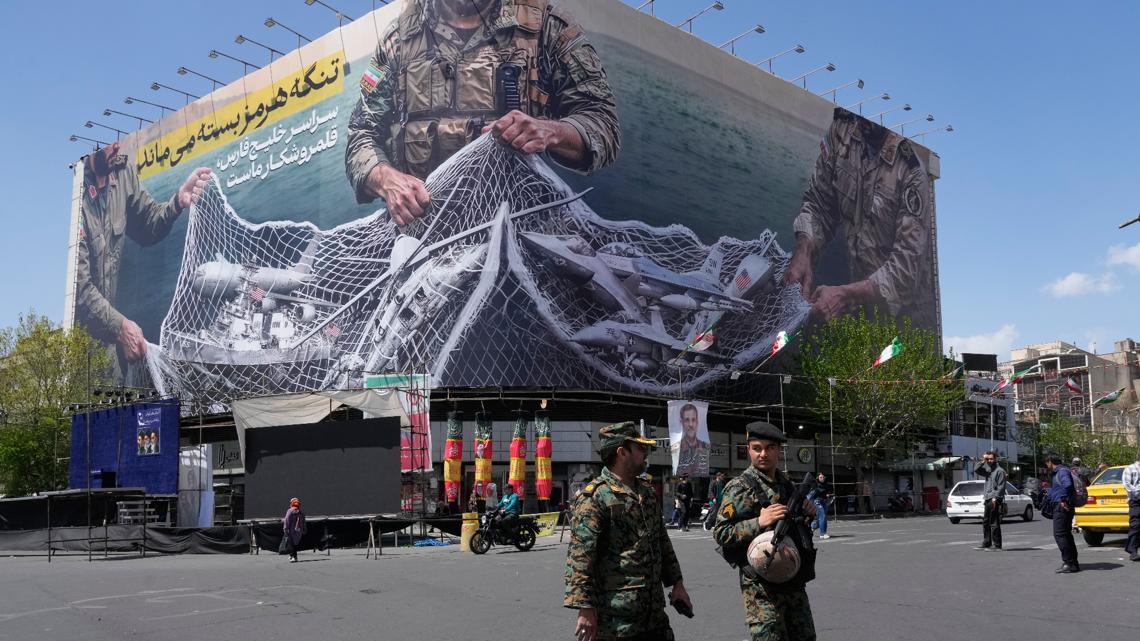

A recent report highlights a “danger zone” over the Traffic Separation Scheme, a vital maritime route through the strait.
DUBAI, United Arab Emirates — On Thursday, Iranian semi-official news outlets published a chart indicating that the country’s paramilitary Revolutionary Guard may have placed sea mines in the Strait of Hormuz during wartime. This move appears to be a strategic gesture aimed at exerting pressure on the United States amid uncertainty surrounding a recently established two-week ceasefire, with further talks scheduled to take place in Pakistan.
The charts, disseminated by the ISNA news agency and Tasnim—an outlet known for its ties to the Guard—depicted a significant “danger zone” marked in Farsi over the Traffic Separation Scheme. This scheme is a critical shipping lane through the Strait of Hormuz, a narrow passage at the entrance of the Persian Gulf, which historically facilitated the transit of 20% of the world’s traded oil and natural gas.
The documents suggested that ships should navigate further north, closer to Iran’s mainland near Larak Island, an alternative route some vessels reportedly adopted during the conflict.
The charts in question were dated from February 28 up until Thursday, April 9. It remains unclear whether the Revolutionary Guard has since removed any mines from the route.
In response, U.S. President Donald Trump issued a statement affirming that American warships and military personnel will maintain their presence around Iran “until such time as the REAL AGREEMENT reached is fully complied with.”
Trump’s comments on his Truth Social platform appeared to be a way to pressure Iran.
“If for any reason it is not, which is highly unlikely, then the ‘Shootin’ Starts,’ bigger, and better, and stronger than anyone has ever seen before,” Trump wrote.
He also insisted Iran would not be able to build nuclear weapons and “the Strait of Hormuz WILL BE OPEN & SAFE.”
The U.S. and Iran both claimed victory after reaching the ceasefire agreement, and world leaders expressed relief. But more drones and missiles hit Iran and Gulf Arab countries after the deal was announced.
At the same time, Israel intensified its attacks on the Hezbollah militant group in Lebanon, hitting commercial and residential areas in Beirut. At least 182 people were killed Wednesday in the deadliest day of fighting there.
The violence threatened to scuttle what U.S. Vice President JD Vance called a “fragile” deal.
Iran’s parliament speaker said Wednesday that planned talks were “unreasonable” because Washington had broken three of Tehran’s 10 conditions for an end to the fighting. In a social media post, Mohammad Bagher Qalibaf objected to Israeli attacks on Hezbollah, an alleged drone incursion into Iranian airspace after the ceasefire took effect and U.S. refusal to accept any Iranian enrichment capabilities in a final agreement.
Iranian Foreign Minister Abbas Araghchi insisted that an end to the war in Lebanon was part of the ceasefire deal, but Israeli Prime Minister Benjamin Netanyahu and Trump said the truce did not cover Lebanon. When the deal was announced, the prime minister of Pakistan, which served as a mediator, said in a social media post that it applied to “everywhere including Lebanon and elsewhere.”
A New York-based think tank warned the ceasefire “hovers on the verge of collapse.”
The Soufan Center said Israel’s strikes on Lebanon on Wednesday added to the risk the deal would fall apart.
“Even if Lebanon was formally outside the deal, the scale of Israel’s strikes was likely to be viewed as escalatory, nonetheless,” it wrote in an analysis published Thursday. “Israel’s strikes can be understood both as an effort to drive a wedge between Iran and its proxies and as a response to being allegedly sidelined in the original ceasefire discussions.”
Copyright 2025 Associated Press. All rights reserved. This material may not be published, broadcast, rewritten, or redistributed.