
Share this @internewscast.com
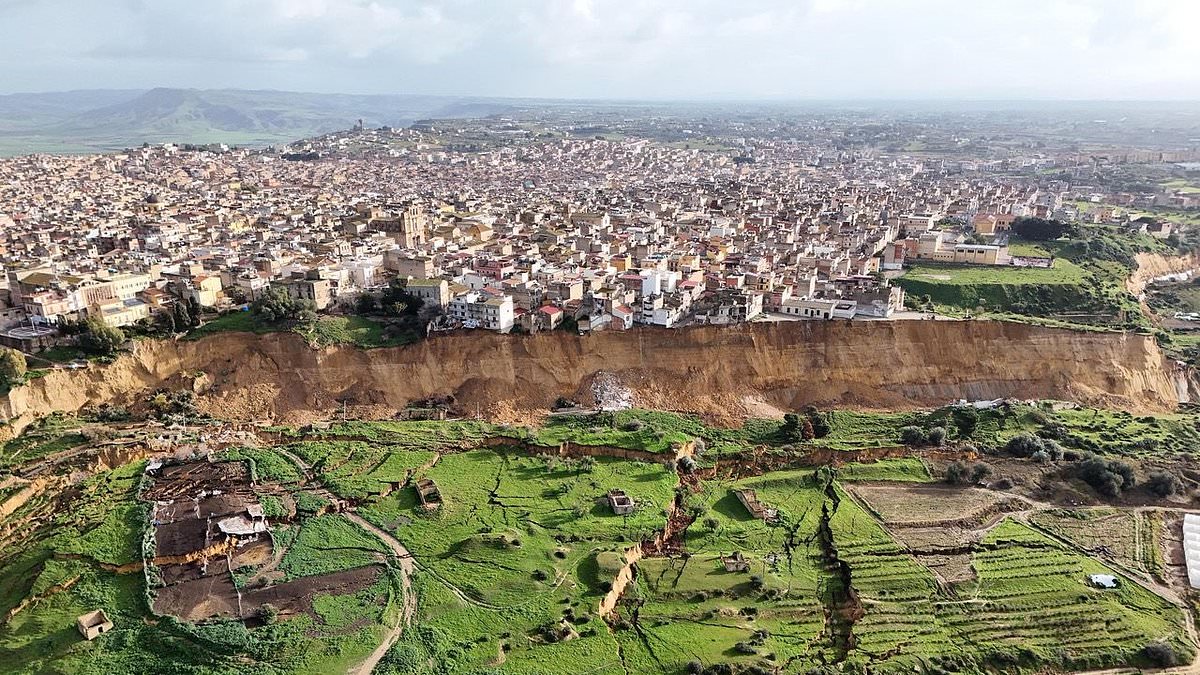
Stunning new photographs have emerged, capturing the remarkable destruction left in the wake of a massive landslide in Sicily. Stretching across 2.5 miles, this natural disaster compelled the evacuation of 1,500 residents and left numerous homes precariously perched on cliff edges.
The town of Niscemi, nestled in the southern region of Sicily, now presents a haunting scene. Images depict houses dangerously overhanging the precipice, where significant portions of the slope gave way last Sunday.
Among the fresh visual evidence, a striking vertical section of the cliff is shown breaking away, with towering heaps of debris littering the ground beneath. The images paint a vivid picture of nature’s relentless force.
Further photographs reveal the collapsed roof of a house, surrounded by a chaotic scattering of bricks and rubble, testament to the sheer power of the landslide.
One particularly jarring image shows a car, left precariously balanced with its front end hanging into the newly formed chasm, a stark symbol of the event’s impact.
Niscemi, a town with a population of approximately 25,000, is situated atop a plateau. Local authorities have issued warnings, highlighting the gradual and ongoing collapse of this landmass toward the plains below, emphasizing the urgency of the situation.
Land has continued to give way due to rain that has soaked the area in recent days, said Niscemi Mayor Massimiliano Conti, who called the situation ‘dire.’

Photos show homes overhanging a precipice following a landslide in the Sicilian town of Niscemi

Aerial view shows widespread devastation and debris in the town of Niscemi following a landslide, with

Picture shows the collapsed roof of a house, with bricks and rubble scattered around it, following a landslide in southern Sicily
‘The situation continues to worsen because further collapses have been recorded,’ he told reporters on Monday.
Conti said local authorities were working with police, fire and civil protection units to assess the next steps, including the resumption of school, which was cancelled on Monday.
No deaths or injuries were reported following the landslide.
Italy’s civil protection unit said all residents in a four-kilometre radius of the landslide had been evacuated, while several inhabitants will have to be permanently relocated.
‘Let’s be clear: there are homes on the edge of the landslide that are uninhabitable,’ the civil protection head Fabio Ciciliano told reporters.
‘Once the water has drained away and the moving section has stopped or slowed, a more accurate assessment will be made …The landslide is still active,’ he added.
Ciciliano also said that the hill Niscemi lies on is sliding towards the plain where the city of Gela is based.
‘The whole hill is falling onto the Gela plain,’ he said.

Homes perched along a landslide slope show severe structural damage, with a car left stranded at the edge of the collapsed ground on January 27, 2026 in Niscemi, Italy.

he landslide front runs beneath homes, leaving entire blocks hanging over the edge of the collapse on January 27, 2026

A drone picture shows houses teetering along the edge of a cliff after a landslide in Niscemi, Sicily, Italy, January 27, 2026
‘There are homes that can no longer be saved and it will be necessary to define a plan for the definitive relocation of the people who lived there’.
Speaking to local news outlet Leggo, Italian geologist Mario Tozzi blamed heavy rainfall for the landslip and said factors such as climate change had had an effect, explaining that it ‘amplifies existing natural events, making them more violent, more frequent, and more damaging.
‘It’s a risk multiplier,’ he said.
Tozzi also said the disaster could have been avoided, saying: ‘There was already a red zone, some houses should have been demolished, but for years nothing was done to remedy a well-known situation.’
The geologist added that ‘the lack of land-use planning, the tolerance of construction in dangerous areas, illegal building, and amnesties’ were all factors that contributed to the landslide, highlighting that: ‘We have built too much and poorly on a fragile landscape.’
Coastal areas of Sicily were hit last week by Storm Harry, damaging seaside roads and residences.
According to the ANSA news agency, heavy rainfall in the region worsened ground conditions and contributed to the landslide.
The region’s president, Renato Schifani, estimated the cost of the damage cost at 740 million euros.

It is believed heavy rainfall in the region worsened ground conditions and contributed to the landslide
On Monday, the Italian government of Prime Minister Giorgia Meloni declared a state of emergency for Sicily, Sardinia and Calabria, the three southern regions battered by the violent storm last week.
Extreme weather events have become more frequent in Italy in recent years. Floods have devastated cities across the country, killing dozens of people and amplifying risks of landslides and floods also in historically less exposed areas.
The administration set aside 100 million euros for the initial needs of the areas worst hit by the recent storm.
But local authorities estimate damage at over 1 billion euros after powerful winds and waves pushed the sea inland, overwhelming coastal defences, destroying homes and businesses.
In Niscemi, the sudden evacuations have fuelled anxiety and anger among residents, some of whom say earlier landslides went unaddressed.
‘I have been told that I have to leave, even though I don’t have anything (collapse) in the house or underneath,’ Francesco Zarba said.
‘We had the first landslide 30 years ago, and no one ever did anything.’