
Share this @internewscast.com
Prosecutors aiming to secure a conviction against SAS hero Ben Roberts-Smith may face significant challenges in court due to a notable lack of evidence, according to admissions by authorities.
Roberts-Smith, a recipient of the prestigious Victoria Cross, was apprehended at Sydney Domestic Airport as he disembarked a flight from Brisbane, with his teenage twin daughters witnessing the event.
He is anticipated to be charged with five counts of war crimes, specifically murder, linked to alleged events in Afghanistan occurring between April 2009 and October 2012. These charges stem from a joint investigation by the Office of the Special Investigator (OSI) and the Australian Federal Police (AFP).
Despite the serious allegations, Roberts-Smith, acclaimed as Australia’s most decorated soldier, has consistently asserted his innocence. He spent Tuesday night in custody, awaiting a bail hearing scheduled for Wednesday.
Ross Barnett, the OSI Director of Investigations, acknowledged during a press conference the complexity of the investigation, citing the absence of access to the crime scenes as a significant hurdle.
“Unlike a standard investigation conducted within Australia, the OSI faces the daunting task of probing numerous alleged murders committed in the midst of a war zone, across 9,000 kilometers away in a country we can no longer access,” Barnett explained.
‘We don’t have photographs, site plans, measurements, the recovery of projectiles – blood spatter analysis. All of the things that we would normally get at a crime scene.’
He added that authorities do not have access to the deceased; there was no post-mortem, no official cause of death, nor any link to weapons that might have been carried by members of the ADF.
Dr Brianna Chesser, an associate professor in criminology and justice, told the Daily Mail it would be a challenging case to prove in court.

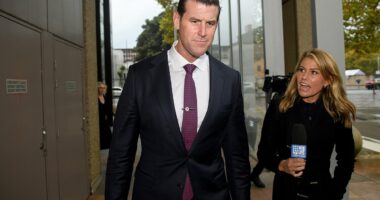
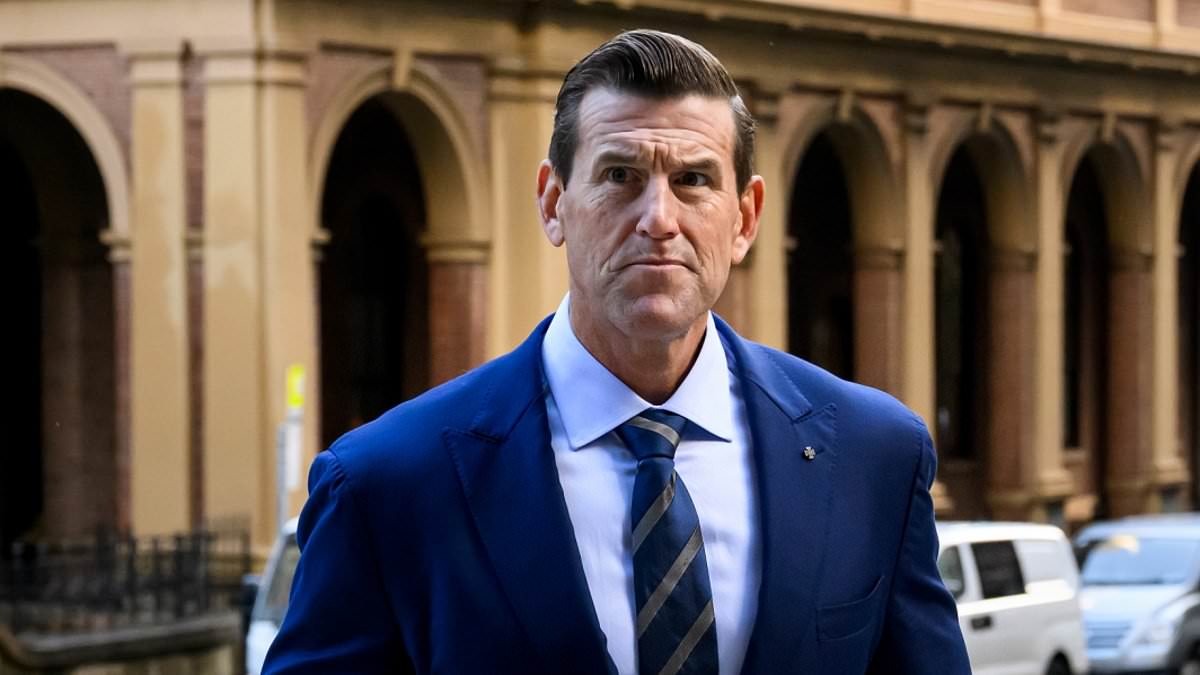
Australia’s most decorated soldier Ben Roberts-Smith was arrested on Tuesday morning

He has been charged with five counts of war crime – murder
‘There are practical, evidentiary and legal issues with bringing a prosecution for historical war crimes in Australia,’ she said.
‘Practically locating and compelling witnesses to give evidence is going to be difficult and there will likely be no access to crime scenes or to the remains of the victims.
‘Former SAS operatives were compelled to give evidence as part of the Brereton inquiry (using coercive legal powers) and there was evidence given in a closed court in the civil proceedings.
‘(But) these resources are not automatically made available in criminal matters so any investigation will likely need to be conducted from the beginning.’
Roberts-Smith sued Nine newspapers and journalists Nick McKenzie and Chris Masters for defamation over their reports in 2018, which accused him of war crimes.
In 2023, Justice Anthony Besanko found the claims that Roberts-Smith was responsible for the murder of four unarmed male civilians while deployed in Afghanistan were substantially true.
He had appealed his 2023 Federal Court loss, disputing Justice Besanko’s findings, arguing they were not backed up by sufficient evidence for such serious claims.
Last year, Australia’s highest court refused the former soldier’s application to appeal the Federal Court findings.

Officials have admitted their investigation into Roberts-Smith has been ‘complex’

The alleged incidents took place in Afghanistan, where Roberts-Smith served
But Dr Chesser said a criminal proceeding was a very different matter to allegations being found ‘substantially’ true under the civil standard of proof (on the balance of probabilities).
‘Any criminal prosecution would require proving guilt “beyond reasonable doubt”, which is a much higher threshold,’ she said.
‘Building a solid prosecution case depends wholly on the evidence that can be obtained regarding the actions of the accused person (circumstantial evidence) and falling short of any admissions being made, a video coming to light, or an eyewitness willing to risk prosecution themselves to testify against the accused, it is going to be a difficult case to prove.’
The OSI and AFP are investigating allegations of criminal offences under Australian law related to breaches of the Laws of Armed Conflict by Australian Defence Force personnel in Afghanistan between 2005 and 2016.
The Australian Centre for International Justice welcomed the arrest of Roberts-Smith as an ‘important step towards truth and accountability’.
Its principal lawyer and executive director Rawan Arraf has been a long-time advocate for David McBride, who helped expose allegations of war crimes committed by Australian soldiers in Afghanistan.
He is currently serving a jail sentence until at least August 2026, after pleading guilty to leaking classified documents exposing the alleged incidents.

Human rights groups have said the arrest is significant for the case of David McBride, a whistleblower who was jailed after pleading guilty to leaking secret documents about alleged war crimes carried out by special forces in Afghanistan
Ms Arraf said the case against Roberts-Smith is a ‘significant and long-awaited step for victims and affected communities in seeking meaningful accountability for these serious allegations’.
‘The proper investigation and prosecution of alleged war crimes by members of the Australian special forces in Afghanistan is essential to ensuring justice for Afghan victims and to Australia meeting its obligations under international law,’ she added.
‘It’s also significant for the Australian public, Australia’s Afghan community, investigative journalists, and the courageous whistleblowers in the ADF and the special forces, as well as David McBride, all of whom have contributed to the process that has led to the investigations and prosecutions to date.’
Rex Patrick, the founder of Whistleblower Justice Fund, echoed this sentiment.
‘The arrest of Ben Roberts-Smith is a stark reminder that accountability so often depends on whistleblowers,’ he said.
‘It also lays bare a profound injustice: Australia jailed David McBride… (who) is now nearing two years in prison for exposing war crimes.
‘At the heart of this story is a terrible truth that the whistleblower was the first person prosecuted and subsequently jailed, while there have been no consequences for the (alleged) perpetrators.’
However, a source close to Roberts-Smith told the Daily Mail that authorities had sought to inflict ‘maximum distress’ during his arrest.
‘Mr Roberts-Smith has never shied away from his accusers, nor sought to avoid scrutiny or place himself beyond the reach of Australian authorities,’ they said.
‘To the contrary, the Office of the Special Investigator and the Australian Federal Police were repeatedly informed by his legal team that he would present himself at a time and place of their choosing should any charges be brought.
‘Instead, he was arrested upon arrival in Sydney during a short visit with his children.
‘In doing so, authorities chose to inflict maximum distress in front of his two young daughters.
‘Mr Roberts-Smith is entitled to the presumption of innocence – a cornerstone of our justice system, and one he fought to defend in service of his country, that has to date been conspicuously absent in his case. That must now change.’