
Share this @internewscast.com
In a powerful plea from exile, a protester who endured severe beatings during the anti-regime protests in Tehran last January is calling on the global community to intervene amidst a surge of death sentences against demonstrators. Having successfully escaped the country, this individual is now using his voice to highlight the plight of those still trapped within Iran’s punitive system.
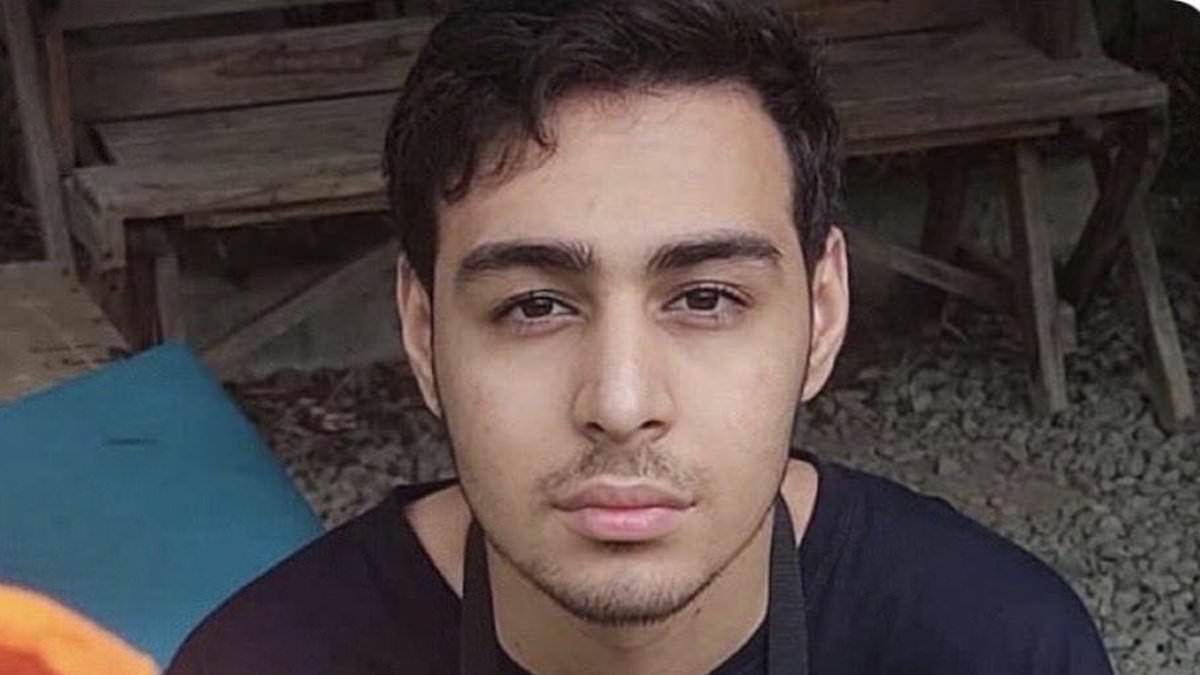
Speaking candidly with the Daily Mail, the protester, identified as Darius*, shares his harrowing experiences and calls attention to the fate of fellow activists who have been arrested and executed since the unrest. He urges international leaders to take decisive action to protect those sentenced to death, describing the regime’s enforcers as “monsters” who must be stopped.
Recent events underline the urgency of his call. As reported by Iran Human Rights, a Norwegian-based NGO, 18-year-old musician Amirhossein Hatami was executed last Wednesday. Hatami, condemned by what has been described as a “death judge,” was punished for his participation in the protests. Disturbingly, his coerced confession was broadcast on Iranian state television, where he appeared with his distinctive black curly hair shorn.
Tragically, the executions did not end there. On the following Sunday at Ghezel Hesar Prison, Mohammad Amin Biglari, 19, and Shahin Vahedparast Kolor, 30, were also put to death. Their deaths have sparked fears for others who await a similar fate.
There is growing concern for dozens more protesters facing execution. Among them are Ali Fahim, 23, and Abolfazl Salehi Siavashani, 51, who are reportedly being held in an undisclosed location within the same prison, potentially awaiting their own executions. The international community now stands at a critical juncture to respond to these urgent humanitarian appeals.
Fears are now growing for dozens more sentenced to death, with reports that two other men, Ali Fahim, 23, and Abolfazl Salehi Siavashani, 51, are understood to be at the same prison in an ‘undisclosed location for execution.’
‘I will never get these images out of my mind, all those young people — it replays over and over in my mind and will haunt me for the rest of my life. All those young lives were just taken and murdered,’ he said.
On January 8th, Darius and his wife were among hundreds of thousands who took to the streets across Iran after the former Shah’s son, Reza Pahlavi, called for the regime to be overthrown.

Amirhossein Hatami was hanged in the notorious Ghezel Hesar prison outside the capital on Wednesday, dashing hopes he would be spared because of his age

Mr Biglari and Mr Kalour’s family were not granted final visits or allowed to say goodbye before they were put to death (pictured is Mohammadamin Biglari, 19)

Both were convicted of ‘Moharaebeh’, or ‘enmity against God’, and sentenced to death by ‘Death Judge’ Abolghassem Salavati (pictured is Shahin Vahedparast Kalour, 30)
What began as mass demonstrations quickly spiralled into one of the bloodiest crackdowns in the country’s modern history. Human rights groups say around 40,000 were killed and tens of thousands arrested as security forces moved to crush the uprising.
The executions came amid Iran’s war with Israel and the United States, which began on February 28 with airstrikes that killed the Islamic Republic’s supreme leader, Ali Khamenei.
Speaking from hiding, he said: ‘I was never at a demonstration in my life before, but we decided to go out on January 8th, on a Thursday evening. Reza Pahlavi called on us to go out at 8 pm, but as Iranians are fashionably late, we came out after dinner at 8:30. There were huge crowds building up.
‘I live in the north of Tehran, in our area, because it’s close to the Iranian television station and many military compounds — it’s usually very tightly controlled and not many people dare to come out.
‘By the time we got to Vanak Square, which is a very central place in north Tehran, there were maybe 50–60,000 people. As far as the eye could see, there was a crowd.’
‘My wife, a few friends, and I were there. We were about 50 rows away from the square when suddenly 16 or 17 motorcycles arrived, two men on each. We heard tear gas. One canister landed right next to my foot.
‘Everyone started running — total mayhem. A woman fell in front of me as I tried to run away. She was about 75 years old. I grabbed her hand and picked her up.’
He then describes how he heard a motorcycle racing up behind him.
Turning to look, he saw a second rider armed with a baton topped by a heavy ball and a gun. The man struck him on the head above the eyebrow, almost blinding him, and he collapsed to the ground.
When he tried to stand moments later, the officer swung again. He raised his hand to block the blow and instantly realised it was hanging limp from his wrist.
‘I started running. They came after me. People were being shot. I think many were plain-clothes security forces. These ‘Yegan Vijeh,’ who are special forces, hit me, but among the crowd there were many plain-clothes security forces shooting people with real guns at close range — they were also pointing a green laser at people, and the snipers on the rooftops would shoot them.

Mohammadamin Biglari, 19, and Shahin Vahedparast Kalour, 30, were executed at Ghezel Hesar Prison (pictured) at dawn on Sunday

Families and residents gather at the Kahrizak Coroner’s Office, confronting rows of body bags as they search for relatives killed during the regime’s violent crackdown on protests in January

In Tehran, most protesters were armed with nothing more than the courage to take a stand
‘They were inside the crowd, shooting demonstrators. They were probably among us from the beginning. People were falling, blood everywhere. Bodies kept going down like roulette, and we just kept on running for our lives.’
Darius says he’s not young but found the strength to run as the terrifying thought raced through his mind that if they caught him with his passport — as he is a dual citizen — they would accuse him of being a Mossad spy.
‘My child’s face, everything went through my head. I started running hard. I tried to jump over one of the big roadside ditches and fell, hitting my head on the cement floor of the ditch again.
‘People helped me up and said my face was covered in blood. One woman cleaned the wound, another stuffed tissues inside the wound, and pulled my hat down to cover it. I didn’t want to remove my mask or hat because of TV cameras and fear they’d identify me later.’
‘I live about two kilometres away. Everyone was trying to help the wounded and escape. My wife, a friend, who later got arrested, and I went into the side streets as all hell broke loose.
‘I’ve lived there for years, I know every alley. We used the back alleys to try to get home. Two motorcycles chased us. They arrested many people behind us. We were lucky. We reached a street where a taxi passed by.
‘There were machine guns. People were being shot and falling. As I ran, bodies were everywhere. You couldn’t take a few steps without jumping over someone.
‘Some were shot with plastic bullets, others with real guns, mostly by plain-clothes security forces who had walked with us toward the square and then suddenly turned on the crowd. I jumped over so many bodies; they just fell to the floor.’
‘Everyone had decided to demonstrate that night. When I eventually got home, those were the last 12 minutes of internet we later found out before the total blackout.
‘I called my family to tell them I was okay. They saw my injuries and were terrified, but I told them not to tell our child. I called a few friends — everyone I spoke to had gone out and experienced the same thing. Friends in west Tehran said hundreds of thousands, maybe millions, were out. In Mashhad, they said millions came out. That night I thought it was over — that the regime was finished.’

Protesters set fire to a car in Tehran on January 8, 2026

Human rights advocates report that thousands of individuals have been put to death following judicial proceedings widely criticised as fundamentally unfair (pictured: Mojtaba Khamenei, the second son of the late Ali Khamenei, and the third Supreme Leader of the Islamic Republic)


Ali Akbar Daneshvarkar and Mohammad Taghavi Sangdehi were killed by Iranian authorities last Monday

Iranian police special forces stand guard during a funeral procession for Alireza Tangsiri, head of Iran’s Islamic Revolutionary Guard Corps Navy, and others killed in Israeli strikes last month
‘Eventually, the internet was cut off. Even mobile and landlines didn’t work. I had a broken hand and needed stitches all over my bruised and battered body. I stayed home for two days and didn’t go to the hospital.
‘A friend arranged an X-ray privately and confirmed my wrist was broken. My neighbour found an orthopaedic surgeon. Two nights later, at 10 pm, I went to his home. He bought injections and all he needed for putting my hand in a cast from a pharmacy and did not let me pay for anything.
‘He then numbed my hand with 2 injections on my wrist and said he would try to reset it manually, as normally I would have needed to be operated on. My wife and friend held me while he pulled and twisted my hand back into place. He put a cast from my hand to my shoulder and stitched my eyebrow.
‘The cut was two centimetres lower than my eye — I could have lost sight in one eye. My leg was bruised from the fall; they cleaned and treated it. I am one of the lucky ones.’
‘We stayed inside. We heard the police were looking for people inside hospitals and shooting them while still hooked up to machines, so ordinary Iranians helped each other in secret. Hospitals were full of injured people and security forces looking to arrest them. People with injuries were being taken to prison.’
Many of the youngsters that night went to the hospital, but instincts told Darius to lie low as reports of the regime killing patients in their hospital beds proved fatal.
‘We heard stories that some injured people in hospitals were killed. There were rumours that militias brought from Iraq were promised money for the injured and more for the dead, so some killed the wounded to get paid more. They took bodies from hospitals.
‘So many dead bodies with bullets in their heads had medical equipment still attached to their bodies.
‘Authorities dropped bodies on the side of the road for parents to find and identify. I saw this with my own eyes, families having to go through the dead,’ he said, his voice heavy with the memory. After the blackout, some footage managed to get out to the international world, showing parents wandering in shock and searching for their children, with phones ringing out from body bags in an attempt to find their loved ones.

Protesters wade through tear gas during an anti-government protest in Tehran
‘At some point, I realised my wallet was missing. I had dropped it in all the commotion. My heart was in my mouth as I realised that if it was found in the streets, I would be identified. I traced my footsteps the day after, and miraculously, it was in the ditch that I had fallen in that night, covered in blood. I am so lucky they didn’t find it.’
‘I laid low until my cast was off and my face had healed, in case I would get questioned at the border, and then eventually left the country. I can’t say how, as I don’t want them to trace me — you really need to understand what these people are capable of. A few days later, the war broke out.’
‘We all want an end to this regime. We want Israel and the US to finish the job. We want Prince Reza Pahlavi to lead us. We want a democratic and free Iran.
The protests and the violent crackdown that followed have left deep scars across the country, with activists warning the true death toll may never be fully known.
Breaking down in tears, Darius says: ‘When you hear this story, it’s hard to comprehend how such things can happen in only 2 nights.
‘But really, they have been doing this for 47 years. How can the Islamic Republic do it to its own people?’
‘They are evil. You need to know what you’re dealing with.’
*Names have been changed to protect identity