
Share this @internewscast.com
Wars may ignite in a single location, but their flames often spread far and wide, leaving a trail of devastation in their wake. As the Middle East finds itself once again engulfed in conflict, with Iran’s Shahed drones targeting both military and civilian sites, the world watches with bated breath. The potential consequences of this burgeoning conflict are nothing short of catastrophic.
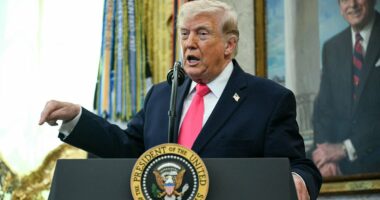
Last June, then-President Donald Trump launched a precise and calculated strike on three of Iran’s nuclear facilities. His goal was straightforward: to thwart the Iranian leadership from acquiring a nuclear weapon capable of annihilating Israel and potentially dragging the globe into a conflict of unimaginable scale.
Following the strikes, Trump confidently proclaimed the mission a resounding victory. He asserted that Iran’s nuclear capabilities had been significantly impaired, even going so far as to describe the situation as “Monumental Damage” in Iran, backed by satellite imagery evidence. “Obliteration is an accurate term!” he declared.
However, it appears that this assessment was either flawed or misleading. Now, the President has embarked on a far more hazardous venture—regime change within Iran, a nation of 90 million, armed to the teeth, and with no clear exit strategy. Unlike last year’s precision strikes, there is a mounting concern among Western military circles that this latest campaign has spiraled beyond control.
The intensity of Iran’s counterattacks has taken even seasoned analysts by surprise. Tehran has struck, either directly or through proxies, at least 11 nations. These include Israel, the United States (at its embassy in Kuwait), and several others such as the UAE, Saudi Arabia, Qatar, Oman, Jordan, Britain (targeting the Akrotiri base in Cyprus), France (via Camp de la Paix in the UAE), and Italy (through the NATO camp at Ali Al-Salem Base in Kuwait). In response, French warships are now navigating the Mediterranean, poised to protect British forces stationed in Cyprus.
And all this has unfolded in just a matter of days.
So are we living through – and as a lifelong soldier I do not ask this lightly – the outbreak of World War III? Certainly I cannot remember a more perilous moment in geopolitics in my lifetime – and I am now 70.
It seems obvious that if, as is all too likely, America gets sucked into a ground war in the Middle East – graveyard of countless military misadventures across the centuries – then China and Russia will waste no time taking advantage.

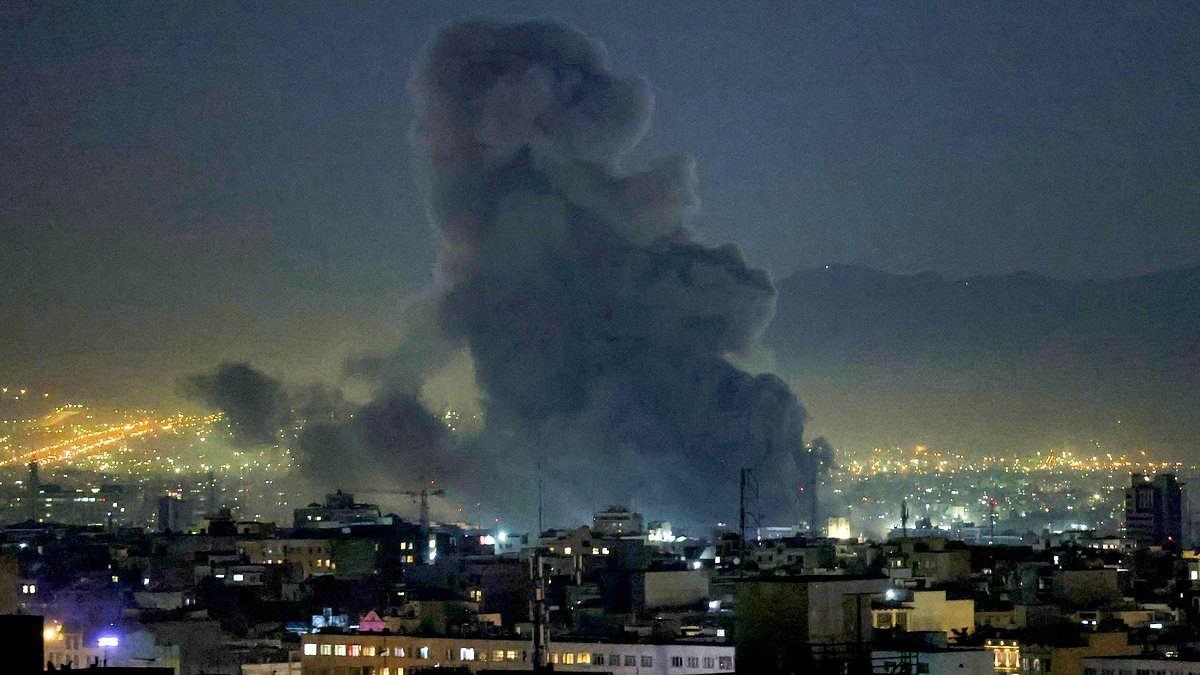
Smoke plumes rise in Tehran after the US and Israel launched air strikes against Iran on March 1

Fire and burnt-out cars seen after a missile strike in Kyiv, Ukraine, in January 2024 amid the Russian invasion
President Xi will seize the opportunity to launch his longed–for invasion of Taiwan, perhaps as soon as 2027. Trump has preferred to maintain America’s longstanding position of ‘strategic ambiguity’ towards the island: that is, not promising any military response if China invades, while simultaneously seeking to deter any such incursion. But his predecessor Joe Biden might have been more honest when, once asked whether America would defend Taiwan, he replied simply: ‘Yes.’
Meanwhile, with Western attention focused on protecting allies in the Gulf as well as dealing with Iran’s response, and with American missiles and other equipment inevitably drawn away from the theatre in Ukraine, Putin would only double down on his four-year-old campaign to seize a sovereign European country. Notwithstanding the defenders’ bravery, he might finally achieve that terrible goal – and then launch an incursion into the Baltics.
Estonia, Latvia and Lithuania have all been held by Russia at various times in their history, but are now Nato as well as EU members. Putin is 73 and widely suspected to be in poor health. He may feel he has one last opportunity to secure his place in history and restore the glories of the motherland by expanding its western frontiers.
Any such invasion, of course, would further destabilise the transatlantic alliance – already grossly weakened by Trump’s disgraceful threats to attack Greenland, an autonomous territory run by Nato ally Denmark. Would Trump – or any successor such as the isolationist current Vice-President JD Vance – risk American lives to defend Tallinn, as Nato’s Article 5 should compel them to? Who knows. But Britain, France and the other major European powers would surely feel duty-bound to step in.
For all these reasons and more, I fear that future historians will look back at this week’s reckless attempt at ‘regime change from the skies’ as the final catalyst for a third world war.
Remember, the First World War was sparked by the assassination of an Austrian Crown Prince by a Serbian anarchist on a bridge in Sarajevo. Few of the millions of Tommies who fought at the Somme or Passchendaele or Ypres had even heard the name Franz Ferdinand in the spring of 1914. However, within days, a global war had begun due to a complex system of alliances that compelled other nations to join the fight.
In 1939, of course, Hitler’s invasion of Poland was the trigger for Britain, France and the Anglosphere outside the US to enter the Second World War. However, Japan had invaded China as far back as 1937. As time went on, other great countries from Russia to America found themselves sucked into the conflict – and the whole planet was aflame by 1941.

Hitler’s invasion of Poland was the trigger for Britain, France and the Anglosphere outside the US to enter the Second World War

Aftermath of a Russian attack on Kyiv last month. With attention on the Gulf, Vladimir Putin could double down on his four-year-old campaign to seize a sovereign European country

Taiwanese Coast Guard Special Task Unit troops patrol the threatened country’s waters aboard a speedboat. President Xi has designs on the territory

Sir Richard Shirreff cannot remember a more perilous moment in geopolitics in his lifetime
The point should be obvious: war is unpredictable, easy to start and hard and often unimaginably painful to end. Just three years ago, Vance himself tweeted that the Blair–Bush campaign in Iraq was an ‘unforced disaster’ that cost $1trillion and killed many innocent people. ‘I pray that we learn its lessons,’ he said.
Now, egged on by Israel which has every reason to fear a nuclear–armed Iran, it appears the current US administration may be sleepwalking into its own disaster. The six coffins now flying home, draped in the Star–Spangled Banner, are unlikely to be the last.
Trump’s own foreign adventures have seen mixed success. He claims to have ended no fewer than eight wars since he came to power, including between Armenia and Azerbaijan, the Democratic Republic of the Congo and Rwanda, India and Pakistan, and Cambodia and Thailand. But he has singularly failed in his much-repeated campaign promise to end the Ukraine conflict ‘on day one’ of his tenure.
Toppling the Venezuelan dictator Nicolas Maduro in a daring night–time raid in January, seizing him and bringing him to the United States to face trial was spectacular and no doubt emboldened Trump in his move to oust Khamenei. Domestic factors are also influencing him: the federal interest rate remains high, acting as a drag on consumption, while the explosive fallout from the Epstein files has undermined Trump’s popularity with swing voters – with midterm elections due in November. And what do autocrats do whenever they start to feel the heat at home? They distract the voter with war.
Now the fate of the world depends on how quickly America can extricate itself from the messy and dangerous situation unfolding in the Middle East. Add war in Europe and war in Asia to war in the Middle East and that’s World War Three in anyone’s book – but this time, all the major powers would go into the conflict possessing weapons that could kill billions. The US and Israel launched these strikes to prevent nuclear proliferation. It would be the most terrible irony in history if that very action was the trigger for a nuclear war that destroyed civilisation as we know it.
- Sir Richard Shirreff is former Deputy Supreme Allied Commander Europe, Nato