
Share this @internewscast.com
Concerns are mounting over the possibility that Donald Trump might enable Vladimir Putin to intensify military actions against Kyiv. Analysts point to a purported proposal from 2019, where Russia suggested a ‘swap’ involving Venezuela for Ukraine.
Recently, the US apprehended Venezuelan leader Nicolas Maduro and his wife, Cilia, transporting them to New York to face accusations of leading a ‘relentless campaign of cocaine trafficking.’
While US officials maintain that Trump’s decision to invade Venezuela was solely in America’s interests, former advisors to the Republican president caution that he might inadvertently allow Russia to take significant steps against Ukraine.
Fiona Hill, an academic with a background on the US National Security Council, had previously informed Congress in 2019 about Russia’s conspicuous signals towards a peculiar exchange involving Venezuela and Ukraine.
Following the US’s recent actions in Venezuela, comments from Russian officials have renewed her concerns.
Despite Venezuela being a long-time ally of Russia, former Russian President Dmitry Medvedev remarked that although the US’s actions were unlawful, they aligned with Trump’s pattern of prioritizing American interests, noting that South America is within the US’s sphere of influence.
It was this language, Hill told The Telegraph, that stirred her memory of the alleged 2019 offer.
She said: ‘Medvedev’s language echoes that of other Russian officials and commentators back in 2019.’
During her 2019 appearance in front of Congress, the Russia hawk said the Kremlin’s proposal harked back to the Monroe Doctrine, a policy made in the 19th century under president James Monroe that sought to establish America’s sphere of influence in the West.

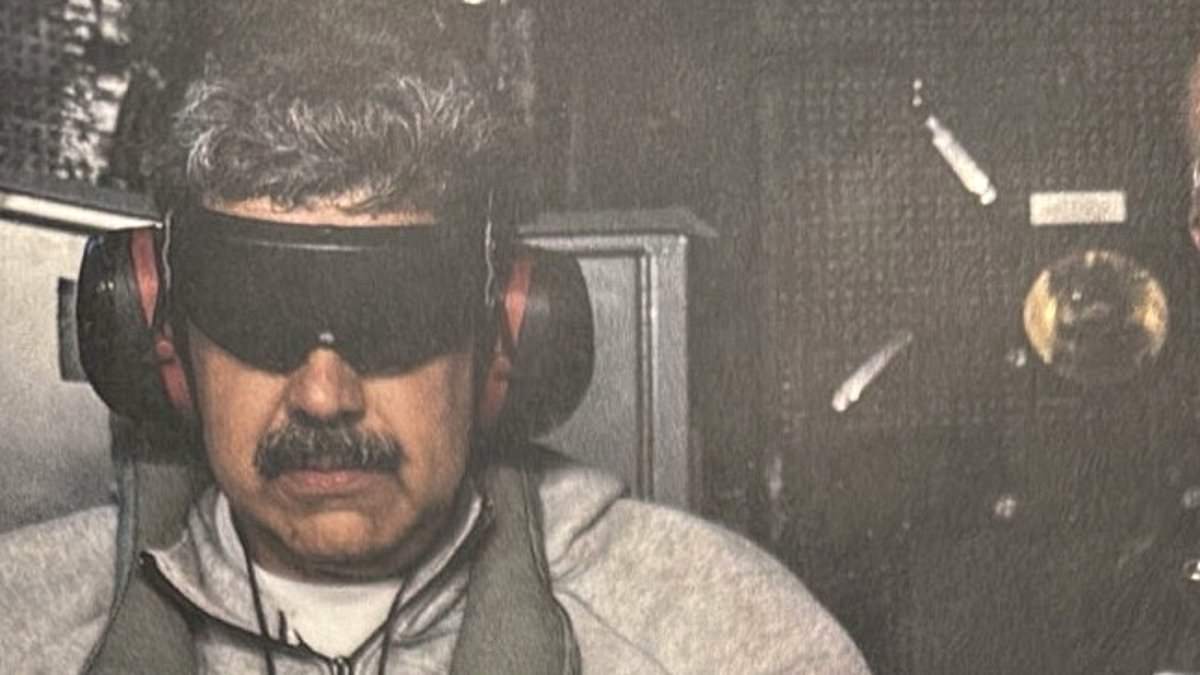
The operation was a success and remained a secret until Venezuelan President Nicolas Maduro was captured. Trump posted this picture of Maduro aboard USS Iwo Jima on Saturday

Fears of the US allowing Vladimir Putin’s (pictured) Russia to crush Ukraine in the wake of the incursion into Venezuela are growing

An explosion rocks Caracas in the early hours of Saturday morning during a US military operation which resulted in the capture of Venezuelan President Nicolas Maduro
She said in her testimony: ‘[Russia was] basically signalling: “You have your Monroe Doctrine. You want us out of your backyard. Well, you know, we have our own version of this. You’re in our backyard in Ukraine”.’
John E Herbst, the former US ambassador to Ukraine, told The Telegraph: ‘Trump’s very clear energetic influence in the Western Hemisphere could lead to an understanding that we get to run things here and they get to run things in their neighbourhood’.
He added: ‘There are some Ukrainians who’ve shared that thought.’
And officials in the Trump administration have signalled that they seem to back this line of thinking.
Marco Rubio, the US secretary of state, said on Sunday of the incursion into Venezuela: ‘This is the Western Hemisphere. This is where we live – and we’re not going to allow the Western Hemisphere to be a base of operation for adversaries, competitors, and rivals of the United States.’
But despite American officials claiming the incursion into Venezuela was done to protect the US’s sphere of influence, a new Daily Mail poll showed that a majority of the US believes Trump’s main motivation was to grab the country’s oil.
That was the top answer in a J.L. Partners online poll conducted on Monday and Tuesday of this week among 999 registered voters.
Overall, 39 per cent said Trump green-lit a military operation to capture Venezuelan dictator Nicolás Maduro to get access to the South American country’s vast oil reserves.

Nicolás Maduro and his wife, Cilia Flores, are seen in handcuffs after landing at a Manhattan helipad as they make their way to a federal courthouse in Manhattan on January 5, 2026

He faces charges including narco-terrorism, conspiracy, drug trafficking, money laundering and more
Another 30 per cent said the move was to stop the flow of illicit drugs, while 17 per cent of registered voters said it was to remove an illegitimate leader.
When the responses were divided by party preference, 59 per cent of Democrats said Trump did it for the oil, compared to 17 per cent of Republicans and 38 per cent of independents.
Republicans were most likely to believe the White House’s explanation that Maduro needed to go due to his widespread drug trafficking.
48 per cent of Republicans named drugs as the top reason for the military action, with just 14 per cent of Democrats agreeing.
30 per cent of independents also named drugs.
After drugs, the second biggest group of Republicans said Trump was motivated to remove an illegitimate ruler.
26 per cent of GOP voters believed this to be the case, versus 16 per cent of independents and just 9 per cent of Democrats.

Nicolás Maduro arrives at the Downtown Manhattan Heliport, as he heads towards the Daniel Patrick Manhattan United States Courthouse for an initial appearance to face US federal charges

Nicolas Maduro has been shuffled into a police SUV on January 5, sporting prison garb, as he makes his way from an NYC jail to his first court appearance
Republicans were the least likely to believe Trump deposed Maduro over oil.
When respondents were asked if they were OK with the idea that the military action was motivated by oil, a majority – 52 per cent – said they weren’t.
Another 29 per cent said it is OK if the U.S. involvement in Venezuela was over oil, while 20 per cent answered that they were unsure.
When that question was broken down by party, Republicans were much more tolerant of the U.S. going into Venezuela for oil, while Democrats and independents were largely in agreement that they were not.