
Share this @internewscast.com
The storm is intensifying with increased momentum.
After weeks of uncertainty surrounding President Donald Trump’s strategy and whether the United States is willing to deploy ground forces in the conflict with Iran, the likelihood of a full-scale invasion targeting a strategic vulnerability is becoming increasingly imminent.
U.S. Marines and paratroopers are gearing up for a potential assault on Kharg Island, a vital hub in Iran’s economic structure.
In a last-minute decision, Trump extended his initial deadline for targeting the country’s energy facilities, pushing it to April 6.
If Iran fails to reopen the Strait of Hormuz—a crucial passage for oil shipments—by the revised date, and if U.S. forces succeed in their mission, this could mark a pivotal moment in the conflict. The anticipated assault, executed from both air and sea, might break enemy defenses and pave the path to victory.
However, unlike the meticulously planned D-Day invasion, an offensive on Kharg Island would be more of an impromptu effort.
Many military experts fear the US, with gung-ho defence secretary Pete Hegseth at the fore, have underestimated the potential for casualties.
This is a midterms election year in the States and, so far, the war has not proved popular with voters.

Will Trump hold back for fear of upsetting his MAGA base? Does he believe a lightning victory will galvanise his poll figures? Is he convinced that the only way to defeat Iran is to cut off their cash supply, which Kharg Island represents? Or is this all an elaborate ploy, aimed at forcing the mullahs to the negotiating table?
The ramifications, as analysed here, are complex and ominous…
Kharg Island
Also known as Forbidden Island, this speck of land 16 miles off the coast of Iran is the Islamic Republic’s main hub for oil exports.
By invading it and seizing control of its terminal, storage tanks and pipeline, the US could shut off the flow of money that supports Tehran’s economy and funds its military. Kharg handles 90 per cent of Iran’s oil output, up to 1.5million barrels a day.
At roughly eight square miles, it is approximately the same size as Iwo Jima, the island in the Pacific that was the scene of some of the most ferocious fighting against the Japanese during World War II – with 7,000 US Marines killed in action and nearly 20,000 wounded.
Kharg has a deepwater tanker port, an airport and a host of military installations including the Matla ul Fajr radar station.
Despite heavily bombing the island last week, the US Air Force has so far avoided hitting its oil infrastructure. Around 20,000 oil workers are stationed there, under the guard of the Islamic Revolutionary Guards Corps (IRGC), and these civilians will probably be used as human shields.

America’s task force
The assault on Kharg could come from two directions: by sea across the Gulf from the United Arab Emirates (UAE) rather than traversing the bottleneck of the Strait of Hormuz; or by air, with forces launched from the aircraft carrier USS Abraham Lincoln in the Arabian Sea as well as from bases in the UAE.
The USS Tripoli, a vast amphibious assault ship, is expected to arrive in the region today with around 2,200 Marines of the 31st Marine Expeditionary Unit (MEU) and 1,200 additional crew on board. With a top speed of 20 knots (23mph), the 45,000-ton Tripoli has a complement of up to 20 F-35B Lightning II vertical lift-off stealth fighters.
It also brings MV-22 Ospreys (a 316mph twin-rotor assault aircraft capable of carrying up to 24 troops) and MH-605 Seahawk helicopters.
In its wake is the USS New Orleans, an amphibious docking ship. The USS Boxer, USS Portland and USS Comstock are on their way too, with between 2,000 and 2,500 Marines from the 11th Marine Expeditionary Unit. The Boxer, a Wasp-class assault ship, also brings Ospreys and Seahawks.
Around 3,000 paratroopers from the Immediate Response Force of the 82nd Airborne Division, based at Fort Bragg in North Carolina, have also been ordered to the Gulf by President Trump.
The deployment includes their commander, Major General Brandon Tegtmeier, and his staff.
American top brass are gathering in the UAE, the Arab state most hostile to Iran, so it’s little wonder that Iran is targeting Dubai’s hotels such as the Fairmont The Palm and the Jumeirah Burj Al Arab.

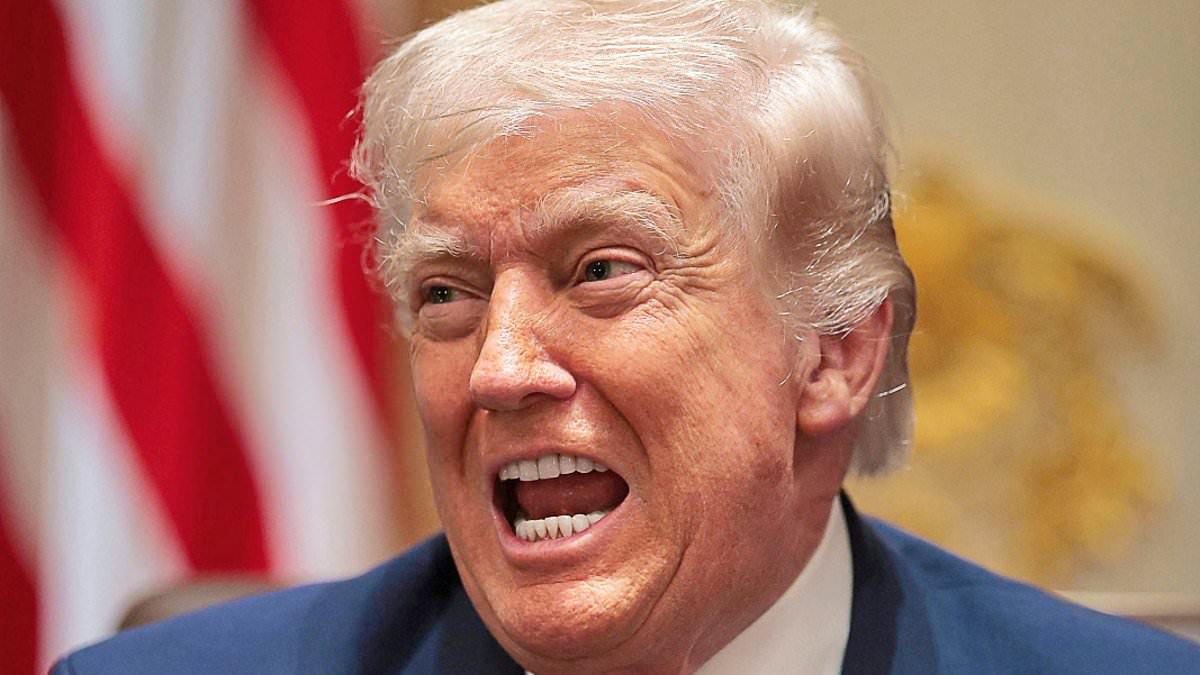
Donald Trump last night paused his original deadline to hit the country’s energy plants and extended it to April 6

Pipelines transferring crude oil from storages on the hills to tankers in the eastern dock of Kharg Island, Iran
Iran’s defences
Despite nearly four weeks of constant bombardment and the decapitation of its government, Iran is still heavily armed and intent on war.
According to the Alma Research and Education Center, an Israeli thinktank, it could have up to 1,000 ballistic missiles in its arsenal.
Equally deadly, across this country of more than 90million people, small-scale factories in garages and kitchens are building thousands of small and medium-sized drones, capable of carrying explosive payloads.
The Gulf coastline of Iran is mountainous, making sitting ducks of the ships below. Allied troops discovered how perilous this type of terrain can be during both world wars – at Gallipoli in 1915 and Anzio in 1944.
These battles saw mass casualties because the defenders had the high ground. At Kharg, it is probable that numerous fanatical defenders, armed with rocket launchers and other artillery, are already well dug in.
Before this month, the regular Iranian Army (Artesh) was 580,000 strong. The IRGC numbers around 190,000, and several million men in the reserves have military training. Their equipment will be much depleted by the relentless pinpoint attacks of US and Israeli missiles, but before the war began, they had 1,500 tanks, mainly elderly models from the Shah’s era before 1979, though with updated sights, electronics and cannon.
Both sides have the modern M4A1 carbine and a light machine gun, both firing Nato standard 5.5mm ammunition.
Iran acquired many of these US weapons from Afghanistan after the collapse of the pro-US government there. Iran manufactures its own rifles and pistols using US standard 5.5mm ammunition, but also has millions of Soviet-style Kalashnikovs. These are notoriously robust in dusty battlefield conditions, but use 7.6mm rounds, which might be in shorter supply.

The IRGC numbers around 190,000, and several million men in the reserves have military training (Pictured: IRGC troops)
The attack
In the event of an attempted landing from the air, the Iranians could set fire to oil storage tanks, containing up to 18million barrels of oil, creating thick black cloud cover.
As long as this lasted, it would complicate attempts at invasion by either a helicopter assault or parachute.
The military obstacle would be temporary but the impact on the global economy would be immeasurable, as China and India are among the countries still reliant on Iranian exports.
A prolonged bombing campaign to soften up Kharg’s defences would make it easier for the Marines and paratroops to get ashore or onto ground from the air, but at the cost of the element of surprise.
Iranian cruise missiles could await helicopters and transport aircraft, which are especially vulnerable when flying paratroop missions because of the need to maintain a steady, comparatively low speed during drops.
Individual Iranians with shoulder-launched missiles and rocket launchers would pose a serious threat as helicopters and troops came into range. So too would ‘first-person drones’, controlled by operators with headsets, which could be lethal against a parachute assault, picking off paratroopers in the air. Some military experts have warned that this combination of risks would turn the initial assault into a suicide mission for the 82nd Airborne.
Others calculate the battle could be won, but that troops would be plunged into a ‘kill zone’ similar to the most intense of the fighting on the Russian front in Ukraine.
The US prides itself on its technological superiority, which is undeniable. But in close-quarter fighting that advantage is less marked. In Venezuela, the US Special Forces used an ultra-low frequency disorientation weapon to confuse president Nicolas Maduro’s bodyguards while he was being captured in January – but that was around one building, not over several square miles.
Despite state-of-the-art body armour, US troops will not be invulnerable. Bullets and shrapnel, particularly at close range, will always be potentially lethal.

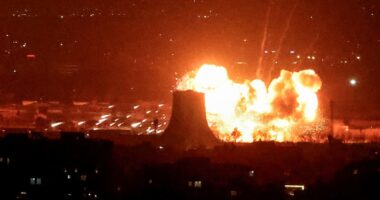
Despite nearly four weeks of constant bombardment and the decapitation of its government, Iran is still heavily armed and intent on war. (Pictured: Israeli security forces cordon off the area following a projectile strike on south Tel Aviv on March 26, 2026)
In Iraq and Afghanistan, where the Allies were able to establish well-defended military hospitals, badly wounded soldiers had a chance of survival if they could be treated for serious injuries before they bled out.
But on Kharg, the numbers dying from wounds will be higher, because getting the injured out will be so difficult. Rescue helicopters and medical teams will be especially vulnerable to drone and rocket strikes.
The aftermath
Even if US troops manage to storm and take the island, they still have to hold it. Missile and drone attacks from the mainland will be constant, and US aircraft will need to fly frequent sorties to hit back.
Air defence systems and counter-drone electronics will also be vital. At the start of their invasion of Ukraine in 2022, the Russians seized Snake Island, south of the key port of Odessa, but had to give it up eventually because Ukrainian drone attacks made it untenable.
The initial invasion force seems unlikely to number more than 5,000 and their losses could be high. Far more troops than that would be needed for any assault on the mainland. The invasion of Iraq in 2003 required an Allied force of 160,000.
Despite Donald Trump’s disparaging comments about British forces, including his sneer yesterday that the UK’s aircraft carriers were ‘toys’, he may well request our assistance.
Even when the initial firestorm is over, US ships will still be vulnerable to attack. China and Russia have both been sharing satellite intelligence with Iran, and if an IRGC missile or submarine could hit an American vessel at long range, the propaganda value would be as colossal as the loss of life was devastating.
The alternatives
This expected attack on Kharg could be a bluff, a feint to distract Tehran from the Americans’ real intentions. Their actual target could be other islands in the Gulf.
If US forces can seize Qeshm Island (an area of 576 square miles) and nearby Larak (19sq miles), both in the Strait of Hormuz, they can block the channel for tankers and container vessels that Iran uses to allow favoured ‘non-hostile’ shipping through – earning $2 million per ship.
US Special Forces such as Delta Force and the Navy Seals might simultaneously be used to raid Iranian command-and-control HQs, which coordinate coastal and island defence.
Three other islands in the Strait – Abu Musa and the two Tunb islands (claimed by the UAE but occupied by Iran since 1971) – could be ‘liberated’ by the US. The Emirates might well agree, in that case, to contribute footsoldiers to any US assault on Iran’s mainland.
But Iranian missiles, drones and mines mean the US Navy cannot safely operate in waters between one target and the next, as it did in the Pacific or on D-Day during the Second World War.
Capturing islands will partly wrest control of the Strait from the Iranians and prevent them from collecting tolls, but it will not reopen the Gulf route. On the contrary, in the short term it will render the blockade total.
Instead of focusing its firepower on the Gulf, the US might aim instead to capture Chabahar. This port, east of the Strait on the Arabian Sea coast, could be an easier landing point. American forces would then have the power to impose their own blockade downstream from Hormuz, able to stop ships friendly to Iran from entering or leaving.
It could be a bridgehead for a future advance into Iran’s interior but does Trump really want to risk fighting all 1,000 miles to Tehran?
Mark Almond is director of the Crisis Research Institute in Oxford