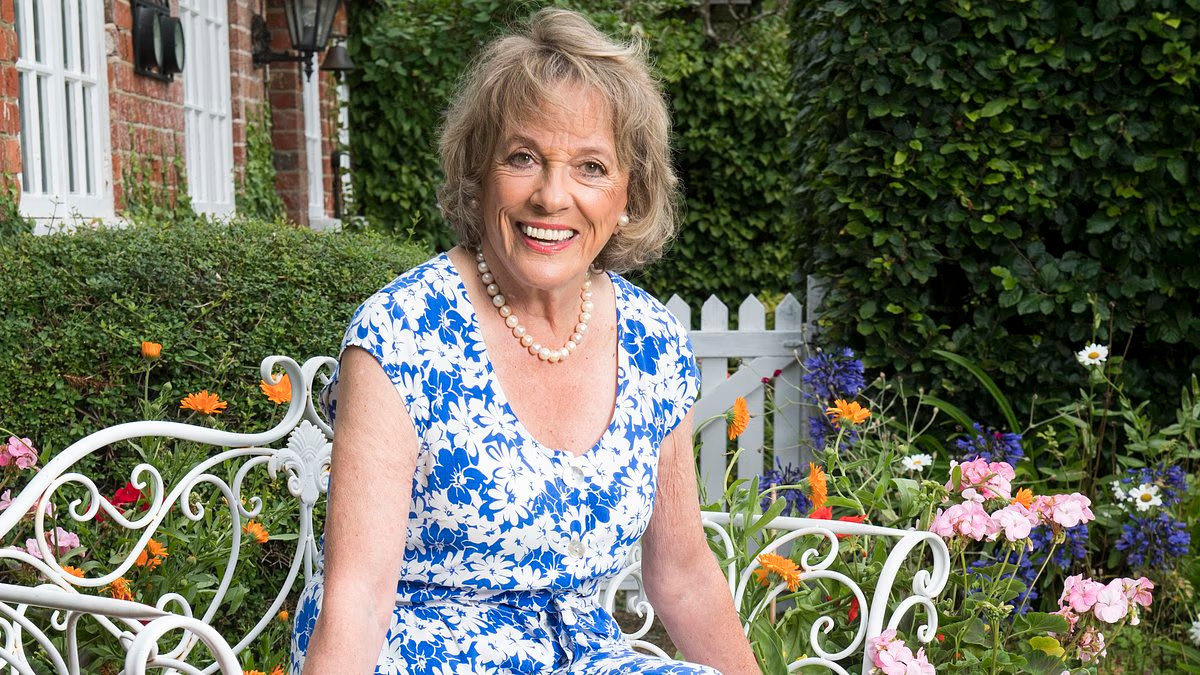

In 1980s Britain, three women were widely regarded as truly powerful: Prime Minister Margaret Thatcher, the Queen and Esther Rantzen.
Yet only one was known to mark her 50th birthday by sprinting naked around her garden, wearing nothing but a huge hat. And only one seemed to take genuine pleasure in challenging the Establishment at every turn.
Dame Esther Rantzen, who died yesterday aged 86 following a lengthy battle with cancer, had once intended to end her life at Dignitas, the Swiss assisted-dying clinic.
She revealed in December 2023 that she had registered with Dignitas, around a year after receiving a stage four lung cancer diagnosis. Last month, however, she said she had become ‘too physically fragile’ to make the journey.
Much of her final period was spent at her country home in the New Forest. Her death came with particular poignancy, less than three weeks after MPs rejected the assisted-dying bill she had campaigned tirelessly to support in the House of Commons.
Throughout her life, Dame Esther was an audacious and formidable presence. She was especially fond of recalling the time she was arrested for wilful obstruction after being stopped by police while filming one of her much-loved street vox pops.
The incident took place in 1980 as she handed out bat soup to unsuspecting passers-by. One woman judged it ‘bit gamey’. A police officer then approached, objecting to the amount of pavement occupied by Esther and the That’s Life crew.
Esther was not inclined to quietly comply. With the cameras still recording, she insisted that nobody was being obstructed and gestured towards a huge stretch of empty pavement as evidence. Moments later, she was being led to a waiting police van.

In 1980s Britain, the story was that the country’s three most powerful women were Prime Minister Margaret Thatcher, the Queen and Esther Rantzen

Esther Rantzen made her final public appearance in June this year, when she celebrated her 85th birthday

Dame Esther was a fearless broadcaster and campaigner whose influence extended far beyond television
In her autobiography, she recalled with delight: ‘Inexperienced at being arrested, I climbed into the passenger seat.’ As the van pulled away, she gave a regal wave to the crowd.
Nor did she show much embarrassment when she was convicted at Horseferry Magistrates’ Court and fined £15. She attended court in a fur coat.
For years, Esther enjoyed retelling the wonderfully absurd story. So did the officer who arrested her, later appearing as a surprise guest when she was celebrated on This Is Your Life.
Dame Esther will be remembered for her many campaigns, her remarkable broadcasting career and, of course, her teeth. But that arrest captured the essence of vintage Esther.
She was mischievous yet deeply principled, and once she had made up her mind, persuading her to change it was never easy.
Esther represented the very best of Britain, even when her particular brand of brilliance veered into the delightfully eccentric. She built a television world entirely in her own image.
Often dressed in an outrageously flamboyant evening gown, she hosted what was arguably the BBC’s most successful light-entertainment programme.
At its peak, That’s Life was essential Sunday-night viewing, drawing audiences of as many as 22.5 million people — figures that seem almost unimaginable in today’s fragmented television landscape.
The programme created a singular portrait of British life, bringing together the amusing, the heartbreaking, the outrageous and the downright bizarre.
In between celebrating the daftness of vegetables shaped as genitals or dogs that said ‘sausages’, Esther fed us genuinely game-changing public service broadcasting, exposing health and safety issues, scandals in prisons, councils, schools.
She held conmen to account, shamed ‘jobsworths’ and got laws (and attitudes) changed.
This was broadcasting with heart, with humour – and with clout. The secret? She said herself that, just as in Shakespeare’s day, audiences wanted ‘to laugh AND to cry’.

Dame Esther Rantzen fronted That’s Life from 1973 until the show came off air in 1994

Dame Esther Rantzen with her husband, Desmond Wilcox, and their children Emily, Joshua and Rebecca in 1986

Dame Esther at home in Hampshire in recent months with her children and grandchildren

Esther Rantzen recording an episode of Wagoners’ Walk in 1977
Esther’s passing marks the end of an entire era in British broadcasting, one where a single presenter could be part of the furniture of nearly every living room in the land.
Extraordinary when you think that she grew up in a house that didn’t even have a TV in the living room.
Although the Rantzens were one of the first in their street to have a television set (by dint of her dad, an electrical engineer, working for the BBC), Esther’s parents were so concerned that the television might stifle conversation that they placed it permanently in the hallway.
She once recalled the postman peeking through the letterbox to watch. Yet by the mid-1980s she had smashed through the glass ceiling supposedly in place to stop women rising too far, and been offered a million pounds by ITV to leave That’s Life and present a nightly news programme for them. She turned it down.
She also turned down the chance to be the first female Controller of BBC1. There were few regrets in her life, but she always did wonder if she should have said yes to that one. It was a close call.
She claimed she turned up to the meeting to discuss the offer with two letters in her handbag – one accepting the role, one turning it down.
In the lift on the way up, she still hadn’t decided which one she would hand over.
Why did she ultimately say no? Part fear. She knew that ‘the vultures would circle me ready to pick out my eyes at the first misjudgment’. Part pragmatism, too.
This was a woman who knew the BBC, and all its failings. ‘Life at the top of the BBC’s pyramid, in its state of civil war, would be unpleasant and destructive,’ she said.
Ultimately, though, she realised that taking the top job would remove her from her audience, and engagement with an audience was Esther Rantzen’s raison d’etre. I interviewed her for this paper several times over the years, and I was struck by this in our final interview, in January last year.
Even as she was discussing her funeral arrangements, she was reaching out to a potential audience.
‘Maybe your readers would like to send me suggestions for hymns and readings,’ she said. They did, as she knew they would.
Esther Louise Rantzen was born in June 1940 in Berkhamsted. ‘Just after Dunkirk,’ she noted in her autobiography.
The war defined her early years. Her first memory was of standing in her cot hearing the wail of air-raid sirens. She was proud of her Jewish heritage.
Her grandparents were among the first Liberal Jews in Britain – ‘utterly Anglicised’, she once said.
‘We ate bacon and ham. We never lit candles to celebrate the coming of the Sabbath. And yet being Jewish still made an enormous difference to my life.’
Her parents Henry and Katherine fostered two child refugees from the horror of Nazi Germany, and paid for their education. She knew those children could have been her.
‘From my childhood I have felt not simply a patriotic affection for Britain, but a deep gratitude. Without the wonderful accident of being born here, I would surely have died in a concentration camp.
‘I learned to prize the freedoms we in Britain so often take for granted, our democracy, our eccentric institutions, like the BBC.’
Being Jewish, she claimed, also made her a natural champion of the underdog. ‘Rightly or wrongly I learned to distrust rules. I also learned to loathe the lynch mob, the bully, the snob. Being a member of a minority is the best lesson in tolerance I know.’
She was also abused as a child, not by a relative but by an uncle figure. She played it down for most of her life – presenting it as some ‘mild’ groping, nothing in comparison to proper abuse – but acknowledged later that her work with Childline, the charity she founded in 1986, had made her wonder.
She did recall telling her mother. ‘At first, I am not sure she believed me. She said: ‘Typical Esther, overdramatising’.’
Did the young Esther set out to change the world? She’d scoff at the idea. She studied English at Somerville College, Oxford, rubbing shoulders with future broadcasting giants (David Dimbleby was a contemporary and she once slept in Melvyn Bragg’s bed. Sadly, she noted, he wasn’t in it).
NEXT UP: Has Nigella Lawson Had a Stroke? Health Update
There she embraced the theatrical, getting involved with student revues. In another life she would have loved to be on the stage – and she certainly had the pins for it (her late husband Desmond Wilcox’s favourite photo of her was one from panto, where she was dressed as Dick Whittington.
‘I kept the boots,’ she said).
Yet she always felt she didn’t have the looks for showbiz. She was a ‘gauche, overenthusiastic trainee luvvy’.
She would struggle with her weight (there was a stint of binge-eating). Even when she had been glossed up by television and success, turned blonde, with fixed teeth, she said she always felt like a ‘dumpy brunette’.
Yet ambition shone from her. By the end of her third year at Oxford, she wrote in her autobiography, ‘I had aimed myself at the BBC.’
She landed her first job at the BBC in 1963, as a lowly trainee radio studio manager, a largely technical job involving, as she once put it, ‘fumbling around in radio studios, looking for the on-switch’.
She was also responsible for securing props for sound effects. Remember the sound of that pterodactyl in a radio drama? No. No one would. Still, it was made by Esther, flapping an umbrella.
She understood even then, though, that she had power at her fingertips. One day she found herself in sole command of the Shipping Forecast, responsible not only for delivering it, but for fading it in and out.

Dame Esther Rantzen as a child. She spent two years living in America when she was young

Dame Esther, pictured right, aged four with her younger sister Cilla and their golden retriever Polly, 1944

In one of the most memorable episodes of That’s Life, Esther Rantzen brought together scores of people who owed their lives to Sir Nicholas Winton

In an emotional moment watched millions of times since, Dame Esther said: ‘Is there anybody in our audience tonight who owes their life to Nicholas Winton? If so, can you stand up please.’ After a short pause, four rows stood up, leaving the retired stockbroker in tears
‘I was entirely alone, all the knobs and buttons at my command,’ she explained. ‘I fantasised that if ever my job became unbearable, I would fade the transmission and give the world my full story, get the lot off my chest.’
Happily, she suppressed her mischief-making tendencies and went on to slog her way up the ranks, moving into researching positions and working on consumer affairs programmes.
There was much to navigate on the way – misogyny included. An early boss used to greet his female staff with a cheery ‘take your knickers off’.
Another would practise his air rifle technique by hitting targets above her head. ‘I learned to duck,’ she said.
By the time she was offered a position on the show that would become That’s Life – where she would meet her future husband, the programme-maker Desmond Wilcox – Esther had a thick skin and invaluable experience not just of journalism but life.
She always thought of herself as a ‘career woman’ but was as surprised as anyone when she discovered a happy family life – married to Desi, with three children – was within her grasp.
It was not without controversy, though. Desi was already married when they met. ‘It was completely wrong,’ she told me in 2020.
‘I was working for him. He was married, with children. It shouldn’t have happened. I can’t defend it, but it swept us away and it stayed that way. It wasn’t an infatuation. I think we were kindred spirits’.
Desmond’s first wife Patsy, who had been Esther’s friend, at first refused to divorce. Things could not have been messier, and the eyewatering candour of Esther’s autobiography did not help. She knew she had handled it badly.
‘I was very raw. I certainly think I wrote it at the wrong time. I should have put it to one side, left it alone. I didn’t mean in any way to criticise her.
‘I was criticising myself, not her. We had been friends.’ Patsy Wilcox died in 1999, so there was no rapprochement. ‘I would have loved to, but she was understandably very angry and blamed me for the break-up of her marriage. There wasn’t a way back.’
Esther and Desi were together for 32 years, until his death in 2000. He was the love of her life. Their marriage even survived him once telling her she had ‘all the allure of a rotting log’.
She laughed. ‘Well, I’ve never seen myself as Mata Hari,’ she reasoned. ‘Let’s face it, I never turned heads. In my 20s I minded very much.
‘I was quite overweight and surrounded by these little butterfly girls. But you learn that you have to have something else. You have to be funny, witty, interesting.’
By the time they started a family, in 1978, she was a household name. Emily was first (she later changed her name to Miriam), followed by Rebecca, then Joshua. They would give her five grandchildren.
She often talked wistfully about her children’s early years, admitting she loved being called Mrs Wilcox ‘by their teacher, and the doctor’.
But she knew she could never have been a stay-at-home mother, and agreed completely when Desi used to rib her about not knowing where the vacuum cleaner was kept.
She never did embrace domesticity. ‘I don’t regret doing so little hoovering, or ironing,’ she said in our final interview.
‘I’m hopeless at it. I believe housework is an art. And I never acquired it. Nor can I knit. Although I was taught how to darn a sock. And make a white stew. Out of scrag end. Not recommended. But I don’t think there is ever a right balance if you want to be a working parent, you feel guilty at work because you’re not at home, and guilty at home because you’re not at work.’

Dame Esther, pictured in 2009, revealed she had turned down the chance to be the first female Controller of BBC1

In its heyday, That’s Life was required Sunday evening viewing, commanding audiences of up to 22.5 million – unthinkable to today’s broadcasters
She once agreed she had workaholic tendencies. ‘I think it’s an addiction. Working in TV is a bit like having a great wave come along when you are clinging to your surfboard. It takes you on at fantastic speed, and because you are really achieving things, you cling on.
‘It’s very difficult to stop and say: ‘Wait a minute. I’d like to pause.’
Her work ethic endured too. There was always something to do, to change. Over the decades she marshalled the great and the good – Princess Diana was a charity ally – but while Childline was her crowning achievement, there were countless causes, often sparked by experience.
When Desi died, and she experienced crippling loneliness for the first time, she launched Silverline, encouraging people to reach out to those living alone.
‘I love to feel needed,’ she once said. She also once described herself as ‘the sort of person who would help an old lady across the road, even if she didn’t want to go.’
The question of whether she had done enough will have gone with her to the grave.
When it came to the Jimmy Savile scandal, she wondered publicly over difficult questions about how much she knew, or should have known.
When she was shown footage from an ITV investigation into Savile’s crimes, she admitted failure. ‘We all colluded with this, didn’t we?’ she said. ‘We blocked our ears to the gossip.’
In our final interview, I asked if there were other campaigns she’d like to have thrown herself into.
She started to list Things She Would Tackle – the misogyny of ballet (‘why make women dance on their big toes. We aren’t horses with hooves’), pedigree dogs having disabilities bred into them, footballers heading balls, boxing (‘how is that a sport?’), internet scams, disability rights (‘why isn’t ME properly researched so that disabled sufferers like my daughter Miriam can look forward to an effective treatment?’), compensation to Windrush and infected blood victims…
‘I’d better stop there,’ she said, finally.
Always efficient, and ever the showgirl, she had planned her funeral with precision, getting the balance between laughter and tears just right. There would be poetry from John Donne, a poem from Pam Ayres (the one about looking after your teeth).
In her final weeks, she even dictated a message to be released after her death. ‘I am so sorry I cannot send you each individual thanks for the fun, the support and the help you have been to me,’ she said.
‘I have been immensely lucky in the friendship and the professional advice I have had from you which has enabled me to live such a long and happy life…
‘Sadly, all good things come to an end, as they say. So I particularly wanted to say goodbye and thank you so very, very much.
‘Perhaps I will see you eventually, on the other side. I do hope so.’