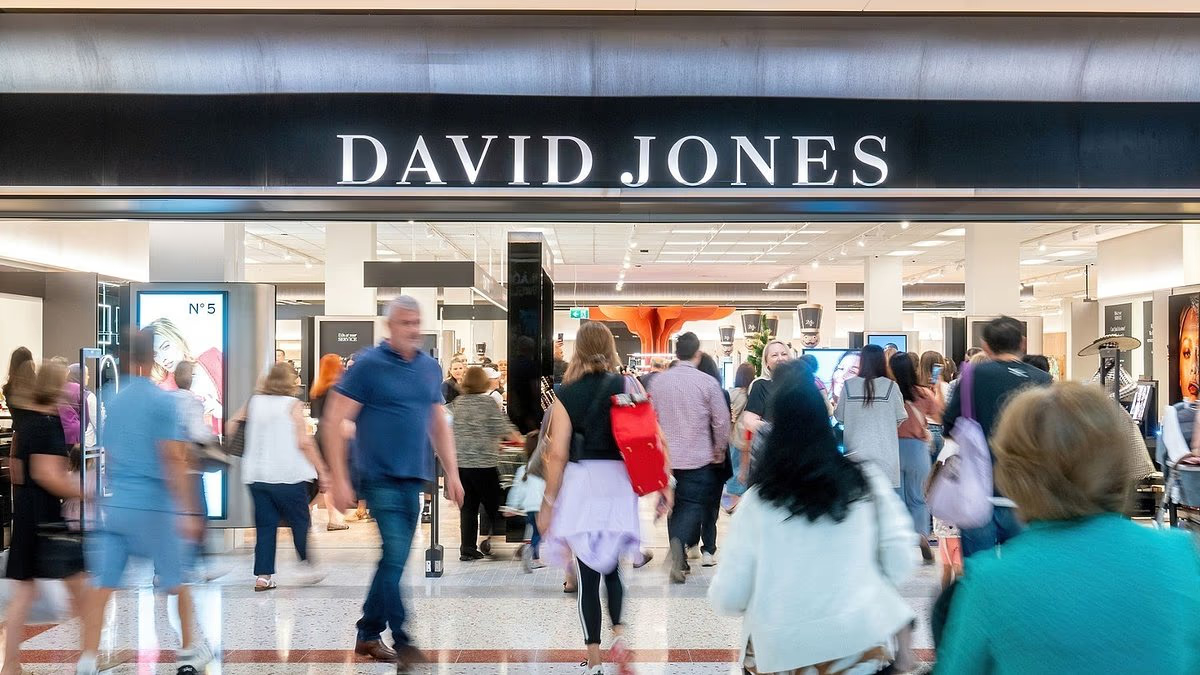

David Jones has announced the 19 stores it plans to close, putting thousands of jobs at potential risk.
The 188-year-old department store chain confirmed on Wednesday afternoon that locations across New South Wales, Victoria, Queensland, Western Australia, South Australia, the Australian Capital Territory and New Zealand would stop trading.
The retailer has not yet revealed when the individual stores will close.
In New South Wales, the affected outlets are at Macquarie Centre, Macarthur Square, Parramatta, Wollongong Central, Hornsby, Green Hills and Warringah Mall.
Victorian closures will include Malvern Central, Highpoint and Glen Waverley. In Queensland, the Robina Town Centre and Sunshine Plaza stores are also set to shut.
Western Australia will lose its David Jones outlets at Hay Street Mall, Carousel and Garden City.
The South Australian stores at West Lakes and Marion are among those earmarked for closure, while the Woden outlet in the ACT will also cease operations.
In New Zealand, the chain’s Newmarket store in Auckland is likewise expected to close.

The 188-year-old retailer entered voluntary administration and receivership last week
Have your say
What does the collapse of David Jones mean for the future of shopping in Australia?
David Jones was placed into voluntary administration and receivership last week after it failed to pay rent to Scentre Group, the owner of Westfield.
The decision has raised serious questions about the future of the retailer’s 6,000 employees.
Insolvency specialist McGrathNicol is acting as administrator, while FTI Consulting has been appointed receiver.
Retail analysts have advised customers to redeem David Jones gift cards as soon as possible amid uncertainty surrounding the closures.
David Jones chief executive Erica Berchtold said last week that the company had developed a detailed strategy to rebuild the business.
“David Jones is an iconic company, and so many Australians have stories and memories of visiting DJ’s stores. I thank our customers, team members and partners for their continued support during this period,” she said.
Established in Sydney in 1838, David Jones is widely recognised as the world’s oldest continuously operating department store trading under its original name.
South Africa’s Woolworths Holdings acquired the chain for approximately $2.1 billion in 2014. The company later sold the operating business to Anchorage Capital Partners for $100 million in 2023.
Retail analyst Barry Urquhart expects struggling suburban branches to face the greatest pressure, while major CBD stores in Sydney and Melbourne may have better prospects because of higher tourist numbers and stronger pedestrian traffic.
He told Our News Outlet that David Jones had been unable to secure a buyer despite spending more than three years reportedly seeking one.
“There has been no sign of anyone wanting to buy it over the past three years. Why would that change now?” he said.
Mr Urquhart said David Jones’ financial problems were part of a wider crisis affecting department stores around the world, with businesses including Macy’s, Saks Fifth Avenue and Bloomingdale’s facing similar challenges.
“When you run out of cash, you run out of time. When you run out of time, creditors push you out of business. That is essentially what is happening. They have a cash-flow problem,” he said.
He also cautioned shoppers against expecting the deep discounting often seen when a retailer collapses, saying David Jones needed to protect its remaining cash reserves.
“They need to generate surplus cash flow. They cannot do that through a huge discount or clearance sale,” he said.
Our News Outlet has contacted FTI Consulting for comment.


