
Share this @internewscast.com
The question of where exactly Jesus was crucified is sparking intense discussions once more, as Christians, scholars, and religious leaders find themselves at odds over the true location of Golgotha.
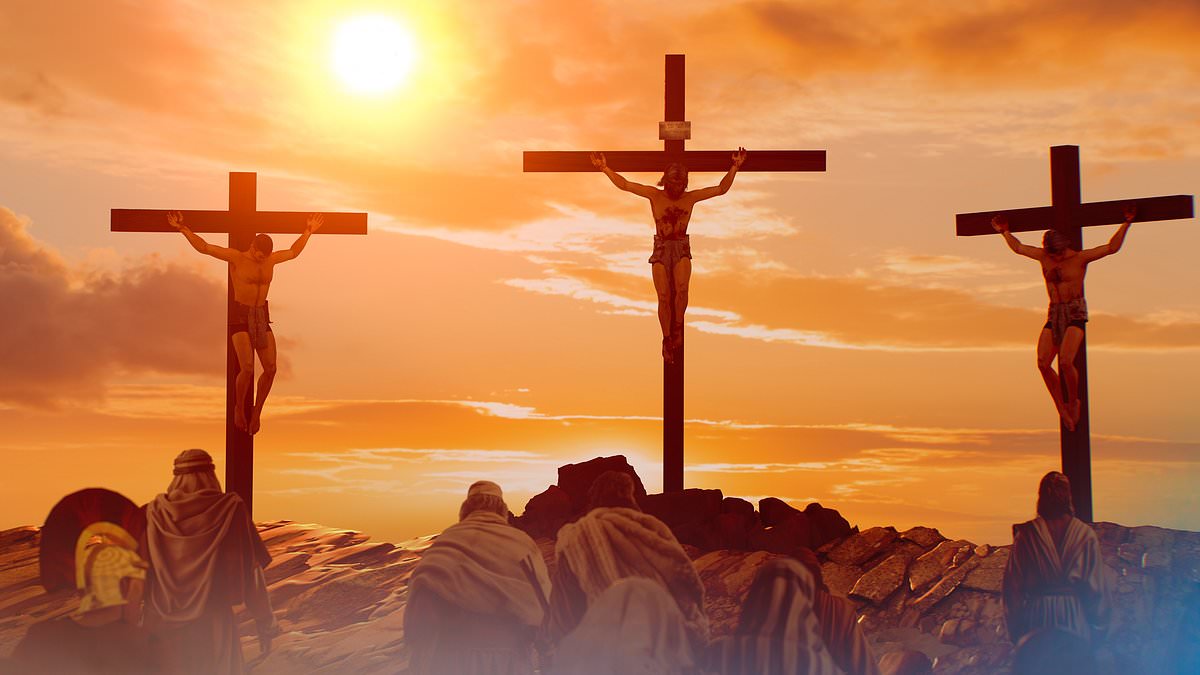
Golgotha, an Aramaic term meaning ‘Place of the Skull,’ is traditionally identified in the Bible as the site of Jesus’ crucifixion, situated outside Jerusalem.
Many hold the belief that the Church of the Holy Sepulchre stands directly above this historical site. This theory, which dates back to the 4th century, gained traction when Roman Emperor Constantine the Great initiated a quest to pinpoint Jesus’ place of death and burial.
Early Christian followers revered a specific spot, leading Constantine to erect a church there to commemorate its significance.
However, some contend that the crucifixion occurred on a hill located beyond the ancient city walls, citing topographical features they claim align more closely with biblical accounts.
Pastor Josh Howerton, who leads Lakepointe Church in Texas, recently promoted the hill theory during an episode of his podcast Live Free, saying: ‘The gospels tell us Jesus was taken outside the city walls to be crucified. This fits. It’s within walking distance.’
Proponents of this alternative site reference older photographs they assert depict a hill with a skull-like formation, complete with features resembling eye sockets and a nose.
He presented an image from the early 1990s that some viewers interpreted as skull-like, though he suggested erosion or possible seismic activity may have altered its appearance over time.
The claims quickly drew mixed reactions online, with many people defending the traditional belief that Golgotha is beneath the Church of the Holy Sepulchre.

Images of the hill outside of Jerusalem appeared to show features resembling a skull, including eye sockets and a nose

The hill near the Garden Tomb, however, looks different today due to decades of erosion, quarrying and urban development that have gradually altered the rock face
‘Golgotha is at the Church of the Holy Sepulchre. Historical and archaeological evidence confirms it,’ one commenter wrote in response to Howerton’s video.
Another wrote: ‘You forgot that the city walls moved out from where they were at the time of Christ’s crucifixion. The most likely location for Golgotha is the Church of the Holy Sepulcher.’
The Bible cites ‘Golgotha’ in several chapters, including in the books of Matthew and Mark, both of which state that Jesus was brought there to die, and the name means ‘the place of the skull.’
Howerton also included the biblical accounts of Jesus being taken outside the city.
Hebrews 13:12 reads: ‘And so Jesus also suffered outside the city gate to make the people holy through his own blood.’
While John 19:17 reads: ‘Carrying his own cross, he went out to the place of the Skull (which in Aramaic is called Golgotha).’
Supporters of the hill theory often cite the nearby Garden Tomb as well, a rock-cut burial site discovered in the 19th century just outside Jerusalem’s Damascus Gate, which they say strengthens the case for the alternative location.
The hill near the Garden Tomb, however, looks different today due to decades of erosion, quarrying and urban development that have gradually altered the rock face.

Supporters of the hill theory often cite the nearby Garden Tomb as well, a rock-cut burial site discovered in the 19th century just outside Jerusalem’s Damascus Gate, which they say strengthens the case for the alternative location

Some believe the Church of the Holy Sepulchre was built directly above the site, a theory dating back to the 4th century, when Roman Emperor Constantine the Great ordered a search for the location of Jesus’ death and burial
Historic photographs from the late 19th and early 20th centuries show more defined features that some believed resembled a skull, but modern construction, roadwork and natural weathering have softened those formations over time.
However, most archaeologists and historians consider the Garden Tomb to be an Iron Age tomb, between the seventh and eighth centuries BC, which is too old to be the actual burial place of Jesus.
Support for the hill theory dates back to the mid-1800s, when German theologian Otto Thenius first proposed that a skull-shaped ridge north of Jerusalem could be the biblical Golgotha.
The idea gained wider attention in the late nineteenth century when British officer Major General Charles Gordon visited the site and argued that the rocky hill resembled a human skull, leading many to refer to it as Gordon’s Calvary.
Other early researchers, including British surveyor Claude R Conder and biblical scholar Henry Baker Tristram, supported the location because it lay outside the ancient city walls, matching Gospel descriptions that Jesus was crucified beyond Jerusalem’s boundaries.
Many historians and archaeologists continue to support the traditional belief that Jesus was crucified at the site now marked by the Church of the Holy Sepulchre in Jerusalem’s Old City.

Pastor Josh Howerton (right), who leads Lakepointe Church in Texas , recently promoted the hill theory during an episode of his podcast Live Free , saying: The gospels tell us Jesus was taken outside the city walls to be crucified. This fits’

The claims quickly drew mixed reactions online, with many people defending the traditional belief that Golgotha is beneath the Church of the Holy Sepulchre
That theory dates back to the 4th century, when Roman Emperor Constantine the Great ordered a search for the location of Jesus’ crucifixion and burial after converting to Christianity.
Early Christians in Jerusalem identified the site as Golgotha, prompting Constantine to construct a church there, establishing what became one of the oldest continuously recognized holy sites in Christianity.
Modern archaeological research has reinforced the traditional view, with scholars such as Israeli archaeologist Dan Bahat noting that the area surrounding the church was once a quarry located outside Jerusalem’s city walls during the time of Jesus, consistent with biblical descriptions.
Historian Joan E Taylor, who reexamined historical and archaeological evidence in a widely cited 1998 study, concluded that the general area of the Church of the Holy Sepulchre remains the most plausible location for the crucifixion, despite ongoing debate.
A more recent discovery in 2025 uncovered remnants of an ancient garden beneath the foundation of the church, which aligns with the Gospel of John.
John 19:41 reads: ‘Now in the place where he was crucified, there was a garden; and in the garden a new sepulcher, wherein was never man yet laid. There laid they Jesus.’
A team from Sapienza University of Rome analyzed plant remains from the site and dated them to the pre-Christian era, placing them around the time of Jesus’ crucifixion and burial. Historians generally date his death to around 33 AD.