
Recent analysis reveals that immigrants are nearly three times more likely to engage in criminal activity compared to native citizens, sparking intense discussions about what some call a ‘cultural phenomenon.’
This revelation came from data issued by the Danish government, which has increased pressure on the Labour Party to release similar data in the UK. The Conservative Party has urged Keir Starmer to provide transparency to the British public regarding this issue.
In an attempt to address public dissatisfaction over the lack of clarity on crime rates among immigrants, Labour pledged last April to release official rankings identifying nationalities with the highest crime involvement.
However, these statistics have not yet been disclosed, leading to criticism that Labour is intentionally delaying the release, potentially hoping the public interest will diminish over time.
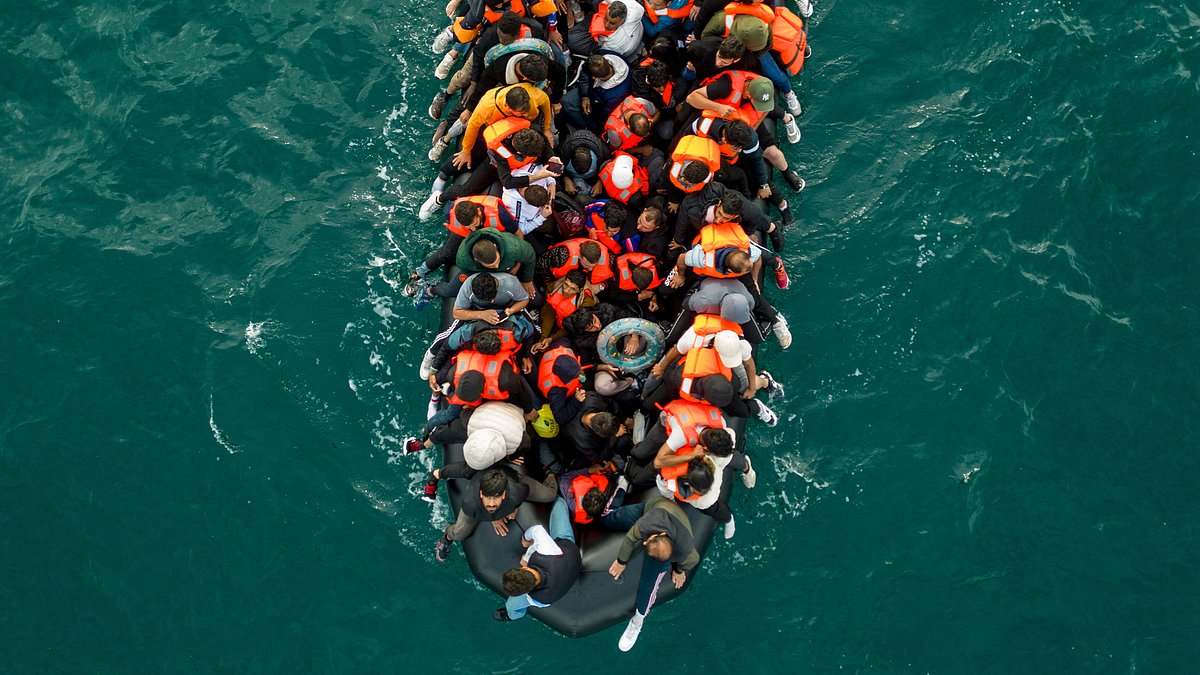
An inflatable dinghy pictured carrying migrants makes its way towards England
In Denmark, which has consistently released similar data for the past 25 years, men born in Lebanon had an age-adjusted crime index of 265 in 2024.
This indicates that, relative to Denmark’s entire male population, men from Lebanon were 2.65 times more likely to have been convicted of a crime.
Their descendants, which include people born in Denmark but where neither parent is both a Danish citizen and born in Denmark, had an even higher score of 386.
Similarly high figures were seen for men born in Somalia and Iraq.
In comparison, Danish males had an index score of 92 – below the baseline of 100.
The age-adjusted crime index score is calculated using the proportion of the population who have received a conviction during the year at each age bracket.
Danish officials use these age-adjusted statistics to account for the fact that some countries have relatively more people in the younger age groups than in the entire population.
This makes the comparison fairer, statisticians say, because younger age groups are statistically more likely to commit crime.
Out of the 31 countries in Denmark’s nationality crime table, Danes ranked 17th when included. A slew of nations from the Middle East and Africa took most of the top spots.
Danish politicians claim the differing rates are because those immigrant groups don’t have the same ‘societal standards’ as they do.
Experts say the league table of criminality has bolstered public support in Denmark for governments across the political spectrum to adopt policies to reduce migration from problem countries.
Denmark, usually seen as Left-wing due to its high taxes, has become known in recent years for its hard-line tactics to clamp down on problems of integration, such as banning the burka and a law to prevent ghettos.
Conservative MP Neil O’Brien said: ‘You can see that people from some countries are much more likely to commit crimes than others, and that all groups of migrants are not the same.
An overhead view of the Sjaelsmark deportation centre for illegal migrants in Denmark
A Danish police officer walks through a temporary immigration detention centre in the country

Denmark banned the wearing of niqabs (pictured) and burkas in 2018 following security incidents
‘There is no good reason for the government to be withholding this data – which they definitely hold, but are refusing to publish.
‘If their idea is that by withholding the data they can stop the public being worried about this then I think they are making a massive mistake.
‘Actually, sunlight is the best disinfectant and being honest with the public about what’s going on is the best way to get to a sensible debate.’
Lars Højsgaard Andersen, a research professor in criminology at the Rockwool Foundation research institute in Denmark, said the data ‘shows pretty much what I would expect’.
He added: ‘People from specific types of backgrounds tend to have much higher conviction rates than natives.’
Meanwhile, Britain’s data black hole means there are no such figures available. This has led researchers to try to fill the gap by cobbling together what exists in an attempt to uncover the truth.
For instance, the Centre for Migration Control reported that Afghan nationals are 22 times more likely to be convicted of sex offences than British nationals.
The Oxford Migration Observatory, the UK’s most-respected organisation studying the topic, found the rate was more likely to be 14.5. A Sky News investigation found the rate was much lower.
Despite the muddle in the UK figures, academics at the institute nevertheless state there is a ‘substantial variation in incarceration by nationality’.
A previous investigation by the Daily Mail, powered by a combination of prison and Census data, found Albanians had the highest rate out of all nationalities – ten times higher than Brits.
Henrik Dahl, a member of the European Parliament for the Danish Liberal Alliance, told the Daily Mail the data played an important role in his country’s democracy.
He said: ‘For instance, you don’t want to grant too many permits to enter to individuals from problem countries.’
Steffen Larsen, a member of the Danish Parliament, also from that party, said: ‘It helps us monitor if that group assimilates and becomes part of Danish society in a positive manner.
‘Or it tells us how many of them we should deport once their homeland is safe.
‘It is an important metric, because that’s a metric that also makes sure that the ethnic population of Denmark actually have faith that the political system will make sure their home country is a safe place to be.’
Denmark was not immune to the consequences of thousands of foreigners settling in their lands after the 2015 Syrian refugee crisis.
But the country has since become known for its hostile environment to migrants, which has driven asylum applications down by almost 90 per cent over the past decade.
In 2024 they plummeted to just 2,333, while the UK total hit a record 108,138.
This has been carried out by a series of tough policies, such as confiscating items such as jewellery and watches from incoming migrants to help fund the cost of their stay.
It also banned the burka – the face and body-covering garment worn by devout Islamic women who’d been brought to the country by their husbands.
All newcomers and their children are also compelled to learn Danish or lose asylum-seeker benefits.
Successful asylum seekers can also lose Danish residency and be returned home if their country of origin is deemed ‘safe’, such as Syria after the recent fall of President Bashar al-Assad.
It was these successful policies which Home Secretary Shabana Mahmood drew inspiration from when she announced the most sweeping reforms to Britain’s asylum system in decades in November.
The plans make it so that refugee status will become temporary with regular reviews every 30 months, and refugees will be forced to wait 20 years for permanent settlement in the UK, up from five years currently.
Mr Dahl said the openness of the information means hidden scandals which take years to surface, like Britain’s grooming gang scandal, would have been ‘out in the open years ago’.
The wrongdoing only began to be slowly revealed in the early 2010s after investigative journalists began to notice a pattern of behaviour.
Although official reports into the scandal have since concluded that the majority of ‘known perpetrators were of Pakistani heritage’ in instances like the notorious Rotherham case, poor quality data makes it difficult to analyse nationwide.
Keir Starmer finally ordered a national inquiry into the scandal last summer after pressure from figures such as Elon Musk and Reform UK leader Nigel Farage.
Some believe that Labour have been dragging their feet over publishing the crime data because they are scared of being called racist.
In response to that, Mr Larsen said: ‘No, no, no, this is informed. It’s not racism. This is a cultural phenomenon. It’s social phenomenon, and we have to deal with it.’
David Green, the chief executive of the think tank Civitas, are now calling upon the government to use the migrant crime data to inform decision-making when it comes to migration.
He told the Daily Mail: ‘I have encountered immigrants who said that crime and corruption were so pervasive in their homeland that it was impossible to lead an honest life.
‘It is therefore wise for us to take into account the national culture that has shaped the personality of individuals who want to live here. Perhaps they want to escape it; perhaps they don’t.
‘The Danish figures suggest that some people are drawn here, not because their homeland is crime-ridden, but because they are criminals who want to move to a nation where the police are often ineffectual crime detectors, and where the judicial system often imposes feeble penalties.
‘Some of us worry that publishing the nationality of offenders will lead to automatic discrimination, but publication is not an excuse for blanket bans but rather it is relevant information necessary to make judgements about the likelihood that particular applicants will be good citizens.’
The calls for change come after Britain’s sharp increase in immigration over the past few years, peaking at a net migration of almost one million in 2023.
Meanwhile small boat arrivals in 2025 were the second highest on record at 41,000.
A government spokesperson said: ‘We recognise the importance of improving the availability of data on Foreign National Offenders and we will publish additional statistics in due course.
‘It is essential we have confidence in their quality to ensure they are accurate and reliable before doing so.
‘This government will not allow foreign criminals and illegal migrants to exploit our laws, which is why we are reforming human rights laws and replacing the broken appeals system, allowing us to scale up deportations.’
Under the Statistics Denmark methodology, an immigrant is a person who is born abroad, and where neither parent is both a Danish citizen and born in Denmark. A descendant is a person who is born in Denmark, and where neither parent is both a Danish citizen and born in Denmark. If at least one parent is born in Denmark and acquires Danish citizenship, the person will subsequently be registered as being of Danish origin.