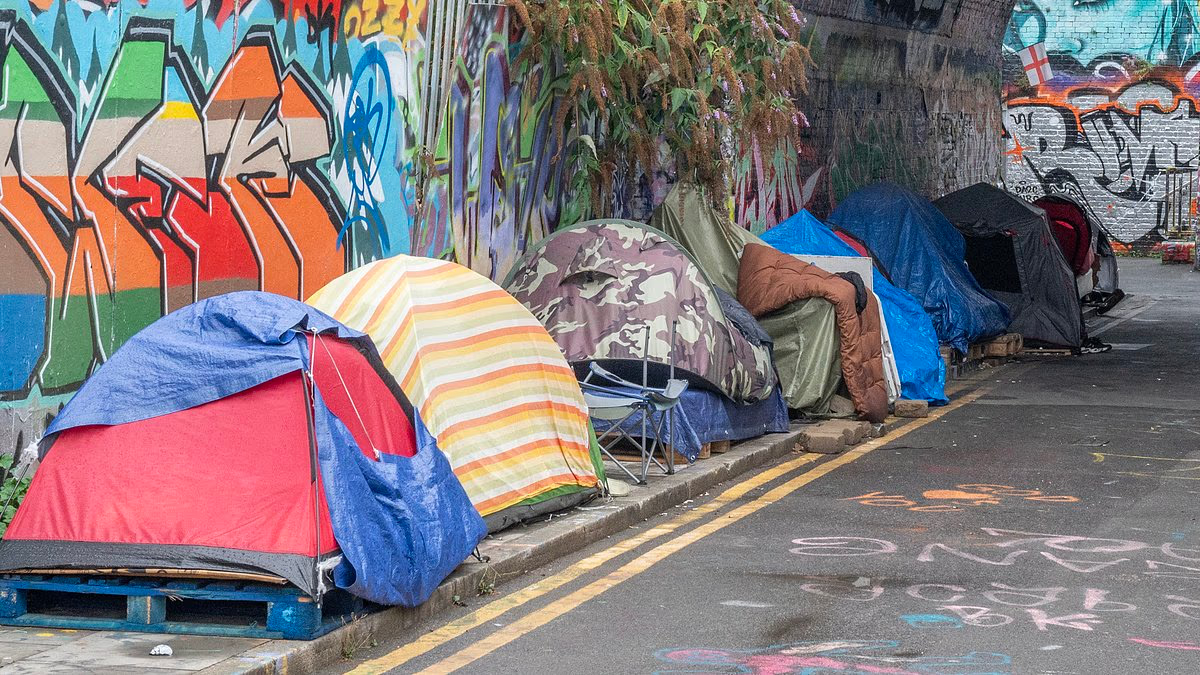

Hidden behind a cluster of coffee shops, tech start-ups and fashionable restaurants is an address few in London would willingly choose. It is not a house, nor even a flat, but a makeshift camp of tents beneath a graffiti-scarred bridge, wedged between two railway lines in Shoreditch.
Barely more than a mile from the City of London, this grim corner has a dark place in local lore. Historians believe Jack the Ripper may have used the area as a shortcut while he stalked nearby Whitechapel in the 1880s. Decades later, scenes from the horror film Omen III were filmed here.
When The Mail on Sunday arrived last week, even bright sunshine and a blue sky broken by soft clouds could not lift the sense of foreboding. In the shadow of gleaming banks and global investment firms, the scene felt almost post-apocalyptic. The question was unavoidable: who is living in this small shanty town, where rats scurry between discarded takeaway cartons and the smell is difficult to bear?
The answer is signalled by the distinctive turquoise delivery bags propped around the camp. Nearby bicycles, some partly concealed beneath tarpaulin, tell the rest of the story. The tents are occupied by homeless Deliveroo riders, along with other couriers who appear to be working for the delivery company Gopuff.
In the days of the Ripper, people living around this spot complained about the stench of fish offal — waste from markets including Billingsgate and Smithfield — as it fermented into fertiliser for the land. Today, residents complain instead of the sharp smell of urine, and at times something worse.
About a dozen men, most of them Sudanese migrants, now sleep here. They do what they can to make the place habitable. Basic facilities are scarce, but there is a stove for cooking and clothes are stored in an IKEA chest of drawers, pushed against the wall of the underpass in a strangely domestic touch.
Above one tent hangs a cross of St George, a visible sign, perhaps, that its occupant wants to show gratitude for the chance to build a new life in another country.
But daily life in the camp is harsh. For the food delivery riders living beneath the bridge, the greatest hardship is the absence of running water.

Tents line a street in Shoreditch, central London, where an encampment largely made up of Sudanese migrants has developed
And it should give their customers pause for thought too, with similar camps springing up across London and elsewhere. Not that most consumers give hygiene much, if any, consideration when summoning takeaways to their front door.
We watched the delivery riders come and go over two consecutive days last week. Slumped under the bridge, they sprang into action when alerted by an app to another job.
Brick Lane, with its plethora of restaurants, is only five minutes’ walk away so there is no shortage of work. Understandably, locals find their presence alarming.
‘It scares me witless down there,’ said Emma O’Donnell, 42. ‘Walking past those staring men feels like running the gauntlet. And it stinks.
‘I haven’t heard of any violence or threats, but my God it feels scary. It can’t be right, can it?’
That, indeed, is the question. Aside from all other concerns, just how are illegal migrants – as many in the Shoreditch camp seem to be – able to get work as self-employed riders when the food firms make it clear they must provide proof of their right to work when applying online?
Yesterday it was revealed that more than one in ten couriers stopped by police during an immigration crackdown were found to be working illegally. The week-long Operation Equalise last summer saw 151 riders arrested out of 1,482 checked by police. At least 17 were deported.
On its website Deliveroo tells would-be workers: ‘Your rider journey starts here!’ The folksy tone continues. ‘We’re so excited to have you join the fleet.’ It then says: ‘We’ll check your documents and complete a criminal record check. Then you’ll sign the rider agreement, order your kit and take to the road!’

Deliveroo’s website informs would-be delivery drivers that they will be subject to a complete criminal history check

Deliveroo food bags were found at the encampment. One of the migrants at the Shoreditch site on Fleet Street Hill said it was ‘common to use a friend’s account’ to get around checks
Asylum seekers are generally not allowed to take paid employment during the first 12 months of their claim or until it is approved.
What makes a mockery of the checks is the practice of ‘account renting’, in which those legally able to do so sign up to the delivery platforms then sublet their accounts.
One of the migrants we encountered at the Shoreditch site on Fleet Street Hill told us it was ‘common to use a friend’s account’.
Beyond offering a few general facts about their lives, most riders are unsurprisingly guarded. Some refuse to answer any questions at all. Locals put their reticence down to another reason. Drugs.
‘They sell drugs there, crack, and do it pretty openly,’ claimed one resident. ‘I’ve seen it myself. They come together in a cluster of bikes and do the deal. Sure, the bikes and the uniforms provide perfect cover.’
When The Mail on Sunday visited the camp on Wednesday afternoon, a heavily tattooed cyclist – who was not seemingly a migrant – was spotted briefly chatting to one of the Deliveroo riders, who tipped the bag fixed to his bike in the man’s direction, as if inviting him to take something from inside it.
Seconds later the cyclist threatened to punch our reporter – ‘I’ll spark you’, he warned – when he suspected their exchange had been filmed on a mobile phone. The cyclist demanded to examine the phone, but the reporter refused.
Others who use Fleet Street Hill as a shortcut say the riders are often ‘spaced out’ or seen ‘dancing without music’.

Residents living near the camp say they have seen people selling drugs and urinating in the streets

One of the riders threatened Our News Outlet’s reporter when he suspected he was being filmed
Peter Shannon, 62, said: ‘I don’t think people would be too pleased if they found out where their food is coming from. Most of these blokes are off their heads on crack. It’s difficult because you know they need somewhere to live, but the current set up is like some sort of slum.’
He added: ‘You see broken glass everywhere, things dumped and people urinating. It was a popular short cut to Cheshire Street. But a lot of folks walk around it now to avoid the madness. You’ve got people screaming there and all sorts, off their heads.’
A convenience store owner on Cheshire Street, which runs into Brick Lane, claimed the migrants ‘charge in here and help themselves. I’m pinned behind the counter so there’s nothing I can do.’
Another resident, a mother-of-two, said: ‘I avoid that area now for our safety. I also can’t bear the smell.
‘The men first appeared last year and were then taken away over Christmas and housed somewhere, but they always come back.
‘The council doesn’t seem to do anything about it long term.’
Earlier this month, Reform UK home affairs spokesman Zia Yusuf announced measures designed to crack down on illegal working, including criminal penalties for company directors and delivery platforms. He told the MoS: ‘Labour and Tory weakness allowed a migrant shanty town to rise in the middle of the capital.’
He said ‘the British people are done with a system that lets corporate bosses walk away scot-free while they enable the invasion of this country and the crime that inevitably comes with it’.
Mr Yusuf claims previous governments ‘created an ecosystem in which illegal migrants are funnelled directly into our national economy, driving down wages and funding the despicable people- smuggling gangs operating across the Channel’.
If Reform wins office, he said, it would make chief executives and directors of large companies personally and criminally liable for illegal working, under legislation he dubbed the ‘Deliveroo law’.
Under the plans, Reform said it would pay members of the public for tip-offs leading to successful prosecutions of shops employing illegal workers. Financial rewards under a ‘Turkish barber’s tip line’ would be paid from larger fines it would impose on companies using illegal employees.
The Home Office said it was already increasing penalties for companies hiring illegal workers, with a source within the department branding some of Reform’s proposals ‘empty posturing’.
Last year Deliveroo said it would strengthen security checks after the Government raised concerns following reports that Channel migrants were able to rent out other people’s accounts.
It said this included facial verification checks and fraud detection technology to ensure only registered account holders could work off their platforms. Existing laws mean employers who knowingly employ people without the right to work can face up to five years in prison. Certainly, the Shoreditch riders seem to find it easy to work, despite their immigration status.
One 28-year-old from Sudan told us: ‘It’s not a problem, we share accounts. It is easy. You can work when you want to, stop when you want to. I must make money otherwise what will I do?’
He added: ‘I came here for a better life. There is nothing for me at home. I came here two years ago. I lived in many places. Here [under the bridge], we are all together. It is better than some other places. What else should I do? I cannot get work another way.’
Another, Ibrahim Mohammed, 26, said he previously lived at the site for a year while working for Uber Eats. He said: ‘It’s hard living here. How are you going to take a shower, for example? The council doesn’t really help. I don’t have any family here. It was three years ago that I came to the UK. You will see a lot of people on the [delivery] bikes here.’
At 5pm on Thursday a rider in a Deliveroo jacket was seen unzipping and entering his tent after returning from a shift. Two others with Gopuff bags then left the site on e-bikes and headed towards Brick Lane.
Back at the camp, the remaining riders lay in the underpass, some changing outside their tents, others moving their branded bags out of sight of passers-by.
Occasionally charity workers arrive to hand out meals. ‘There is a human side to this that is overlooked by a lot of people. They are suffering and should be given better help,’ said another local.
When approached by the MoS, a Deliveroo spokesman said: ‘We are yet to receive evidence confirming these individuals have gained access to our platform illegally, but remain extremely concerned by these reports and are increasing monitoring efforts in the area to identify any signs of suspicious account activity.’
The spokesman added: ‘We take a zero tolerance approach to illegal working on the platform, and the organised criminal exploitation that is often behind it. We are in contact with the council to investigate further, and continue to work closely with the Home Office.’
These sentiments are echoed by Gopuff, which said it ‘takes right to work compliance extremely seriously and have zero tolerance for illegal working on our platform’.
A spokesman added: ‘All Gopuff account holders undergo a right-to-work check on registration.
‘And beginning on October 1, we are introducing facial verification technology for account holders and substitutes, in line with new Home Office requirements.’
Three miles north of the Shoreditch underpass, other migrant food delivery riders have set up camp in Stoke Newington’s Clissold Park, an area which has long been popular with young families.
Save for the decidedly more congenial surroundings, it’s a similar story there – a small cluster of tents and clothes, with Just Eat delivery bags strewn outside them.
Last week, an embarrassed warden, tasked with clearing the park before it closed at 8.30pm, was challenged by a local man who asked: ‘Why do we have to go, but they [the delivery riders] are allowed to stay?’
The warden sheepishly responded that ‘we will tell them to go’, before casting his gaze elsewhere.
‘Needless to say they didn’t have to go,’ said the man afterwards. ‘There you have it – that’s modern Britain in a nutshell.’