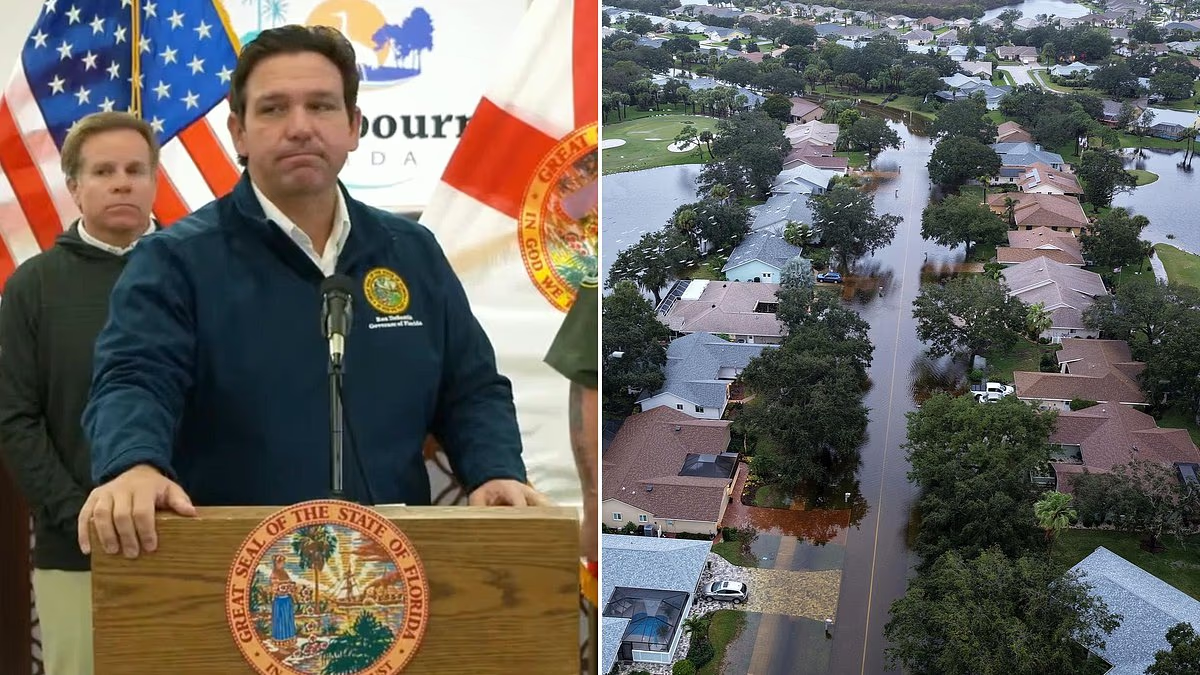

Florida Governor Ron DeSantis is preparing a second appeal for federal disaster assistance after the Sunshine State was struck by two historic flooding events in less than a month, with additional flooding threatening parts of the state this week.
State personnel have conducted nearly 500 rescues from floodwaters, entire neighborhoods have been submerged and thousands of emergency supplies have been distributed after some areas received as much as 20 inches of rain over the past week.
The latest crisis has developed before Florida received presidential approval for its first request for federal aid, which was submitted on November 9.
The danger is not over. Exceptionally high tides are threatening coastal communities from Palm Beach to Miami, while another storm could bring renewed flooding as early as Tuesday night.
Speaking at a news conference in West Melbourne on Monday, DeSantis said his administration was documenting the newest damage as it prepares another request for a Major Disaster Declaration.
‘We are going to get the data that FEMA requires for this second round of flooding,’ DeSantis said. ‘And we will be submitting another one to reflect what’s happened over the past week.’
The Republican governor said the application could be filed soon, once officials had gathered enough evidence of the damage for the Federal Emergency Management Agency (FEMA).
The consecutive floods have placed Florida’s emergency services under immense strain, mobilizing rescue crews, volunteers and government agencies to assist communities overwhelmed by rising water.

Florida Governor Ron DeSantis said he is preparing a second request for federal disaster aid after historic flooding struck the Sunshine State twice in quick succession

An aerial view shows the devastating extent of flooding across neighborhoods near Melbourne, Florida, earlier this month

A man and young girl use a kayak to travel along a submerged residential street in Hollywood, Florida, after torrential rain flooded communities earlier in November
The unrelenting rain has left some Floridians facing a second expensive cleanup within weeks, with little time to recover before another deluge hit.
In parts of South Florida, slow-moving storms delivered more than 17 inches of rain in less than a week, leaving residents to deal with extensive damage as forecasters warned that more severe weather could follow.
The National Weather Service warned that king tides could flood coastal areas on Wednesday and Thursday mornings. Exceptionally high water levels may continue for several hours on either side of high tide.
The weather service said a storm arriving Tuesday night could worsen conditions if it moves inland.
At the same time, the St. Johns River has risen to levels not recorded in more than 70 years.
The river has remained above flood stage near Cocoa since November 2 and last week broke a record that had stood since 1953.
Forecasters expect the river to stay at least two feet above flood stage, extending the threat to nearby communities even once the rain ends.
SEE ALSO: California Man Charged With Making Online Threats Against ICE Agents, DOJ Says
Figures released by Florida’s Division of Emergency Management highlight the scale of the state’s response.

Floodwaters surround a residential development in Hollywood as South Florida prepares for further coastal flooding from exceptionally high tides

A teenager wades past partially submerged vehicles after relentless rain turned neighborhood streets into waterways in Hollywood, Florida, on November 18

Residents in Hollywood, Florida, struggle through knee-deep water as the state faces another potentially costly recovery effort
Emergency crews have installed more than 10,000 feet of temporary barriers, known as Tiger Dams, to keep rising water away from critical infrastructure.
Two base camps have been set up for emergency responders, along with facilities for volunteers and two logistics centers overseeing relief operations.
Authorities have distributed more than 22,000 cases of drinking water, 7,500 ready-to-eat meals and 1,200 buckets filled with supplies to help residents clean flood-damaged homes.
Crews have also assisted with cleanup at more than 250 properties.
Four emergency resource centers, bringing together multiple government agencies, have helped more than 1,600 residents seeking assistance after the floods.
A Major Disaster Declaration could provide federal funding to help local governments pay recovery costs. Additional aid could also be available to residents whose homes were damaged or rendered uninhabitable.

A homeowner kayaks through a flooded yard to collect belongings from her home off Jungle Road in Geneva, Florida, on Friday after nearby Lake Harney rose following heavy rain

Florida Fish and Wildlife officers conduct welfare checks and assess conditions in Cocoa last Thursday

A dog swims beside a fence through deep floodwater in Geneva, Florida, underscoring the disaster’s impact on residents and their pets

Dramatic footage captured a tornado looming over homes in Boynton Beach as severe weather swept across South Florida on Saturday
DeSantis cautioned, however, that even if federal assistance is approved, homeowners should not assume Washington will cover all of their losses.
‘FEMA, if we get approved for individual assistance, they could get relief through that,’ the governor said.
Residents forced to leave their homes can also apply for temporary accommodation through Florida’s Emergency RV program.
The state initiative offers an alternative for eligible households that lack suitable housing while their properties are being repaired.


