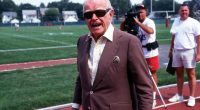
In the mid-90s, the Walt Disney Company dismissed Jeffrey Katzenberg, the executive who played a key role in revitalizing the studio’s declining success and initiating a new era of successful animation.
In doing so, they may have made one of the most costly errors in corporate Hollywood history.
Not only did Jeffrey, now 74, help establish DreamWorks SKG with Steven Spielberg and David Geffen, but under his guidance, the new studio quickly rose to become Disney’s biggest competitor in the animation field.
This was a development that few in the industry could have foreseen, yet Jeffrey’s progression from an insider at Disney to a rival influential figure transformed the landscape of contemporary entertainment.
Jeffrey’s film career began in 1974 when he joined Paramount Pictures as an assistant to the chairman, Barry Diller.
His work ethic and ambition quickly became apparent and after a short time, he was promoted to work directly under head of production Michael Eisner, according to the LA Times.
He became a trusted lieutenant and was soon overseeing major hits such as Saturday Night Fever, Grease and Beverly Hills Cop.
And when Eisner left Paramount in 1984 to become CEO of Disney, Jeffrey followed him, appointed to chair Walt Disney Studios during a time of significant decline.

Jeffrey Katzenburg (right), pictured with Roy Edward Disney (left) joined Disney when its animation unit was on the brink of collapse
At the time, Disney’s animation division was near collapse. Jeffrey immediately began reshaping the unit, scrapping underperforming projects and helping complete a handful of decently successful films.
But his real impact came with The Little Mermaid, the first film over which he had full creative control.
It became a massive box office hit and signalled the start of what is now known as the Disney Renaissance.
Under Jeffrey’s leadership, Disney produced a string of hits including Beauty and the Beast, Aladdin and The Lion King.
These films grossed billions of dollars, revitalised the company’s reputation and re-established animation as a dominant force in global cinema.
But Jeffrey’s influence extended beyond animation. He oversaw all of the studio’s filmed content, from motion pictures and television to home video distribution.
He also played a major role in launching Disney’s Touchstone Pictures and producing a string of adult-oriented comedies such as Good Morning, Vietnam, Dead Poets Society and Pretty Woman.
Under his influence, Disney rose from the bottom of the box office rankings to become the most successful studio in Hollywood by the late 1980s.

Brad Pitt pictured with Katzenburg for the failed DreamWorks production Sinbad: Legend Of The Seven Seas, which lost the company a reported $100million

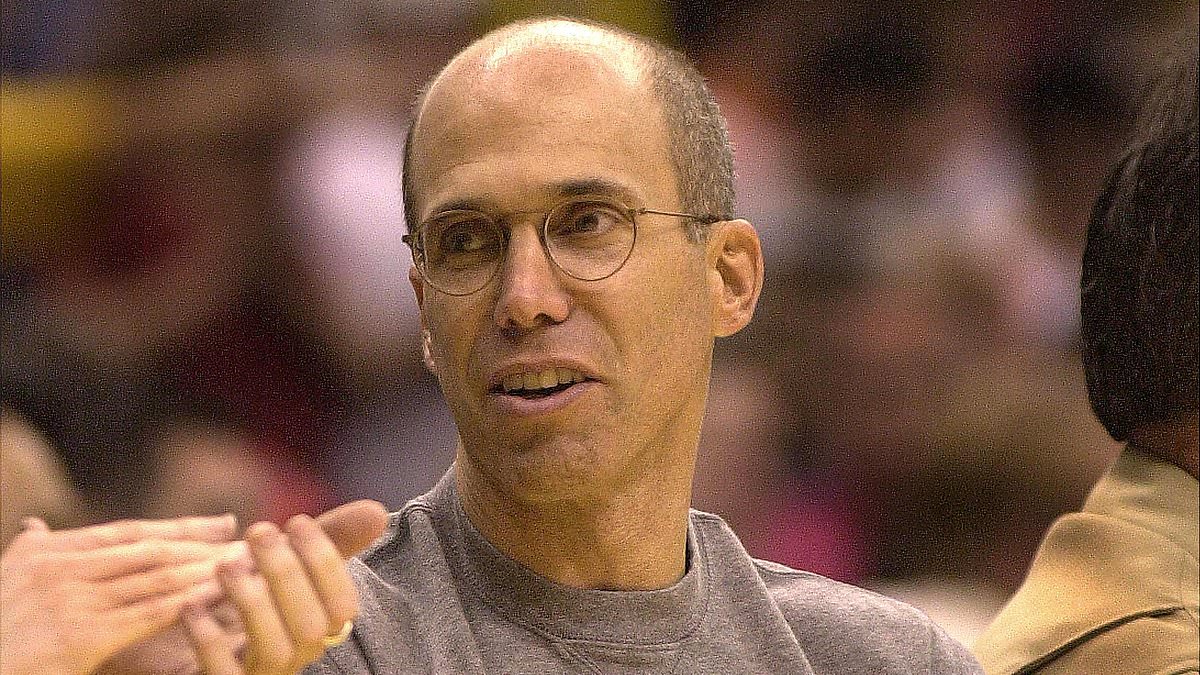
After Katzenburg (pictured in 2001) completely turned around Disney’s animation unit, earning billions, he apparently demanded more influence in the company

Jeffrey went on to create huge hits such as Shrek (pictured) and Madagascar
He co-launched Hollywood Pictures, oversaw the acquisition of Miramax and greenlit the historic partnership with Pixar, resulting in the production of Toy Story.
But even with these achievements, Jeffrey’s relationship with the company began to deteriorate.
He had always been a highly ambitious executive and, in 1993, he even sought promotion to company president.
But after the untimely death of then-president Frank Wells in a helicopter crash the following year, CEO Michael Eisner decided not to promote Jeffrey to the vacant role.
According to Jeffrey, Eisner had previously assured him the position would be his if it became available, he told The Hollywood Reporter.
Instead, Eisner stepped into the role himself, reportedly under pressure from Roy E. Disney, who had become uncomfortable with Jeffrey’s aggressive style and growing influence, the LA Times reported.
Jeffrey left the company in October, 1994, his contract completed but his departure laced with acrimony.
And shortly afterward, he filed a lawsuit against Disney, claiming he was owed bonuses and back pay. The case was ultimately settled out of court in 1999 for a reported $250million.

Jeffrey, pictured with actor Val Kilmer (L), left Disney in 1994 and filed a lawsuit against the company, which was settled out of court for a reported $250million
That same year, Jeffrey embarked on a new chapter in his career that would alter the animation industry once again.
With the encouragement of Steven Spielberg, Jeffrey co-founded DreamWorks SKG just two months after leaving Disney.
He was given primary responsibility for the studio’s animation division and began building it from scratch.
Initially, the studio experimented with both traditional and stop-motion animation, producing titles like The Prince of Egypt, Chicken Run and The Road to El Dorado.
But the major breakthrough came in 2001 with Shrek, a computer-animated satire of the traditional fairytale narratives Disney had popularised.
Shrek was not only a commercial hit but also a critical success, winning the first-ever Academy Award for Best Animated Feature.
Its humour appealed to both children and adults, establishing a groundbreaking new tone in family entertainment.
It also spawned a billion-dollar franchise, complete with sequels, merchandise and spin-offs that have endured for more than two decades, with the next Shrek film coming to cinemas at the end of 2026.

Jeffrey’s (R) career began when he joined Paramount in 1974, and was promoted to work directly under Head of Production Michael Eisner (L) (Pictured with actress Marie Osmond)
Ahead of his time, Jeffrey recognised early on that the future of animation lay in computer-generated imagery.
After the commercial failure of the traditionally animated Sinbad: Legend of the Seven Seas in 2003, which lost the company over $100million, he shifted DreamWorks entirely to CG animation.
This transition led to a series of hits including Madagascar, Kung Fu Panda and How to Train Your Dragon.
By the mid-2000s, DreamWorks had become Disney’s most serious competition in the animation market, both in terms of box office performance and cultural influence.
In 2016, Jeffrey sold DreamWorks Animation to NBCUniversal for a staggering $3.8billion, AWN reported.
He personally received an estimated $500million from the deal, bringing a lucrative end to a chapter that had begun with his being fired from Disney more than two decades earlier.
It appears Disney’s decision to remove him in 1994 was rooted in internal politics and personal rivalries.
Yet in doing so, the company created a competitor that would challenge its dominance for years.
In the story of Hollywood’s modern animation era, Jeffrey is a central figure not just for what he built, but for what he built after seemingly being told he was no longer needed.