
Share this @internewscast.com
Donald Trump hailed a significant achievement for global peace after successfully negotiating a last-minute cease-fire agreement, offering a promising solution to the ongoing conflict with Iran.
The breakthrough deal emerged following Trump’s ultimatum to Tehran to open the Strait of Hormuz, warning that failure to comply could result in catastrophic consequences for the region.
“A monumental day for World Peace!” Trump declared in an early morning post on Truth Social. “Iran is ready for change, and so is the rest of the world!”
Trump emphasized that reopening the Strait would usher in a new era of prosperity by restoring vital trade routes and addressing economic challenges.
“The United States will assist in managing the traffic through the Strait of Hormuz,” Trump stated. “Expect a surge of positive developments and substantial economic gains.”
While granting Iran a two-week period to finalize a peace agreement, Trump cautioned that the U.S. military would maintain its presence in the region during negotiations.
‘We’ll be loading up with supplies of all kinds, and just “hangin’ around” in order to make sure that everything goes well,’ Trump said.
The Iranians put forward a 10-point ceasefire plan that Trump called ‘workable basis on which to negotiate.’

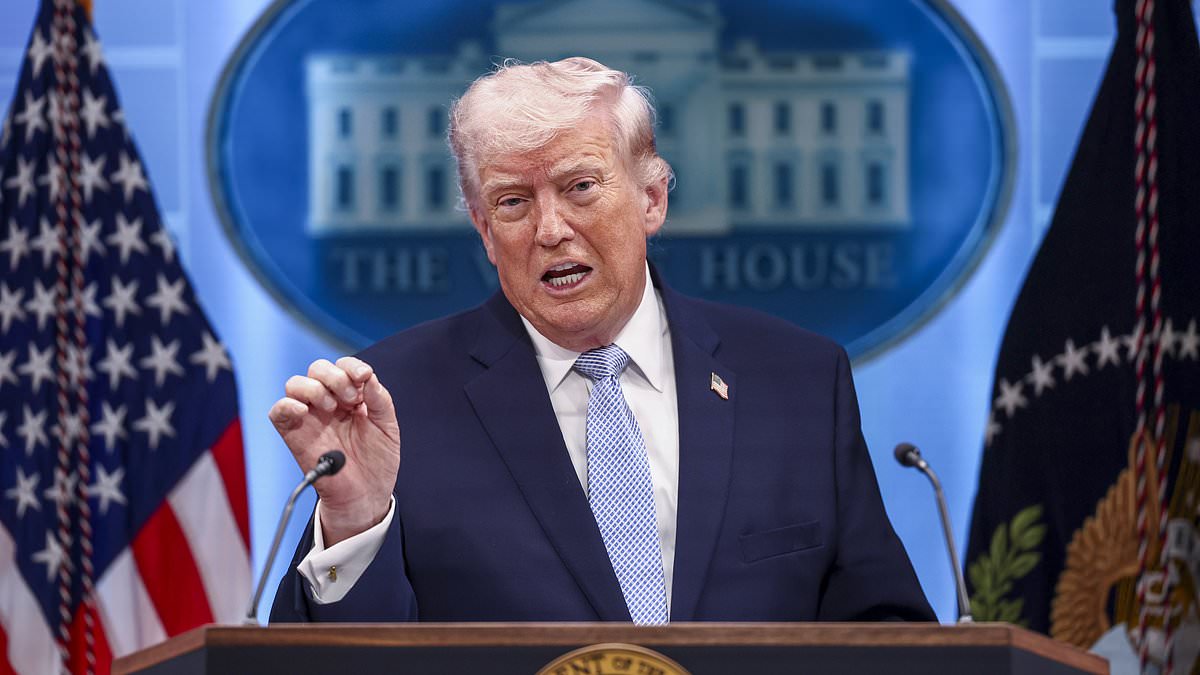
Donald Trump celebrated a ‘big day for World Peace!’ after an 11th hour cease fire deal that provided a ‘workable basis’ to end the conflict with Iran

Streaks of light illuminate the sky during an interception attempt as the conflict hit a ceasefire

The plan, published by the Iran Supreme National Supreme Council-backed Nour News, includes Iran continuing to control the Strait of Hormuz
The 10-point plan allows Iran to continue controlling the Strait of Hormuz, although Tehran said countries who did not threaten them militarily would be allowed to pass.
Other key points were removing sanctions, compensating Tehran for war damage and a ceasefire on all fronts, including Israel’s battle in Lebanon with Hezbollah.
One contentious proposal in the deal requested that Iran can enrich uranium for their nuclear program.
The phrase ‘acceptance of enrichment’ for its nuclear program, was included in the Farsi-language version of its ceasefire plan.
However, this was missing in English versions shared by Iranian diplomats to journalists.
It wasn’t immediately clear why that term was missing.
When asked about Iran enriching uranium last week, Trump told Reuters he wasn’t concerned about the prospect.
‘That’s so far underground, I don’t care about that. We’ll always be watching it by satellite,’ Trump said.


In a statement Wednesday morning, Israeli Prime Minister Benjamin Netanyahu’s office said it supports Trump’s decision to suspend strikes against Iran for two weeks, but that it doesn’t include the war with Hezbollah in Lebanon

South Carolina Senator Lindsey Graham, one of the most fiery backers of the war efforts, was concerned that it appeared Trump had accepted Iran’s demands

Some of Trump’s key allies – including South Carolina Senator Lindsey Graham – expressed concerns about the peace plan.
‘As to an Iranian ten point proposal to end the war, I look forward to reviewing it at the appropriate time and its submission to Congress for a vote,’ Graham said.
Graham found the notion of Iran enriching uranium to be a non-starter.
‘Every ounce of the approximately 900 lbs. of highly enriched uranium has to be controlled by the U.S. and removed from Iran to prevent them in the future from having a dirty bomb or returning to the enrichment business,’ Graham stated.
Israeli Prime Minister Benjamin Netanyahu said the cease fire deal does not include Israel’s campaign in Southern Lebanon.
Multiple rallies were held across Iran in reaction to the deal but many were unhappy with the results.
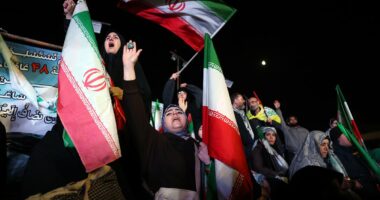
Pro-government demonstrators in the streets of Iran’s capital Wednesday morning after the ceasefire was announced screamed: ‘Death to America, death to Israel, death to compromisers!’
Organizers tried at one point to calm demonstrators, but they continued the chants.
They also burned American and Israeli flags in the street.

Pakistan’s Prime Minister Shehbaz Sharif (pictured right) helped negotiate the deal with Trump


People wave flags as they gather after a two-week ceasefire in the Iran war was announced

Smoke and flames rise at the site of airstrikes on an oil depot in Tehran
The protests showed ongoing anger from hard-liners, who had been preparing for what many assumed would be an apocalyptical battle with the US.
Iranian Foreign Minister Abbas Araghchi said passage through the strait would be allowed under Iranian military management.
It wasn’t immediately clear whether that meant Iran would completely loosen its chokehold on the waterway.
The plan allows for both Iran and Oman to charge fees on ships transiting through the strait, according to a regional official who spoke on condition of anonymity to discuss negotiations they were directly involved in.
The official said Iran would use the money it raised for reconstruction.
In addition to control of the strait, Iran’s demands for ending the war include withdrawal of US combat forces from the region, the lifting of sanctions and the release of its frozen assets.
Since the war began, Trump has repeatedly backed off deadlines just before they expire.
In doing so again Tuesday, Trump said in a social media post he had come to the decision ‘based on conversations’ with Pakistan Prime Minister Shehbaz Sharif and Gen. Asim Munir, Pakistan’s powerful army chief.

Pakistan’s Prime Minister Shehbaz Sharif (pictured right) helped negotiate the deal with Trump

Iran’s new supreme leader, Mojtaba Khamenei, reportedly signed off on the ceasefire deal, according to the New York Times
Sharif, in a post on X hours earlier, urged Trump to extend his deadline by two weeks to allow diplomacy to advance. He used the same post to ask Iran to open the strait for two weeks.
‘Almost all of the various points of past contention have been agreed to between the United States and Iran, but a two week period will allow the Agreement to be finalized and consummated,’ Trump said.
There are concerns in Israel about the agreement, according to a person familiar with the situation who spoke on condition of anonymity because they were not allowed to speak to the media. The person said Israel would like to achieve more.
Iran’s stockpile of highly enriched uranium is still buried at enrichment sites. The program had been one of the main issues cited by both Israel and the US in launching the war.
Things had looked dire in the days and hours leading up to the deal announcement by Trump.
On Monday, Trump expanded his threat against Iran to include all power plants and bridges as his ultimatum to make a deal ticked closer, after Tehran rejected a 45-day ceasefire proposal and said it wants a permanent end to the war.
‘The entire country can be taken out in one night, and that night might be tomorrow night,’ Trump said.
He suggested that his Tuesday 8pm deadline was final, saying he’d already given Iran enough extensions.

Iranian Foreign Minister Abbas Araghchi said passage through the strait would be allowed under Iranian military management
Even before the deadline expired, airstrikes had already hit two bridges and a train station.
American forces also struck military infrastructure on Kharg Island for the second time, a key hub for Iranian oil production.
Israel’s military warned of an increased risk of inbound attacks as Trump’s deadline approached.
Trump’s expansive threat did not seem to account for potential harm to civilians, prompting Democrats in Congress, some United Nations officials and scholars in military law to say such strikes would violate international law.
Tehran’s representative at the UN, Amir-Saeid Iravani, said the threats ‘constitute incitement to war crimes and potentially genocide’ and that Iran would ‘take immediate and proportionate reciprocal measures’ if Trump launches devastating strikes.
Trump had even been criticized by some conservatives, including former Fox News host Tucker Carlson.
Before the announcement, blasts were heard in the Qatari capital Doha, while the UAE said its air defenses were responding to missile threats.
The US and Israel have battered Iran with attacks targeting its military capabilities, leadership and nuclear program.
Iran has responded with a stream of strikes on Israel and Gulf Arab neighbors, causing regional chaos and outsized economic and political shock.
Late Tuesday, Pakistan’s prime minister urged Trump to extend his deadline by two weeks to allow diplomacy to advance.
In a post on X, Shehbaz Sharif, whose country has been leading negotiations, also asked Iran to open up for two weeks the Strait of Hormuz.
China, which is Tehran’s biggest trade partner, encouraged the Iranians to find a way to a ceasefire as talks progressed, according to two officials who were not authorized to comment publicly and spoke on condition of anonymity.
Before the deadline, airstrikes hit two bridges and a train station, and the U.S. hit military infrastructure on Kharg Island, a key hub for Iranian oil production.
While Iran cannot match the sophistication of U.S. and Israeli weaponry or their dominance in the air, its chokehold on the strait since the war began in late February is roiling the world economy and raising the pressure on Trump both at home and abroad to find a way out of the standoff.
US crude oil prices plunged after Trump’s announcement, with West Texas Intermediate contracts falling by more than 15 percent to $95 per barrel after hitting $116 earlier Tuesday.