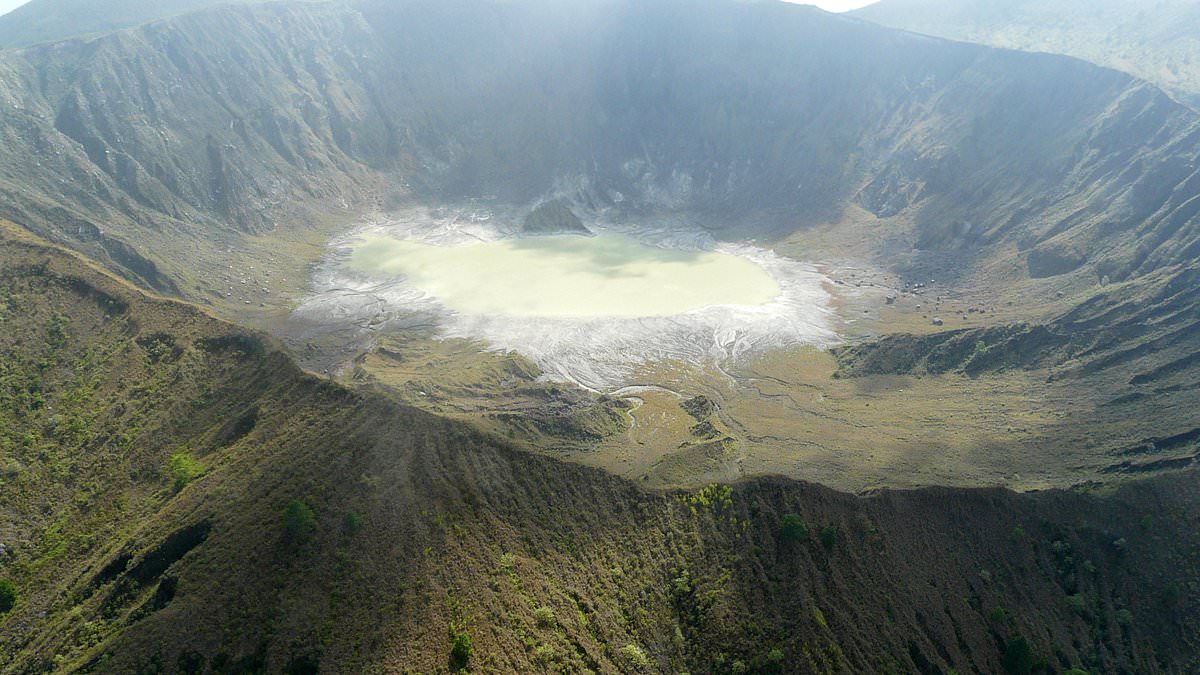

After remaining silent for over 40 years, a once-quiet volcano is stirring again, catching the attention of scientists who are monitoring its renewed activity with great interest.
Experts have noticed a rise in temperature, the emergence of bubbling gases, and the formation of unusual sulfur structures within Mexico’s El Chichón volcano, also referred to as Chichonal.
This activity was documented by researchers from the National Autonomous University of Mexico (UNAM) during their observations conducted between June and December 2025.
The volcano’s last eruption in 1982 was a catastrophic event, claiming the lives of at least 2,000 individuals, marking it as one of Mexico’s most lethal volcanic eruptions.
Scientists have reported increased heat levels, alterations in the chemistry of the crater lake, and emissions of gases like hydrogen sulfide and carbon dioxide, both of which pose significant risks at elevated concentrations.
Additionally, the formation of peculiar hollow sulfur spheres in the pools of liquid sulfur within the crater has been noted.
Despite the dramatic signs, experts say there is currently no evidence of magma movement beneath the volcano. Researchers stress the activity is likely hydrothermal and does not indicate an imminent eruption.
The new findings come from detailed fieldwork and remote monitoring conducted by UNAM’s Institute of Geophysics, which has been studying Chichonal’s internal dynamics for years.

Researchers have detected rising temperatures, bubbling gases and unusual sulfur formations inside Mexico’s El Chichón volcano, also known as Chichonal.
During recent inspections, scientists reported that the crater lake, normally green and dominated by algae, had turned grayish, suggesting elevated levels of sulfates and silica in the water.
Thermal measurements showed that temperatures in the lakebed and surrounding crater floor had risen higher than typical background levels.
The team also documented fluctuating chloride concentrations and changing gas-water interactions, signs that hot fluids are circulating beneath the surface.
Gas sampling revealed hydrogen sulfide (H₂S) and carbon dioxide (CO₂) accumulating near the crater, gases that can pose risks to humans and animals if they build up in enclosed or low-lying areas.
However, scientists emphasized that such emissions are common in active hydrothermal systems and do not necessarily signal an eruption.
Volcanologist Dr. Patricia Jácome Paz of UNAM explained that the unusual activity is most likely caused by superheated groundwater interacting with hot rock rather than molten magma rising toward the surface.
‘The observed behavior is consistent with hydrothermal processes or minor steam-driven explosions,’ she said in a recent lecture discussing the findings.
Seismic data collected in the region also show low levels of earthquake activity, further suggesting that magma is not currently moving beneath the volcano.

The volcano last erupted in 1982, killing at least 2,000 people in one of Mexico’s deadliest volcanic disasters
Chichonal has been restricted to visitors since its catastrophic 1982 eruption, but it has become a key research site for scientists studying how volcanoes evolve long after major explosive events.
The volcano’s crater lake and sulfur deposits provide rare opportunities to examine how heat and fluids reshape volcanic landscapes over time.
The memory of the 1982 disaster remains vivid in southern Mexico.
Beginning on March 28 of that year, Chichonal unleashed a series of powerful eruptions that continued into April, sending ash clouds high into the atmosphere and triggering deadly pyroclastic flows.
Entire villages were destroyed, agricultural land was buried under ash and debris, and thousands of residents were forced to flee.
The eruption devastated coffee farms, livestock, and infrastructure, causing long-term economic and environmental damage across the region.
Today, scientists say the current activity bears little resemblance to the conditions that preceded the 1982 eruption.
Still, they caution that volcanoes can remain dynamic for decades, even centuries, after a major event.
Subtle changes in temperature, gas emissions, and water chemistry can provide early clues about how a volcanic system is evolving underground.
To better track Chichonal’s behavior, researchers are using drones, satellite remote sensing, and on-site instruments to monitor thermal anomalies, gas plumes, and ground deformation.
Continuous monitoring is critical, scientists say, because volcanic systems can change rapidly, and early detection is key to public safety.
For now, experts say there is no cause for public alarm. But the renewed activity at Chichonal is a reminder that dormant volcanoes are rarely truly inactive, and that even decades of quiet can mask ongoing processes deep beneath the surface.


