Share this @internewscast.com
Katherine Bennell-Pegg has made history as the first Australian to qualify as an astronaut through the nation’s space program and has been honored as Australian of the Year.
At a ceremony held at the National Arboretum in Canberra on Sunday, three additional honorees were celebrated: Professor Henry Brodaty AO, recognized for his pioneering work in dementia treatment, was named Senior Australian of the Year; Nedd Brockmann, an ultra-marathon runner and passionate charity advocate, was awarded Young Australian of the Year; and Frank Mitchell, an Indigenous leader in the construction industry, was acknowledged as Australia’s Local Hero for 2026.
Mark Fraser AO CVO, CEO of the National Australia Day Council, praised the awardees as “visionaries.”
“Their aspirations and accomplishments extend well beyond personal gain. Instead, their efforts are aligned with achieving outcomes that benefit the broader community,” he remarked in a statement released to the press.
Discover more about these distinguished individuals below.
Bennell-Pegg shares that her ambition to become an astronaut was ignited at a young age.
From an early age, Bennell-Pegg says she dreamed of becoming an astronaut.
“When we had our careers counselling, they said, write down three different things you want to be. I wrote down one: astronaut,” she said in a recent interview.
In 2024, she completed basic astronaut training as one of six graduates trained by the European Astronaut Centre in Germany, becoming the first international participant to achieve this distinction.
She was selected from more than 22,500 applicants worldwide.
Now 41 years old, Bennell-Pegg is working as a space engineer and has contributed to the development of numerous space missions and innovative technologies.
For her, space is not about escaping the Earth, but helping to see it more clearly.
“Space is a high point in the sky from which we can see bushfires and floods and phenomena across our country. It’s how we look after our first responders by connecting them in remote regions. It’s how we guide our farmers’ farming equipment, how we ensure our national security, and how we unlock discoveries that can only be unlocked in space,” she said.
“It’s ‘pinch me’ stuff to be in this position, and I hope by being here and showing what’s possible, I can unlock that path for more to follow in the future. When I grew up, I was mesmerised by the tars above me, but they felt very far away. I was inspired by Australians that had been to space before.”
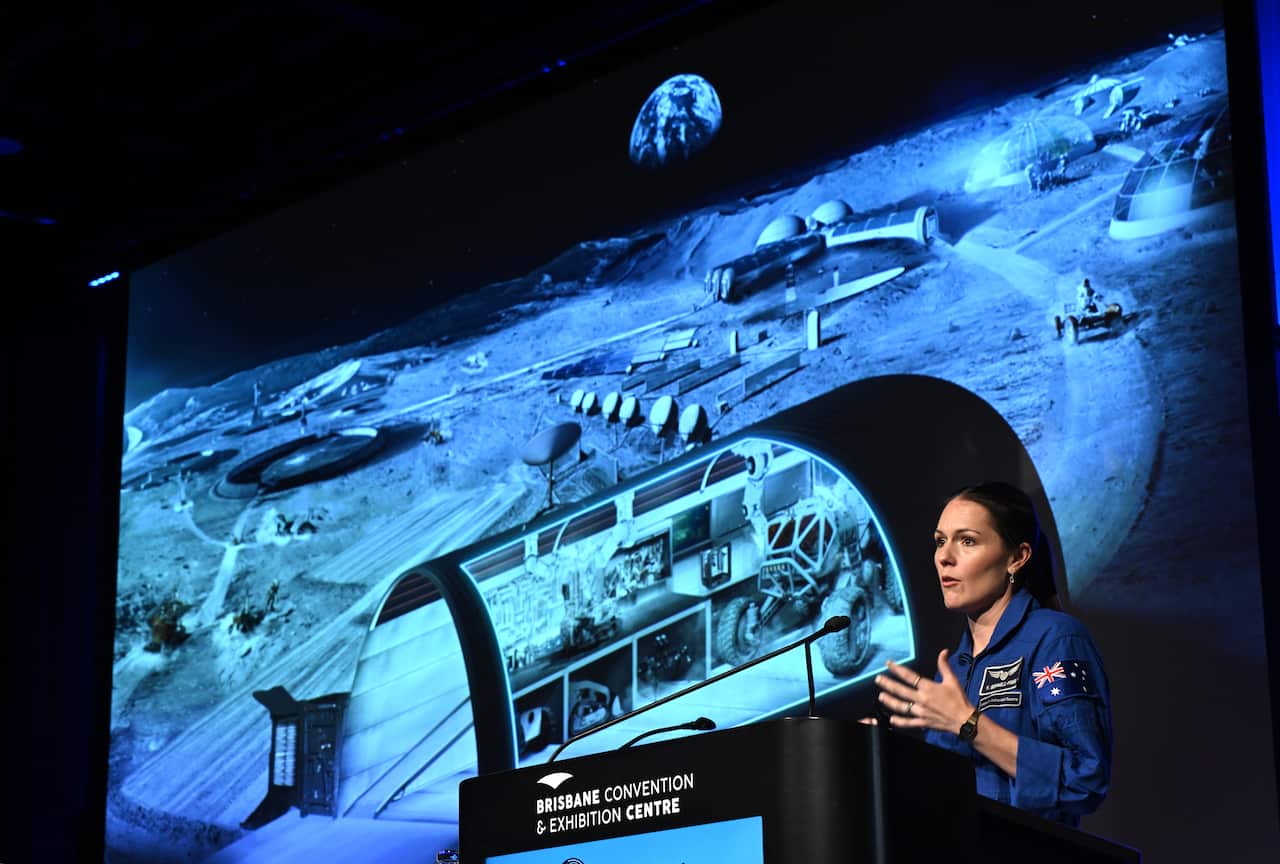
Beyond her professional accomplishments, Katherine Bennell-Pegg is a passionate advocate for Australia’s space sector, frequently speaking to school students and industry professionals to motivate the next generation and help foster new opportunities. Source: AAP / Darren England
Despite Bennell-Pegg’s long list of achievements, she says it’s “still just the beginning” for her.
“I’ve not been to space yet. I’m working to remain ready in case that opportunity should arise.”
Fraser said Bennell-Pegg’s work was “shaping the future not only in space, but in everyday life through the impact of research and development”.
“She leads by example, openly sharing her story to inspire the next generation and reminding us all of the power of a dream, and where determination can lead,” he said.
Speaking after her victory was announced, Bennell-Pegg said Australia was “leaving too much talent on the launch pad”.
“For Australia to be able to influence and to contribute to addressing the global issues of the next years, the next century, we need every curious mind engaged, regardless of gender, of background or of postcode,” she said.
“I’ve seen firsthand how space, when truly in reach, ignites powerful motivation to do just that.”
Senior Australian of the Year: Professor Henry Brodaty AO
Seventy-eight-year-old Professor Henry Brodaty AO has reshaped the diagnosis, treatment and prevention of dementia, enhancing the lives of countless people in Australia and across the globe.
In 1972, Brodaty’s father was diagnosed with Alzheimer’s disease at the age of 52.
At the time, dementia was poorly recognised and frequently overlooked. Individuals living with dementia, along with their carers, received minimal support and had few options for care or guidance.
His father’s experience sparked a lifelong commitment to improve the lives of people affected by dementia and their families.
In 2012, Brodaty co-founded UNSW’s Centre for Healthy Brain Ageing, from which he’s spearheaded internationally renowned research that has advanced global understanding of dementia risk and prevention.
At Sunday’s event, Brodaty dedicated his win “to all of us who are older, and all of us who hopefully will get older, and especially to those affected by dementia and their families.” He also mentioned his father, who he said had died with dementia aged 59, and his mother, who was his father’s carer in those years.
He also reiterated previous calls for Australia to implement a ‘slip, slop, slap’ type campaign for brain health.
“This needs to be a whole-of-life approach. The earlier we start, the better. So, is there hope for dementia? You bet.”
Fraser said Brodaty has “turned his personal experience into a lifelong commitment to improving outcomes for people living with dementia”.
“His work will benefit not just those affected today, but all of us in the future,” Fraser said.
Dementia has recently overtaken heart disease to become Australia’s leading cause of death, according to Australian Bureau of Statistics data released in November.
Young Australian of the Year: Nedd Brockmann
In 2022, 23-year-old electrician Ned Brockmann made international headlines by running from Perth to Sydney in 46 days — and raising over $2.6 million for people experiencing homelessness in the process.
Brockmann’s awareness of homelessness grew during his weekly trips to TAFE, where he regularly saw people sleeping rough along Sydney’s Eddy Avenue.
Determined to draw attention to homelessness, the marathon runner decided to take action.
His 3,952km run from Perth’s Cottlesloe Beach to Sydney’s Bondi Beach didn’t only raise millions for charity but also set an Australian record (although one that has since been broken).
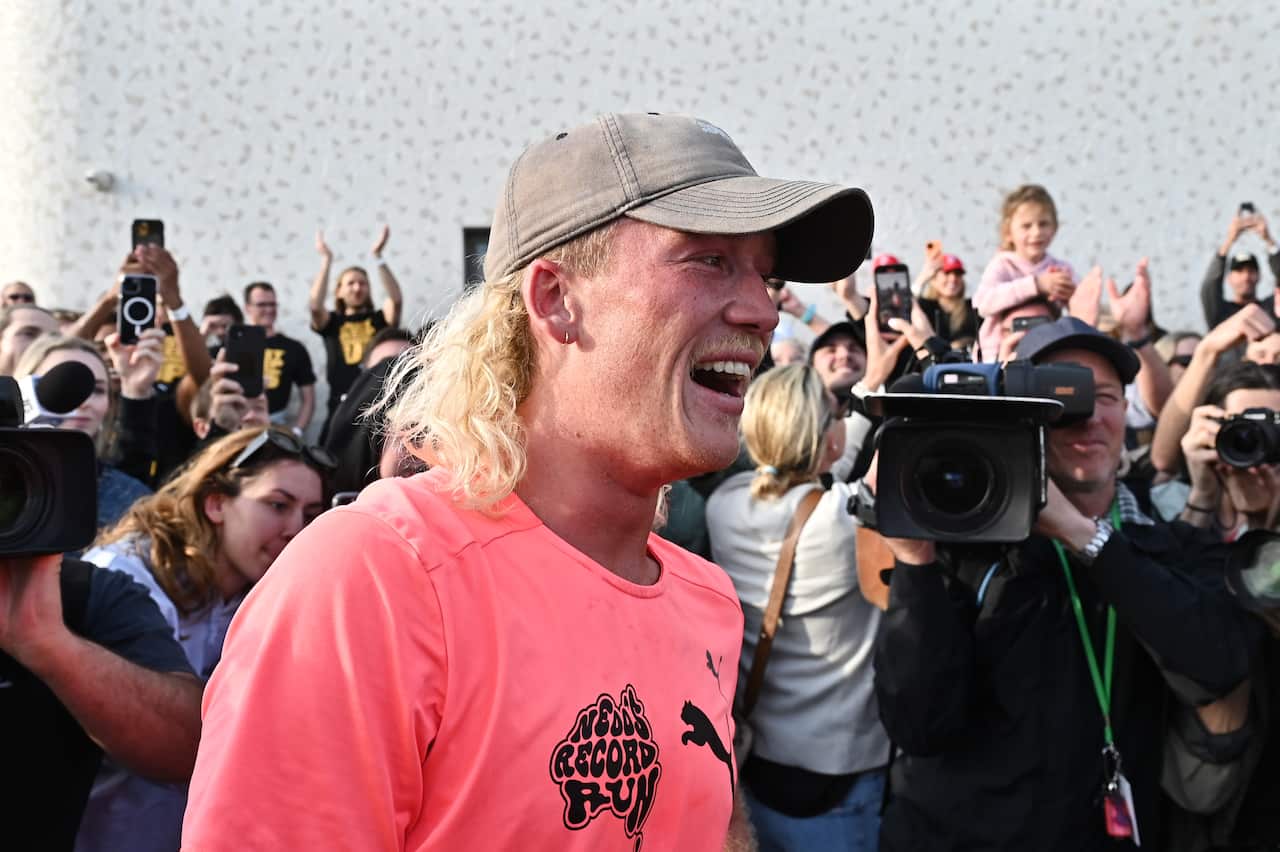
Nedd Brockmann raised over $2.6 million from over 37,000 individual contributors to his Australian-record-breaking run from Perth to Sydney in 2022. Source: AAP / Steven Saphore
In 2024, he launched Nedd’s Uncomfortable Challenge, a charity campaign through which participants choose their own “uncomfortable” physical or mental challenge to raise funds for those sleeping rough.
Together with his team, Brockmann has since raised more than $8 million for the cause.
Upon receiving the award on Sunday, Brockmann, now 27-years-old, said: “In a country as prosperous as Australia, why is it that 122,000 Australians sleep rough every night? That number should stop us all in our tracks.”
Fraser said that Brockmann had “chose[n] not to look away” from the scale of Australia’s homelessness crisis.
“Instead, he took action, and he hasn’t stopped since,” Fraser said.
“He continues to run for change, finding new ways to help end homelessness, and engaging others to join the fight along the way.”
Australia’s Local Hero for 2026: Frank Mitchell
Frank Mitchell has been recognised for his efforts to create opportunities for Aboriginal Australians in the trades and construction industry.
The 43-year-old Whadjuk-Yued Noongar man has said that, as a young single father, being offered an electrical experience was a profound opportunity.
“Having lost two friends to drugs and suicide in my teenage years, I was in a bit of a death spiral when I was in my early 20s, and two things happened over the course of the next five years that really I can look back on and attest to my life’s outcomes turning around,” he said recently.
He said one was the unplanned birth of his son when he was at the age of 21, which “really shook me to my core about recognising that I had to provide for this beautiful boy”.
The second was the opportunity to do an electrical apprenticeship.
“I really wasn’t feeling confident that I could achieve an electrical apprenticeship trade, but this one man believed in me, that was my uncle,” he said, adding that the experience had instilled in him a desire to “pay that forward”.
So, when he became a business owner in 2015, he set about creating such opportunities for other Aboriginal Australians.
Mitchell and his business partners have now created over 70 Aboriginal upskilling positionsand awarded over $11 million to Aboriginal subcontractors.
“For some people, opportunity and belief might be enough. For Aboriginal and Torres Strait Islander peoples, it’s more complex than that,” Mitchell said in his acceptance speech on Sunday night.
“We’re constantly navigating racism, stereotypes, and the ongoing impacts of colonisation. I used to advocate for organisations to simply give Mob a job. But I know now, opportunity alone is not enough.”
Fraser said Mitchel’s “approach to building an industry-led community that combines training, employment and culture is delivering stronger futures for people who need them most and demonstrates what can be achieved through collaboration and social inclusion,”
For the latest from SBS News, download our app and subscribe to our newsletter.