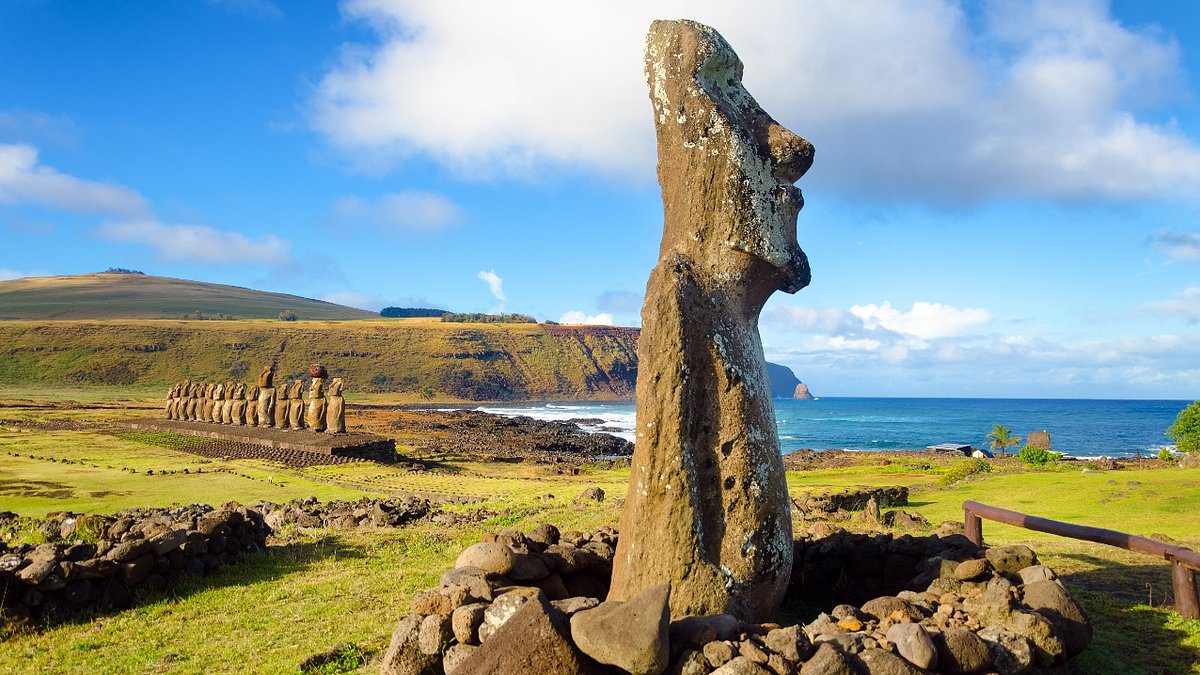

A new statue has emerged from the dirt of a recently dried-up lakebed on Easter Island, baffling scientists who said it should not be there.
Easter Island is considered a mystery due to its 1,000 large stone heads, known as moai, which are 700 to 1,000 years old.
Terry Hunt, an archaeology professor at the University of Arizona, shared with Good Morning America: “While we believed we knew all about the moai, discoveries of new ones still surprise us. Recently, we found a new statue in the lake at the quarry where these statues are originally crafted.”
‘There have been no moai found in the dry lakebed before, so this is a first.’
The newly discovered moai is among the smallest found, suggesting that many more could be hidden within the reeds.
Each moai is created to honor a significant individual, typically a leader, with many being adorned with eye stones at their final placement. The tallest of these statues reaches over 30 feet in height and weighs as much as 86 tons.
Salvador Atan Hito, the vice president of Ma’u Henua, which is the Indigenous group responsible for managing the island’s national park, expressed: “This discovery holds immense significance for the Rapa Nui community.”
‘Because it’s here in the lake and nobody knew it existed, even our ancestors, our grandparents didn’t know about this one.’

Situated in the southeastern Pacific Ocean, Easter Island was initially colonized by humans around AD 1200, who are known for creating the famous large head statues called moai.

Archaeologists uncovered another new statue in 2023 (pictured), which would found lying face-down
Hunt and Hito said the current dry conditions may help archaeologists discover more moai in the lakebed.
‘Under the dry conditions that we have now, we may find more,’ Hunt told GMA.
“The tall reeds that grow in the lake have concealed them from view. However, using technology that can detect underground objects might reveal additional moai hidden in the lakebed sediments,” explained an observer.
‘When there’s one moai in the lake, there’s probably more.’
Due to its remote location, Easter Island is traditionally assumed to have remained socially and culturally isolated from the wider Pacific world.
This assumption is further supported by the uniqueness of Easter Island’s renowned Moai statues, which are believed to have been constructed between AD 1250 and 1500.
For the past decade, Hunt and his colleagues and students have created an inventory of 981 moai on the island, complete with precise GPS locations and measurements.
Many moai remain in a quarry near Rano Raraku, the now-dry crater lake where the newest statue was found, in various stages of completion.

There’s no doubt Easter Island (pictured) in the southern Pacific is geographically one of the most isolated places on Earth

The Moai are monolithic human figures carved by the Rapa Nui people on Easter Island, between AD 1,250 and 1,500
The largest, called Te Tokanga or ‘The Giant’ in the Rapa Nui language, was never finished and lies on its back, measuring 63 feet long and weighing an estimated 90 to 100 tons.
The team made a similar discovery in 2023, finding another new moa that measured five feet by six inches long and was found face up in the ground.
Hunt said the statue’s eye sockets had been carved, which is historically the final step in a moai’s construction before display.
The base is also flat, rather than sloped, to help with moving the statue.
Researchers believed that the ancient Rapa Nui people likely moved the moai statues by ‘walking’ them upright using ropes to rock and pivot the statues forward in a controlled, rocking motion.
This method, supported by experiments and oral traditions, allowed them to move these massive statues across the island without dragging them on sleds or rollers.
Hunt frequently uses cell phones and drones for 3D imaging of the moai.
He is also exploring the use of ground-penetrating radar to detect hidden moai or structures underground, particularly in the Rano Raraku lakebed.
Historically, the original inhabitants, known as the Rapa Nui, were believed to have been completely shut off from the wider world.
However, a study released in July by researchers in Sweden challenged the long-held narrative.

Pictured, ahu (a central stone platform) on Mo’orea, Windward, French Polynesia, southern Pacific Ocean
They said the 63.2-square-mile island in the southern Pacific was not quite as isolated over the past 800 years as previously thought.
The island was populated with multiple waves of new inhabitants who bravely traversed the Pacific Ocean from west to east. ‘Easter Island was settled from central East Polynesia around AD 1200-1250,’ study author Professor Paul Wallin at Uppsala University told the Daily Mail.
‘The Polynesians were skilled sailors, so double canoes were used.’
For their study, the team at Uppsala University compared archaeological data and radiocarbon dates from settlements, ritual spaces and monuments across Polynesia, the collection of more than 1,000 islands in the Pacific Ocean.
The experts point out that ahu stone platforms were historically constructed at Polynesian islands further to the west.
These rectangular clearings were communal ritual spaces that, in some places, remain sacred to this day.
‘The temple grounds ahu [also known as marae] exist on all East Polynesian islands,’ Professor Wallin added.

Archaeologists believe they will uncover more statues in the future
The team agreed that an early population of people spread from the west of the Pacific to the east before encountering Easter Island and populating it around AD 1200.
They argued that Easter Island was populated several times by new seafarers, and not just once by a single group that remained isolated for centuries, as previously assumed.
‘The migration process from West Polynesian core areas such as Tonga and Samoa to East Polynesia is not disputed here,’ they say in their paper.
‘Still, the static west-to-east colonization and dispersal suggested for East Polynesia and the idea that Rapa Nui was only colonized once in the past and developed in isolation are challenged.’
Based on their evidence, they also think ahu originated on Easter Island before the trend spread east to west across other western Polynesian islands during the period of AD 1300-1600.
It was only after this that the Polynesian islands, including but not limited to Easter Island, might have become isolated from each other.