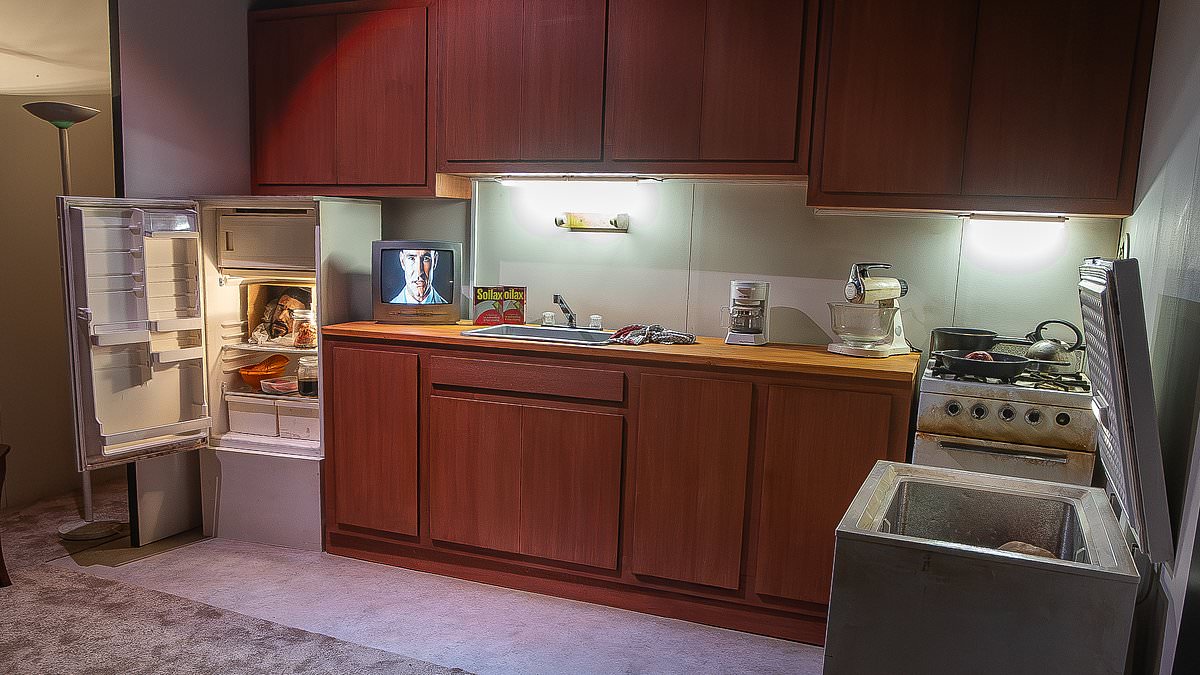

A piece of unidentified human organ sizzles ominously in a pan on the stove of a retro 1980s kitchen. Nearby, a large drum ominously labeled ‘toxic waste’ and ‘caution acid’ sits on the tiled floor, dissolving discarded flesh and body parts.
With some trepidation, I lift the lid of a chest freezer to reveal a human torso and various body parts frozen inside, meticulously dismembered and preserved for future consumption.
Turning my attention to the refrigerator, I open the door to be confronted by the unsettling sight of a man’s head on a shelf, surrounded by a chilling assortment of chilled Budweiser cans and severed human appendages.
I find myself inside the recreated lair of notorious serial killer Jeffrey Dahmer.
Or rather, a faithful replica within the new true crime exhibit, ‘Mind of a Serial Killer: The Exhibition,’ which has recently opened in Manhattan, New York.
Throughout a series of dimly-lit rooms, this immersive experience transports visitors into the haunting environments of 20 of history’s most infamous serial killers, showcasing replicas of their grim tools and reliving their twisted crimes.
Enter a chilling, foggy woodland scene where Ted Bundy has parked his VW Beetle, the passenger seat and inside door handle removed so that terrified, trapped women have no means of escaping his murderous desires.
Walk through the crawl space of John Wayne Gacy’s home littered with the skeletal remains of his victims as the killer clown’s haunting costumes loom out from the darkness.

A man’s head sits on a shelf of the refrigerator inside Jeffrey Dahmer’s replica apartment

A human torso and other dismembered body parts are frozen inside the chest freezer, waiting for consumption at a later date

Visitors to the new true crime exhibit ‘Mind of a Serial Killer: The Exhibition’ can step inside a model of Dahmer’s apartment

Between 1978 and 1991, Jeffrey Dahmer lured young boys and men to his home in a residential building in Milwaukee, Wisconsin, before drugging and strangling them
Step inside Ed Gein’s workshop where a woman’s bodysuit is pinned up on the walls, a nipple belt dangles from a shelf and bowls made out of human skulls sit on tables.
Inside Dahmer’s one-bedroom apartment visitors get a glimpse into the place where at least 17 victims met their tragic ends.
Between 1978 and 1991, Dahmer lured young boys and men to his home in a residential building in Milwaukee, Wisconsin, before drugging and strangling them.
In some cases, he performed lobotomies on victims, had sex with their corpses, or dismembered and ate their remains.
When police finally entered the apartment in 1991, they found a grisly scene of body parts, macabre photos of the victims’ final moments and the beginnings of a shrine made from skeletal remains.
Confronted by the worst of the worst in human nature, it’s little surprise that visitors to this new exhibit must be 18 years of age and must sign a waiver before entering, acknowledging that what they are about to experience might cause ‘emotional distress.’
But the exhibit is not just about reliving the horrors of the crimes in disturbingly realistic detail.
Instead, it aims to delve into the darkness of the serial killers’ minds.
John Zaller, the executive producer of Exhibition Hub who curated the Mind of a Serial Killer, believes that the enduring fascination with true crime and serial killers comes from this desire to understand how and why perpetrators end up this way.
Join the discussion
Does exploring the darkest minds in true crime exhibits help us understand evil or glorify it?

Serial killer John Wayne Gacy – who used to work as a clown at kids’ birthday parties – is seen in a mug shot in December 1978

The crawl space of John Wayne Gacy’s home was littered with the skeletal remains of his victims

A replica of Ed Gein’s workshop where a woman’s bodysuit is pinned up on the walls, a nipple belt dangles from a shelf and bowls made out of human skulls sit on tables
‘There’s a general introspection that humans want to explore. We want to know: what part of this darkness also lives inside me?’ he told the Daily Mail.
‘I think everybody’s got an instinct for annihilation within them. We could all make these choices ourselves on a daily basis but we don’t.
‘I think that’s why this subject is so fascinating to us because we’re talking about human beings who go way beyond the norms of society. And yet they start out as people just like us.
‘So how does somebody end up becoming the person who can perpetrate such horrific acts on others?’
Zaller said that the exhibition seeks to answer these very questions, unpacking the psychological drivers that motivate some people, mainly men, to become serial killers.
‘For most of us, we’re never going to live in that darkness, but we can peer beyond the threshold to try to comprehend what goes in these people’s minds,’ he said.
It’s something that the FBI’s Behavioral Science Unit has long tried to understand.
The exhibition begins inside a mock BSU investigation room from the early-1970s, with wooden desks, dial phones and typewriters harking back to the birth of criminal profiling.
It was in a room just like this where agents John Douglas and Robert Ressler first began tracking the patterns and signatures of repeat killers, trying to understand what drove them to kill – and kill again.

Ted Bundy confessed to killing at least 30 victims – but the true extent of his crimes will likely never be known

In one room of the exhibition, visitors can see a replica of Ted Bundy’s VW Beetle, with the passenger seat and inside door handle removed

The exhibition also features a mock FBI investigation room, harking back to the birth of criminal profiling and behavioral analysis
The thinking was that by understanding serial killers, law enforcement could better identify and catch them.
More than half a century later, the FBI has just enlisted its newest recruit, Gilgo Beach serial killer Rex Heuermann who has now agreed to work with the behavioral analysts to gain insights into his motivations and behaviors.
Heuermann’s mugshot looms above visitors as they enter the exhibit – serving as an instant reminder that these serial killers are far from myths and phantoms of the past.
They are fathers, husbands, businessmen, neighbors, guys next door, even the New Yorkers walking past you in the street.
In fact, Heuermann’s Midtown Manhattan office is just over 20 blocks from the site of the exhibition.
It was there that the Long Island architect was finally arrested on leaving work one day in July 2023.
Three years on and just one week before the exhibition opened, Heuermann finally pleaded guilty to murdering seven women and admitted to the murder of an eighth.
‘These people are very much part of our society, and many of them have the ability to operate in our society,’ Zaller said.
‘These actors move through the world, not as members of society, but as predators looking for targets.
‘One of the most chilling things is that we have no idea how vulnerable we are. This exhibit is not meant to make you feel comfortable.’
Zaller hopes that the exhibition doesn’t just shock and scare visitors but also educates through a safe lens.

Rex Heuermann’s mugshot looms above visitors as they enter the exhibit – serving as an instant reminder that these serial killers are far from myths and phantoms of the past

Rex Heuermann appears to smirk as he pleads guilty to murdering seven women and admits to killing an eighth in a court hearing earlier this month
At one point, visitors have the opportunity to don a VR headset and experience being an investigator hot on the heels of a serial killer and in a race against time to rescue two victims before it’s too late.
And, at the end of the exhibit, a mirrored room filled with candles offers a rare moment of calm and reflection on the lives lost to these perpetrators.
‘I wanted to focus on the victims too because in this advent of true crime, everybody knows the serial killer’s name but nobody remembers the victims,’ Zaller said.
‘They lost their lives and their families’ lives were ruined forever by these people that some folks now want to idolize.’
For all the shock factor of standing surrounded by the blood, gore and torture tools of the most prolific serial killers known to man, the exhibition hammers home a more terrifying reality: that the biggest thing to fear is the human mind itself.
As Zaller said: ‘I want to take you down below the surface into the darkness of these people but also bring you back into the light in the end.’