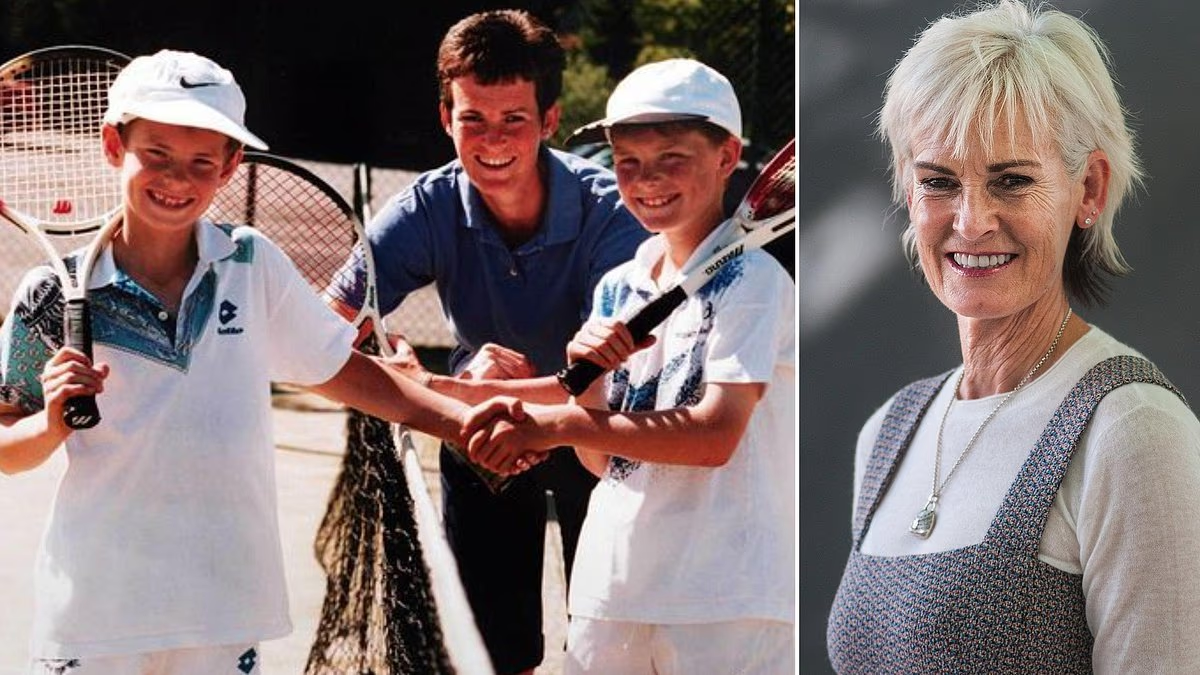

Judy Murray understands better than most the extraordinary commitment required to help produce sporting champions.
Yet she has admitted that, knowing what she knows now, she might not have urged her sons to pursue elite tennis.
The 67-year-old, who appeared on Strictly Come Dancing with Anton Du Beke, made the comments while chairing a discussion about the future of women’s and girls’ sport at St George’s School in Edinburgh.
As the panel considered the role parents play in encouraging children to take part in sport, Murray joked about her sons Andy and Jamie: ‘I know all about the parent thing, and let’s just say I’m not doing it with my grandchildren.
‘I was telling someone the other day that if I had known then what I know now, I probably wouldn’t have done it.
‘But there you go—you can’t really get anywhere without your parents. I think that, particularly when children take up an individual sport, so much responsibility falls on the parents to make everything happen, pay for it and spend all that time waiting around.
‘If your child is good at a team sport, the club can usually take care of the fixtures, training, kit and so on. You still have the driving back and forth and, of course, watching, but it is a very different experience—and the costs are different too.’

Judy Murray raised concerns about the decline of sport in state schools

Murray said she might not have encouraged Andy and Jamie to pursue elite sport if she had known then what she knows now

Murray was speaking at a Fearless Women in Sport event
Murray shared the stage with Olympic medallist Eilidh Doyle and other speakers at the Fearless Women in Sport event, held during this year’s Scottish Women and Girls in Sport Week.
The tennis coach also warned about the deterioration of sport in state schools, saying the growing use of technology was contributing to increasingly sedentary lifestyles among children.
She said: ‘My kids tried everything except skiing, and even now they sometimes remind me that they never got the chance to try it. There weren’t any mountains in Dunblane.’
Murray said her tennis-star sons eventually made the sport their priority during their teenage years after sampling a variety of activities as children.
However, she added: ‘One of the things that concerns me now is the state of sport in state schools and how much poorer it has become. The arrival of screens also means many more children are living increasingly sedentary lives.
Earlier this year, the Scottish Government announced a £20million Summer of Sport initiative, coinciding with the Commonwealth Games in Glasgow and Scotland’s qualification for the World Cup.
After the panel, attended by pupils from state and independent schools across Scotland who listened and put forward their own questions, she said: ‘Over the past 20 years or so, I have watched sport in state schools go backwards and backwards, and it makes me wonder where the next generation of Scottish Olympians and Commonwealth Games athletes will come from.
‘So often, these are children identified by teachers at school and directed towards a local athletics club, rugby club or another sporting organisation.
‘When I saw £20m being allocated to the Summer of Sport—a sort of one-off programme over the summer—I thought that money could instead have been used to provide a PE specialist in every primary school, helping ensure that children develop physical literacy.’
Sport Minister Maree Todd said: ‘The additional £40 million for sport in the 2026-27 Scottish Budget included £20 million to strengthen clubs, coaches, volunteers and pathways across Scotland, helping to create more opportunities for people to be active throughout their lives, both in and beyond school.
‘Alongside this, the £20 million nationwide Summer of Sport programme, which will run into next year, has already delivered thousands of opportunities for more children and young people to get active.’
She added: ‘It has demonstrated the impact targeted funding can achieve and, crucially, has also helped connect participants to local clubs and programmes, creating pathways into sustained participation.
‘It was developed by sportscotland, in partnership with the sport sector, to encourage children and young people to be inspired by the landmark summer of international sport to get active, stay active, and enjoy the benefits of physical activity.’


