
Dark matter, which accounts for over 25% of the universe’s composition, has long evaded detection through traditional telescopic observations.
However, scientists at Johns Hopkins University in collaboration with the Leibniz Institute for Astrophysics may have finally uncovered the clues they’ve been seeking.
Dark matter itself does not emit energy, but when its particles collide, they release a burst of gamma-ray radiation.
Researchers suspect that the enigmatic gamma-ray emissions observed within our galaxy might pinpoint the locations of hidden dark matter.
If their hypothesis is confirmed, this could serve as the first definitive evidence of dark matter’s existence.
Professor Joseph Silk, a study co-author, stated, “Dark matter is the dominant force in the universe, playing a vital role in holding galaxies together.”
‘It’s extremely consequential and we’re desperately thinking all the time of ideas as to how we could detect it.
‘Gamma rays, and specifically the excess light we’re observing at the centre of our galaxy, could be our first clue.’

Scientists say that a glow of gamma ray radiation from the Milky Way could be evidence that dark matter exists. In a new paper, researchers argue that this glow is produced by colliding particles of dark matter
Dark matter is an elusive type of particle that makes up a large part of the extra mass that is ‘missing’ from most galaxies.
Although scientists can see the gravitational effects this hidden mass creates, dark matter doesn’t give off any energy of its own that our telescopes can detect.
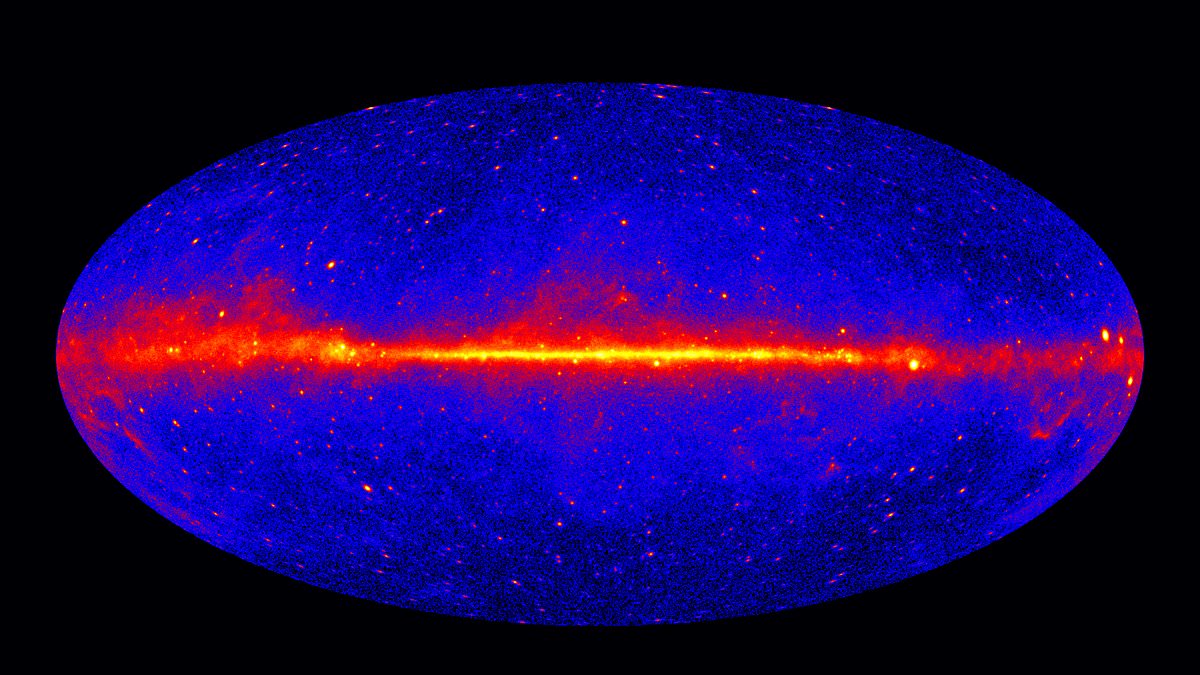
Since 2008, NASA’s Fermi satellite has been slowly piecing together a picture of the Milky Way using gamma rays.
When scientists looked at this gamma ray picture of the galaxy, they noticed something extremely unusual.
The centre of the Milky Way seemed to be filled with a diffuse glow of gamma radiation that didn’t appear to come from any specific source.
To explain this, scientists put forward two competing explanations.
Either the glow was caused by the spinning cores of dying stars – or it was was caused by colliding dark matter.
However, figuring out which of these explanations is the most likely has proved tricky.

Researchers believe the mysterious gamma–ray glow coming from inside our very own galaxy could reveal exactly where dark matter is hiding
In their study, published in the journal Physical Review Letters, the researchers used supercomputers to create a map of where dark matter should be in the galaxy.
What made their approach different was that they took into account how the Milky Way came into existence.
‘Our galaxy formed out of a vast cloud of dark matter,’ explains Professor Silk.
‘The ordinary matter cooled down and fell into the central regions, dragging along some dark matter for the ride.’
Over billions of years, the dark matter from these other systems gravitated to the dense galactic core, and the number of collisions increased.
When the researchers took these simulations and compared them to real pictures of the galaxy taken by Fermi, he found that their predictions were a match.
Lead author Dr Moorits Muru, of the Leibniz Institute for Astrophysics, told Daily Mail:’. One of the main challenges for the dark matter explanation was that its predicted distribution didn’t match the observed gamma-ray excess.
In our new study, we found that this mismatch came from a simplifying assumption: scientists had modeled dark matter as perfectly spherical around the Galactic Center – in reality, our simulations show it’s flattened.’

In a new paper, scientists simulated where they thought dark matter should be in the galaxy (illustrated), and worked out what the pattern of gamma rays should look like. When they compared this to the actually distribution of gamma rays they found that the predictions matched
Although this isn’t yet a ‘smoking gun’ for the existence of dark matter, it raises the tantalising possibility that the gamma ray glow really is coming from dark matter.
While it is still possible that the gamma ray glow is being produced by spinning neutron stars, this study tips the scales in favour of dark matter.
Dr Moorits says: ‘Our findings make it less likely that the radiation is produced by millisecond pulsars.
‘This is not a concrete proof, but it is a step closer to understanding dark matter.’
Professor Silk says his ‘great hope’ is that the soon–to–be–constructed Cerenkov Telescope Array in Chile will be able to settle the debate once and for all.
This will be the world’s most powerful gamma ray telescope, and should have the sensitivity to detect the tiny differences between gamma rays produced by dark matter and radiation from spinning neutron stars.
Alternatively, the telescope could scan nearby dwarf galaxies, which should be made mostly of dark matter.
‘Detecting the same signal Fermi found for the galactic centre would confirm the dark matter hypothesis,’ says Professor Silk.