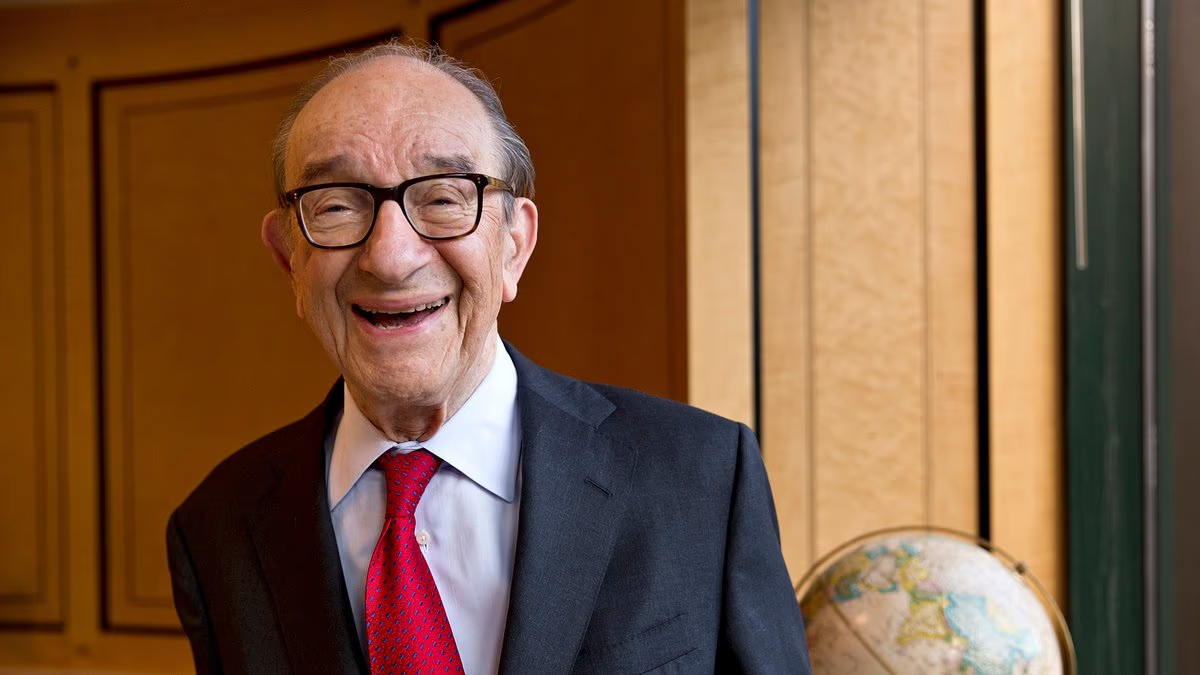
Alan Greenspan, the influential economist who spent nearly two decades at the helm of the US Federal Reserve and became one of the most consequential figures in global finance, has died aged 100.
Greenspan, who led the Federal Reserve from 1987 to 2006 across the administrations of four US presidents, died Monday due to complications from Parkinson’s disease, according to reports confirmed by his wife, longtime journalist Andrea Mitchell.
He is survived by Mitchell, whom he married in 1997.
‘Alan passed away at our home this morning at the age of 100 from complications of Parkinson’s Disease,’ Mitchell said in her statement.
‘He was a giant of a man who helped shape the US economy for decades under presidents of both parties, but was always honest in acknowledging his mistakes,’ she said.
For much of his public career, Greenspan was viewed as the pre-eminent steward of the American economy, gaining the nickname ‘The Maestro’ as executives, investors and policymakers looked to him for clues on interest rates and the direction of the wider economy.
His time at the Fed covered a series of defining shocks and market turning points, from the 1987 stock market crash and the Asian financial crisis to the dot-com surge and collapse, as well as the economic fallout from the September 11 attacks.
Following his departure from the Federal Reserve in 2006, Greenspan continued to shape economic debate through books, corporate advisory work and regular commentary on global financial trends.

Alan Greenspan, former chairman of the Federal Reserve, is survived by his wife Andrea Mitchell

Alan Greenspan was sworn-in as chairman of the Federal Reserve by President Ronald Reagan
EXCLUSIVE: BBC Insider Shares Troubling New Claims About Chris Moyles
His reputation was tainted, however, by the global financial crisis which struck a decade later.
Born in New York City in 1926, Greenspan initially pursued music and played clarinet and saxophone before turning to economics, eventually earning advanced degrees and building a successful consulting business.
Appointed to his role in the Federal Reserve by President Ronald Reagan in 1987, Greenspan remained in office through the administrations of George H W Bush, Bill Clinton and George W Bush.
As a result, he became one of the longest-serving Federal Reserve chairmen in US history.
During the 1990s, he was credited with helping oversee a period of economic expansion.
His decision to resist calls for interest-rate hikes during a productivity-driven boom fueled years of low inflation, elevating him to near-celebrity status in Washington and on Wall Street.
As a result, tributes poured in following news of his death, with many calling him one of the most influential economic policymakers of the late 20th century.

Greenspan and Mitchell met in 1983, when the former journalist interviewed him about the future of Social Security
One X user called him, ‘a landmark figure in economic history,’ writing, ‘Alan Greenspan shaped monetary policy through one of the most transformative eras in modern finance.’
‘He defined the era of the ‘Great Moderation low inflation, stable growth…until it all ended. It has a huge influence. The end of an era,’ another X user wrote.
The Federal Reserve shared a statement saying it ‘extends its deepest condolences to his wife, Andrea Mitchell, and to his family.’
‘Chairman Greenspan’s legacy endures at the Federal Reserve,’ the statement adds. ‘in those he mentored directly, in the economists and public servants he inspired, and in the frameworks and practices he helped shape.’


