
Hundreds of thousands of demonstrators are expected to take to the streets across France on Thursday, while public-sector workers prepare to strike in a fresh challenge to President Emmanuel Macron.
The latest unrest has shaken Macron’s government and dominated the political agenda just five months before the presidential election, with far-right leader Marine Le Pen currently leading opinion polls.
The mobilisation has been called by trade unions, including the left-wing CGT, and supported by student organisations. It follows protests over the cost of living, public services and education that have produced France’s worst civil disorder in years.
Authorities have sought to ease tensions after riots and looting on October 17 caught security forces by surprise. Shops and public buildings were damaged across the country, intensifying criticism of Macron’s response to the crisis.
“We are extremely vigilant because there is no question of reliving October 17,” government spokeswoman Maud Bregeon told reporters after Wednesday’s cabinet meeting.
About 70,000 police officers will be deployed across France.
The domestic intelligence service estimates that between 500,000 and 700,000 people could join protests outside Paris, while up to 80,000 are expected to march in the capital.
Interior Minister Laurent Nunez vowed an “extremely firm response” to any violence or public disorder.

People in Halloween costumes gather at La Plaine Square in Marseille, France, on October 31, 2026

Thousands of protesters gather at La Plaine Square in Marseille on October 31, setting up barricades and clashing with police

A protester holds a firework during a Paris demonstration organised by labour unions and supported by the Yellow Vests movement, French high school students and university students over living costs and rising fuel prices on October 31
The Education Ministry said 17.5 per cent of teachers in public primary schools were expected to strike. Unions also warned that rail and public transport services could face significant disruption.
Students are among those expected to join Thursday’s marches, saying deteriorating conditions in schools and growing uncertainty over their prospects remain pressing concerns.
“We’re trying to maintain as much mobilisation as possible. Some people are staying away because they’re afraid. Many are afraid of police violence,” said Irma de Banville, a 19-year-old student in Paris.
The French government has defended the tactics used by police while insisting that any alleged abuses will be investigated.
Macron called a defence and security meeting on Wednesday ahead of the protests. The move reflected the scale of a movement that began with student anger over worsening school conditions and limited opportunities for young people but has since grown into a wider challenge to the government.
“The aim in the coming weeks is to bring the river that has overflowed back into its bed and launch the presidential election in the calmest conditions possible,” an official close to Macron said. The official pointed to the smaller number of high schools blockaded this week compared with earlier in the crisis.
Nationwide protests last Saturday were largely peaceful, although clashes broke out on the fringes.
The political climate remains tense nonetheless. Candidates are positioning themselves ahead of the election, while opposition parties seek to harness public anger over living standards and government policy.

Demonstrators take to the streets as tensions intensify during protests in Paris, France, on October 31

Weeks of unrest have shaken Emmanuel Macron’s government and dominated the political agenda five months before the presidential election

A masked protester joins a nationwide demonstration in Marseille, southern France, on October 31

A vehicle burns as demonstrators take to the streets during escalating protests in Paris, France, on October 31

Demonstrators clash with police as tensions rise during protests in Paris, France, on October 31

Demonstrators carrying banners, flags and costumes clash with police during Yellow Vests protests in Paris, France, on October 31
A strike in the power sector in mid-September reduced electricity supplies across France and lowered delivery capacity at the country’s largest liquefied natural gas terminal, Dunkirk LNG.
“It will be a powerful mobilisation,” said Marylise Leon of the CFDT union, predicting turnout comparable to the 2023 protests against pension reform, when more than one million people marched.
Unions representing workers in public and private education, railways, public hospitals and postal services have all called for strike action.
In demands directed at both the government and employers, unions are seeking a higher minimum wage, which has not received a discretionary increase since 2012, along with across-the-board pay rises, tax changes and improved learning conditions for young people.
An attempted-murder investigation was opened after petrol bombs were thrown at security forces in Paris on Saturday.
Several teenage protesters have also suffered serious injuries, while thousands of people have been arrested.
Authorities have acknowledged security and intelligence failures that helped pave the way for the clashes, widespread looting and damage to public property seen on October 17.
On Wednesday, the Paris prefecture prohibited a major protest route between Place de la Bastille and Place de la Concorde because it would have crossed the city centre.

Protesters build barricades in side streets around La Plaine Square on October 31

Protesters kick tear-gas canisters back towards police in Paris, France, on October 31

French high school students hold a sit-in outside Lycee Henri IV in Paris during a nationwide day of strikes and protests on November 5

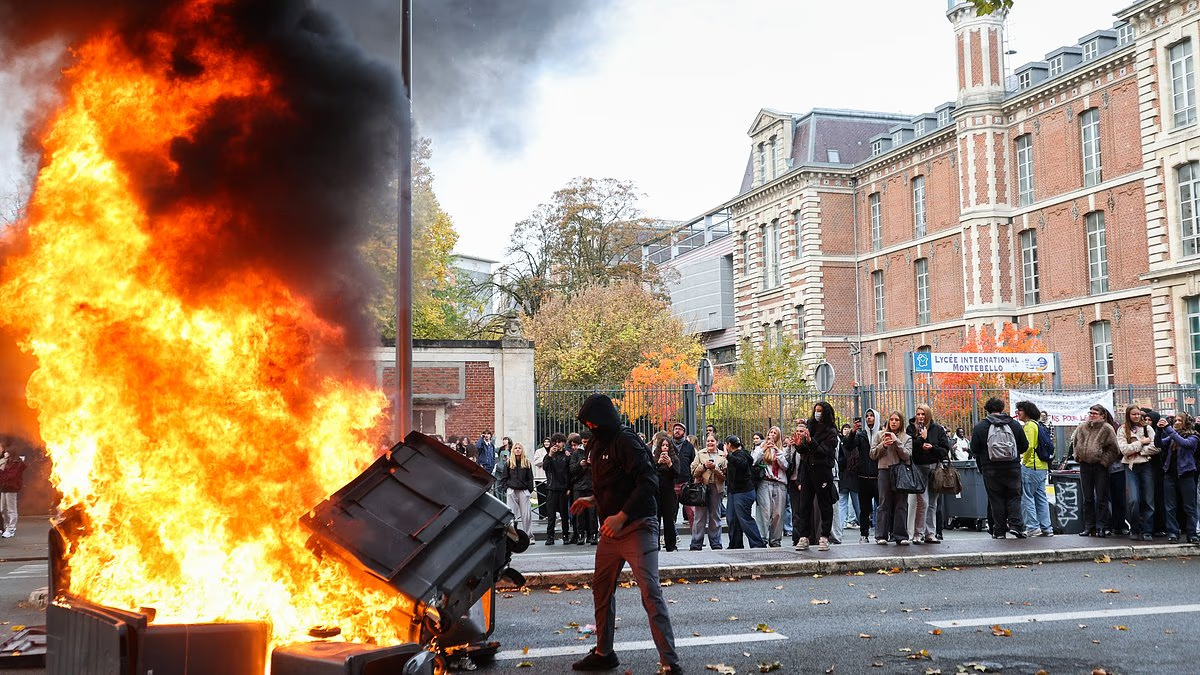
A person throws rubbish bins onto a fire outside the International high school Montebello in Lille, northern France, on November 2

A protester waves a flare during a demonstration against rising living costs in Nantes, France, on Saturday, October 31
Police replaced the prohibited route with an authorised march heading east, away from central Paris.
Several unions have condemned the route bans as an attack on the freedom to demonstrate. Some have submitted last-minute appeals seeking to have the original routes restored.
“We can see a cumulative effect: public support for the high school and university students’ movement is not fading, and people are questioning restrictions on civil liberties, particularly bans on demonstrations,” said Fabrice Fort of the CGT union.
“This has been a wake-up call for people who do not usually speak out,” he added.
Comparable protests have emerged elsewhere in Europe in recent weeks, with youth-led demonstrations reported in Denmark, Germany and Italy.


