
Even amid the horrors of October 7, one scene stood apart for its stark brutality: a child appearing to celebrate the abduction and killing of a young woman.
The boy, wearing a red-and-white T-shirt, was part of a crowd in Gaza that cheered as the bloodied, partially naked body of the victim was displayed on the back of a pickup truck.
The woman was 22-year-old Shani Louk, one of hundreds of people killed by Palestinian attackers at the Nova music festival.
Her relatives identified her remains by the distinctive tattoos on her legs and her long braids.
As the truck moved through the streets, people gathered around it, striking the bodies of Louk and other victims with their fists and shouting jeers.
The boy in the red-and-white shirt, who appeared to be barely a teenager, then leaned into the vehicle and spat on Louk’s body.
The images prompted an unavoidable question: how could a child be drawn to such an act of cruelty?
The answer is central to any discussion about Gaza’s future—and to the prospects for lasting peace across the region.

Footage shows children at a Hamas training facility and taking part in a mock tunnel exercise

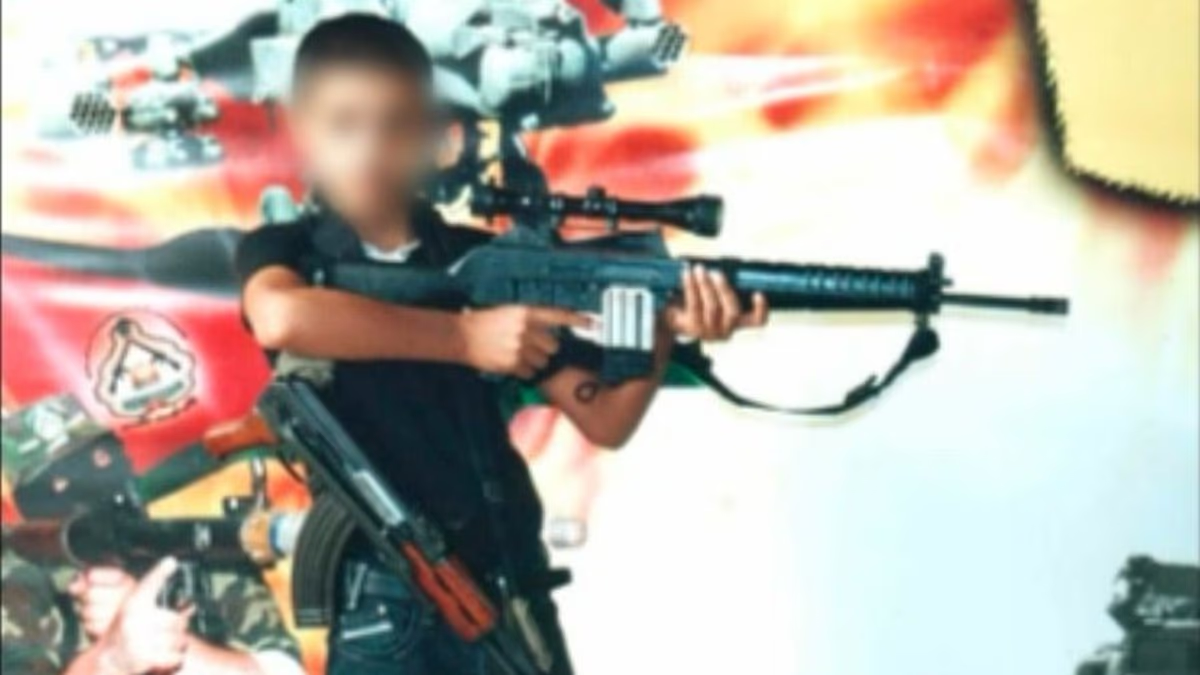
A child is pictured handling weapons during training alongside members of the terrorist organization
A substantial body of evidence points to the influence of Hamas, the proscribed terrorist organization that has ruled Gaza for nearly two decades, and its efforts to expose successive generations to an extremist ideology centred on violence, hatred and death.
The allegations are particularly contentious because, over the past 20 years, hundreds of millions of pounds in British government funding have been directed to the UN agency that operates many schools in Gaza.
An investigation by The Mail on Sunday has now examined how Hamas, after taking control of Gaza in 2007, used the territory’s education system to promote what it describes as a jihadist worldview among children.
Gazans who spoke out at considerable personal risk described Hamas’s growing influence over schools, cultural institutions and family entertainment, warning that a so-called ‘culture of death’ has inflicted lasting damage on Palestinian society.
Some residents are now urging the outside world to intervene, saying independent education is steadily being squeezed out and that action is needed before another generation is shaped by the same ideology.
Since seizing power, Hamas has sought to influence young people through military summer camps, schools, mosques and its wider control over daily life in the territory.
Shireen, a 29-year-old mother of two who spoke to the MoS from Gaza under a pseudonym and at great personal risk, recalled how the territory changed after Hamas came to power. Years later, she said, she became frightened that the same beliefs were beginning to reach her own family.
The moment that alarmed her most came when her son returned home after studying at a mosque.

Textbooks used in Palestinian schools under Hamas’s control have been accused of promoting its jihadist ideology among children

The woman on the left became known as the ‘lady in red’, one of the most haunting and recognisable images from the October 7 massacre
‘Under Hamas, it became a curriculum of terrorism. They teach them terrorism, killing and the path of death. There is extreme racism and they teach them how to kill and how to fight Jews.
‘We send children to the mosque to learn religion and the Koran and to become closer to Almighty God. I was shocked our children would come back from the mosque knowing about how to die.’
Then came the words from her own young son that left her horrified. ‘He told me, ‘When I become a martyr, I will receive houris [an Islamic description of paradise].’
‘He was not even ten. I wondered how a child his age could have these things in his mind.’
Horrified, Shireen began teaching him at home. ‘I don’t want him going to the mosque and having ideas about terrorism, death and killing put into his head – how to fight and how to enter paradise.’
But Shireen says another family living nearby had already experienced the nightmare she feared for her own child.
‘Our neighbour’s son was 15. He used to go to the mosque for his education. He was very religious.’
The family lived in eastern Gaza, close to the boundary with Israel. Palestinian militant groups often encourage people to approach or cross it and, according to Shireen, the teenager was given a weapon and headed towards the border to target Israeli guards.

People flee the Nova Music Festival after a Hamas attack in Israel on October 7

Israeli army soldiers search the remains of a torched vehicle for forensic evidence at the site of the October 7 attack
‘He was killed,’ she says sadly. An Israeli soldier shot him. It is a senseless fate.
Elsewhere, Amin Abed, 40, bears the scars of the terror group’s indoctrination of school children.
He fled Gaza for the UAE after members of the terror militia beat him. Amin witnessed how the educational system was captured by the group’s extremist ideology.
He says: ‘When Hamas came to power, the same curriculum continued, while the teaching process gradually began to be adapted to Hamas’s ideas, extremism and organisational ideology.’
In 2012/13, Gaza’s Hamas-run authorities introduced Al-Futuwwa – translated as ‘youth’ or ‘young manhood’ – into government high schools, giving teenage boys weekly military-style instruction alongside their studies.
The Guardian reported at the time that some 37,000 boys aged 15 to 17 took part in weekly classes involving instructors from the Hamas-controlled security services, with pupils familiarised with Kalashnikov rifles, explosives and other weapons.
It was supplemented by voluntary camps where boys received further weapons training.
Hamas officials defended the scheme as educational and disciplinary, while a Gaza-based human rights group warned it was fostering a ‘military culture’.
Amin says: ‘The central message of this Al-Futuwwa programme was that ‘death is our highest aspiration in Gaza.’ ‘
He says that through this core belief, Hamas created a broad segment of society that glorified and sanctified death, the outcome being people whose main focus became jihad, fighting and killing Jews.
‘These programmes became mandatory in schools, and even Hamas’s interior minister would intervene to impose these curricula and this mentality,’ Amin tells The Mail on Sunday.
YOU MIGHT ALSO LIKE: Major the Belgian Malinois Faces Euthanasia as Owner Appeals to Judge for Reprieve
‘A close friend was recruited by Hamas and had his head filled with hate-filled rhetoric to the point that, in 2007, he shot his own father, claiming that he was fighting disbelief and tyranny, because his father opposed Hamas.’
Hamza Howidy, 28, who fled Gaza after being tortured for opposing Hamas, says he experienced the group’s influence on education first-hand.
The Hamas-run school he attended was founded by Sheikh Ahmed Yassin, the terror group’s spiritual leader.
‘We were taught Islamic education – the worst kind,’ says Hamza. ‘In the mornings we would sing Islamic songs. Hostility towards Israel was the norm and so was the idea of ‘resistance’.
‘The teachers were radical and anything secular was banned. We used to sing ‘Jihad is our path, death is our dream’.’
Hamza says that, even as a child, he felt there was something abnormal about it.
‘On one side of us were Hamas training camps and on the other was the Israeli border. People would walk around the school with guns.’
When Israeli tanks came close to the school, Hamza’s parents decided to pull him out.
But, he says, the hate-filled curriculum was no better when he later attended the Islamic University of Gaza.
The radicalisation of a generation can come as little surprise to anyone who has read Palestinian school textbooks.
A Grade 8 Arabic textbook, for instance, teaches reading, grammar and vocabulary through a passage describing suicide bombers wearing ‘explosive belts’ and daggers slashing Israelis’ throats. It also urges pupils not to forget the image of burned Jews.
Another textbook, this time a Grade 5 tome on Islamic Education, features a chapter on the religion’s early female defenders.
It recounts a woman stabbing a Jewish man to death and instructs pupils to ’emulate’ her and other women’s stories.
These examples and many others were revealed by Israeli based NGO, IMPACT-se (The Institute for Monitoring Peace and Cultural Tolerance in School Education).
Its devastating reports heavily criticised the United Nations Relief and Works Agency for Palestinian refugees (UNRWA) – which ran hundreds of schools for 300,000 children before the war – for turning a blind eye to radicalisation and naked anti-Semitism in the education system.
What was worse is that they were doing it on the back of funding from Britain and the West.
The last Conservative government – along with the US, Italy, Canada and Australia – suspended funding of UNRWA as allegations emerged that a dozen of its employees participated in the October 7 attack.
Barely a month after winning the General Election, Labour ended the suspension by pledging £21 million to the controversial UN body.
Marcus Sheff, CEO of IMPACT-se, said: ‘On October 7, 2023, graduates of this education system put into practice many of the messages they had encountered in the classroom and committed horrific acts.
‘The textbooks at the heart of this indoctrination are published by the Palestinian Authority, and the fact that Hamas has chosen to use them in its schools year after year illustrates exactly how dangerous they are.
‘Anyone interested in a peaceful future in the region must demand comprehensive reform of the Palestinian curriculum. Anything less risks laying the foundations for another October 7.’
Noor (not her real name) is an educator from Gaza who told this newspaper it was ‘extremely painful’ to watch Hamas undermine genuine attempts to educate children.
She worked with SOS Children’s Villages Palestine, which runs education programmes in Gaza, but says its work has been dramatically curtailed under pressure from Hamas.
‘There are many teachers who cannot, or are unable to, teach because of Hamas’s pressure,’ she said.
‘The result isn’t only that people lose their jobs. The more serious result is that the space for independent education is shrinking, while Hamas’s control over schools and over the way our children are educated is increasing.’
Yet amid the destruction, some Gazans have been trying, at considerable risk to their own safety, to take matters into their own hands.
Fearing what years of Hamas rule may mean for the next generation, parents and educators have begun making their own attempts to change how children are taught.
In eastern Rafah, an area under Israeli military control, an armed anti-Hamas Palestinian group led by Yasser Abu Shabab established a school teaching around 130 displaced children from nursery to seventh grade.
‘We want to create a generation of learners, not terrorists,’ a senior member of Abu Shabab’s forces told The Times of Israel.
Footage from inside the classrooms shows children being taught about equality, freedom and coexistence.
One teacher tells pupils that people should not be discriminated against because of their religion or ethnicity, while another says she and others like her ‘long for peace, hope and security’.
Professor Hussein al-Deek, from the Modern University College of Ramallah, says: ‘Gaza must now be opened up to the world, and the centres of ideological indoctrination must be dismantled.
‘Art, entertainment and music centres should be opened, and educational institutions and school curricula must be taken out of the control of any extremist group.’
If the education system remains closed, he says, Hamas ideology will continue its spread to even ‘ordinary Palestinians who are nonpolitical and not members of any party… who have embraced the discourse of hatred toward the other’.
An international body likely to play a significant role in reforming Gaza’s schools is the Board of Peace.
Chaired by Donald Trump, it will oversee Gaza’s post-war transition, including governance, security, demilitarisation and reconstruction.
An official told the MoS: ‘The president’s vision as represented in the plan – and endorsed by the UN Security Council – speaks specifically toward the criticality of deradicalisation.
‘The National Committee for the Administration of Gaza is the future technocratic Palestinian governance in Gaza, which is developing new curricula, new education protocols, efforts to promote social peace, and reintegration of Gaza into the region.’
The success of their efforts and those of the courageous educators and parents in Gaza will not be known for decades, by which time today’s infant boys born into war will be young men.
To prevent another October 7 massacre, it’s imperative that they don’t carry hatred into adulthood.


