Share this @internewscast.com
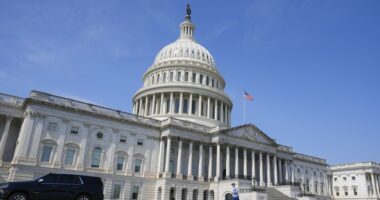
WASHINGTON — In a swift move on Wednesday, House Republicans passed a bill aimed at tightening voter registration requirements before the upcoming midterm elections. This initiative, a significant priority for the Trump administration, is expected to encounter substantial resistance in the Senate.
The proposed legislation, known as the Safeguard American Voter Eligibility (SAVE) America Act, mandates that individuals provide proof of citizenship when registering to vote. Acceptable forms of proof include a valid U.S. passport or birth certificate. Additionally, the bill requires voters to present a valid photo ID at the polls, a requirement already enforced by some states. The measure narrowly passed with a 218-213 vote, primarily along party lines.
Proponents of the bill, largely from the Republican Party, argue that these measures are necessary to curb voter fraud. However, Democrats contend that such requirements could disenfranchise millions of voters by complicating the voting process. Although federal law stipulates that only U.S. citizens can vote in national elections, it does not currently demand documentary proof of citizenship. Experts assert that instances of voter fraud are exceedingly rare, with very few noncitizens managing to cast ballots. Notably, less than 10% of Americans lack documentation to verify their citizenship.
During a committee hearing, Rep. Bryan Steil, R-Wis., defended the legislation, stating, “Some of my colleagues will call this voter suppression or Jim Crow 2.0.” He dismissed these allegations as unfounded and emphasized the necessity of the bill to uphold existing laws, especially those preventing non-citizen immigrants from voting. “The current law is not strong enough,” Steil argued.
This Republican-led initiative to overhaul voting regulations at the onset of the midterm election season is sparking significant concern. The move comes amid President Donald Trump’s controversial suggestion to centralize control over U.S. elections, despite the Constitution assigning this responsibility to individual states.
Election turmoil shadows the vote
The GOP’s sudden push to change voting rules at the start of the midterm election season is raising red flags, particularly because President Donald Trump has suggested he wants to nationalize U.S. elections, which, under the Constitution, are designed to be run by individual states.
The Trump administration recently seized ballots in Georgia from the 2020 election, which the president insists he won despite his defeat to Democrat Joe Biden. The Department of Justice is demanding voter rolls from states, including Michigan, where a federal judge this week dismissed the department’s lawsuit seeking the voter files. Secretaries of state have raised concerns that voters’ personal data may be shared with Homeland Security to verify citizenship and could result in people being unlawfully purged from the rolls.
“Let me be clear what this is about: It’s about Republicans trying to rig the next election,” said Rep. Jim McGovern of Massachusetts, the top Democrat on the Rules Committee, during a hearing ahead of the floor vote. “Republicans are pushing the Save America Act because they want fewer Americans to vote. It’s that simple.”
The legislation is actually a do-over of a similar bill the House approved last year, which also sought to clamp down on fraudulent voting, particularly among noncitizens. It won the support of four House Democrats, but stalled in the Republican-led Senate.
This version toughens some of the requirements further, while creating a process for those whose names may have changed, particularly during marriage, to provide the paperwork necessary and further attest to their identity.
It also imposes requirement on states to share their voter information with the Department of Homeland Security, as a way to verify the citizenship of the names on the voter rolls. That has drawn pushback from elections officials as potentially intrusive on people’s privacy.
Warnings from state election officials
The new rules in the bill would take effect immediately, if the bill is passed by both chambers of Congress and signed into law.
But with primary elections getting underway next month, critics said the sudden shift would be difficult for state election officials to implement and potentially confuse voters.
Voting experts have warned that more than 20 million U.S. citizens of voting age do not have proof of their citizenship readily available. Almost half of Americans do not have a U.S. passport.
“Election Day is fast approaching,” said Sen. Lisa Murkowski, R-Alaska. “Imposing new federal requirements now, when states are deep into their preparations, would negatively impact election integrity by forcing election officials to scramble to adhere to new policies likely without the necessary resources.”
The fight ahead in the Senate
In the Senate, where Republicans also have majority control, there does not appear to be enough support to push the bill past the chamber’s filibuster rules, which largely require 60 votes to advance legislation.
That frustration has led some Republicans, led by Sen. Mike Lee of Utah, to push for a process that would skip the 60-vote threshold in this case, and allow the bill to be debated through a so-called standing filibuster – a process that would open the door to potentially endless debate.
Lee made the case to GOP senators at a closed-door lunch this week, and some said afterward they are mulling the concept.
“I think most people’s minds are open,” said Sen. John Kennedy, R-La., “My mind’s certainly open.”
But Murkowski of Alaska said she is flat out against the legislation.
“Not only does the U.S. Constitution clearly provide states the authority to regulate the ‘times, places, and manner’ of holding federal elections, but one-size-fits-all mandates from Washington, D.C., seldom work in places like Alaska,” she said.
Karen Brinson Bell of Advance Elections, a nonpartisan consulting firm, said the bill adds numerous requirements for state and local election officials with no additional funding.
“Election officials have a simple request of Congress – that you help share their burdens not add to them,” she said.
___
This story has been corrected to fix a statistic. Fewer than one in 10 Americans do not have paperwork proving they are citizens; an earlier version incorrectly said fewer than one in 10 have valid passports.
__
Associated Press writer Kevin Freking contributed to this report.
Copyright © 2026 by The Associated Press. All Rights Reserved.