
Share this @internewscast.com
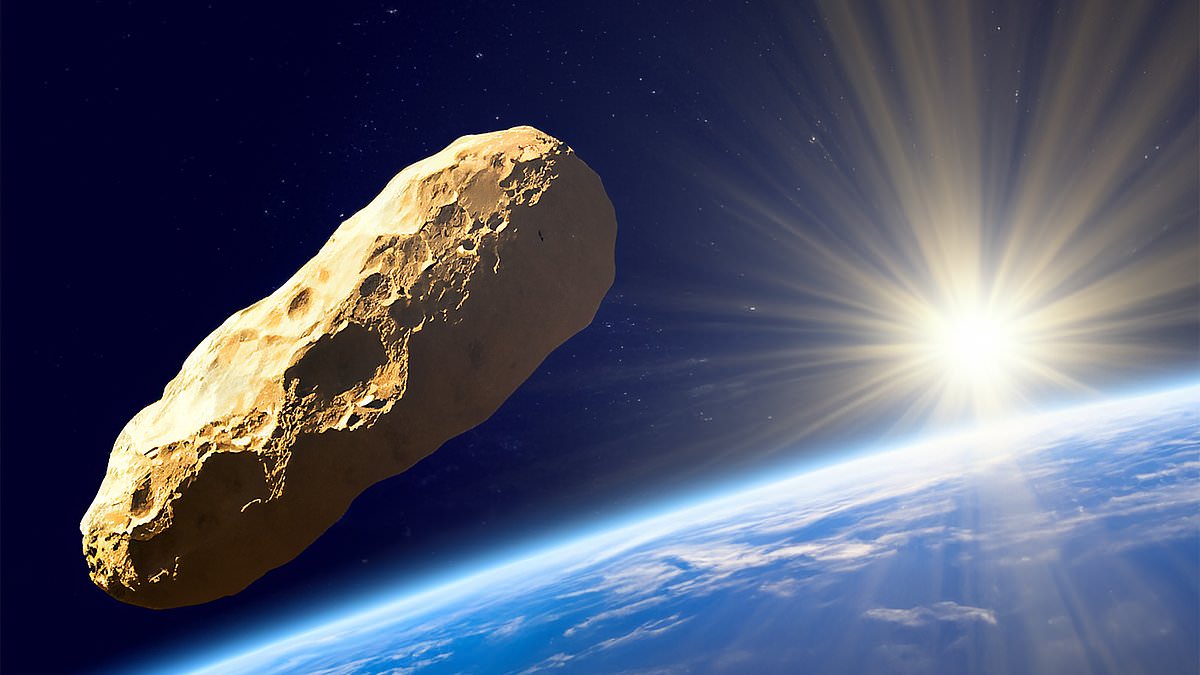
When an unidentified interstellar object miles wide races through our solar system at 37 miles per second, the scientific community takes keen interest.
Although NASA, which identified the object known as 3I/ATLAS in early July, and most astronomers concur that it’s a comet far from Earth, some propose a more unsettling hypothesis.
They believe it could be a ‘hostile’ alien spaceship.
Alarmingly, this alternative perspective is spearheaded not by a fringe conspiracy theorist but by a Harvard astrophysics professor.
In a research paper, Professor Avi Loeb, along with Adam Crowl and Adam Hibberd from the London-based Initiative for Interstellar Studies, presents a comprehensive theory about the nature of this cosmic traveler.
They propose that, rather than a comet, the object may be a massive mothership from a distant world, equipped with technology far superior to ours.
Loeb and his team have noted eight irregularities regarding 3I/ATLAS, including its size, path, and behavior, to bolster their extraordinary hypothesis.
Each individual anomaly is statistically very rare, they insist, and so taken together they strongly suggest that some as-yet-unknown intelligence is steering the object towards us.

Nasa was the first to spot the object, now known as 3I/ATLAS, in early July

3I/ATLAS shoots across a dense star field in this image captured by the Gemini North telescope last month
‘An encounter with an interstellar, alien technology is a blind date of astronomical proportions,’ Prof Loeb told the Daily Mail. ‘You don’t know what you will meet, because our imagination is limited to our experience on Earth.’
He argues that the plots of science fiction films are ‘pretty much tailored to fit the narrative of what we are doing here on Earth and just expanding [on it]’.
That is, most of us have no conception of what a really advanced civilisation might look like. Expecting present-day humans to comprehend the sort of technology aliens would have developed in order to reach us is ‘like asking a caveman to imagine an iPhone’, says Loeb.
He has suggested sending a message using radio waves to the object: ‘Hello, welcome to our neighbourhood. Peace!’
However, he also acknowledged the risks of this, noting that any intelligent life might see the signal as a threat.
Most of Loeb’s professional peers have determined that 3I/ATLAS will turn out to be a comet. They believe it has been drifting through space for billions of years, accelerating thanks to the gravitational ‘catapult effect’ of the countless stars it has passed. Its current speed of 130,000mph makes it the fastest comet ever recorded, says Nasa.
Predictably, some of Loeb’s fellow astronomers are peeved that he is, as they see it, letting the side down by venturing into science fiction. Oxford University astronomer Chris Lintott says he’s spouting ‘nonsense on stilts’.
And Loeb, it has to be said, has been urging the world to keep an open mind about extra-terrestrials for some time.
An expert on black holes, he has spent years searching for signs of alien life and, in 2021, founded the international ‘Galileo Project’ to focus on this area. Two years later, he led an expedition to a site on the bed of the Pacific Ocean where a meteor was believed to have come to rest, claiming the remains his team discovered could have come from an extraterrestrial spacecraft.

Professor Avi Loeb led an expedition to a site on the bed of the Pacific Ocean where a meteor was believed to have come to rest, claiming it could have come from an alien spacecraft

The professor and his associates have identified eight anomalies about 3I/ATLAS to support their outlandish theory, including its size, trajectory and behaviour
Nasa, whose telescope in Chile first spotted 3I/ATLAS on July 1, says the object should remain visible to ground-based telescopes in September but will then pass behind the sun. It is expected to reappear by early December.
So what are the anomalies about 3I/ATLAS that have so alarmed Professor Loeb?
The first relates to its lack of ‘tail’. Comets are propelled through space by gravity and solar radiation. The latter turns the comet’s surface ice into gas, which – together with the dust it carries – creates a visible tail.
Loeb said he was ‘puzzled’ that the object has undergone ‘significant non-gravitational acceleration’ without apparently having any such tail. He was also disturbed by its unusual ‘retrograde’ orbit around the sun (in other words, it’s moving against the flow of the solar system).
This, he argues, could be a ‘defensive manoeuvre’ by its alien pilots to make it harder for their craft to be intercepted by rockets fired from Earth.
3I/ATLAS’s trajectory also means it will pass relatively close to Venus, Mars and Jupiter – again statistically unlikely but, he notes, affording it the perfect opportunity to snoop at the other planets in our solar system, like some sort of extraterrestrial spy.
He points out that 3I/ATLAS will achieve ‘perihelion’ – reaching its closest point to the sun – on the opposite side of the sun relative to Earth.
This, says Loeb, ‘could be intentional to avoid detailed observations from Earth-based telescopes’. It would also, he warns, allow it to launch ‘probes’ or other ‘gadgets’ in secret to invade or infiltrate – or even change direction and visit our planet itself, arriving with little warning as early as late November.
Some critics, while agreeing with him that scientists should be less dismissive of ET research, accuse Loeb of cherry-picking data to suit his argument.
In the past few days, Nasa has revealed an image taken by the Hubble Space Telescope which it hailed as the ‘sharpest-ever picture’ of 3I/ATLAS.
The image remains blurred (hardly surprising given it shows something 277 million miles away) but Nasa claims it suggests the object is a comet because it appears to show a ‘teardrop-shaped cocoon of dust coming off its solid, icy nucleus’.
But Professor Loeb is adamant there is still no evidence the object has the tail of dust thrown off by comets. The jury’s still out, he insists.
So, if – and, yes, this is a big if – 3I/ATLAS does turn out to be an alien spacecraft, is there anything we could do?
In the short term, Loeb and his co-authors have suggested using Nasa’s unmanned Juno spacecraft, currently in orbit around Jupiter, to photograph the object.
But Juno may not have enough fuel left for such a mission.
In the long term, Loeb argues, we should treat all interstellar objects entering the solar system as potentially the creation of aliens. He believes governments should co-ordinate through an international body.
‘We talk about the existential risks from artificial intelligence, from climate change, from an asteroid impact, but there’s no discussion about the risk from alien technology,’ he told the Mail.
He’d like to see governments form ‘task forces’ to determine how to respond if and when alien intelligence is finally detected, and how to break the news to the public without triggering panic.
Of course, the public reaction may depend on whether the visitors wish us well or ill.
‘In the first case, humanity needs only to wait and welcome this interstellar messenger with open arms,’ says Loeb. ‘It is the second scenario that causes serious concern.’
Loeb says we’ll get a much better indication of what exactly 3I/ATLAS is when it can be seen – possibly as early as later this month – by the James Webb Space Telescope.
The telescope, which is now a million miles from us, will be able to view the object in infra-red, allowing it to analyse the sunlight reflected from it and determine precisely what it is.
It’s easy to be cynical about ET hunters like Professor Loeb and he concedes himself that he is expecting to be wrong.
But with all his expertise, one has to consider the daunting question: What if he’s right?