
Ancient Aramaic inscriptions, written in the language spoken by Jesus, are shedding new light on a largely forgotten moment in the spread of early Christianity through the Roman Empire.
Carved into stone, the text refers to both Jesus Christ and Mithras, the god at the center of a secretive, male-only religion that once attracted Roman soldiers, traders and other devotees across the empire.
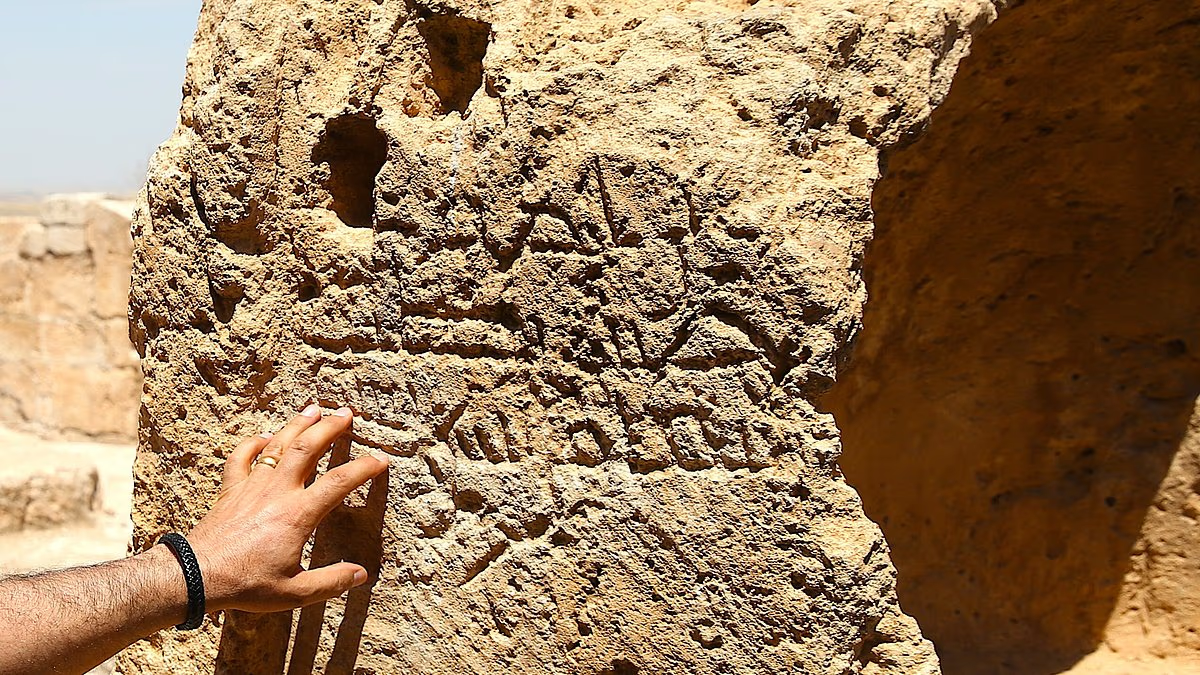
The inscriptions were found at the entrance to an underground temple dedicated to Mithras in southeastern Turkey. Researchers believe the writing records the symbolic shutdown of the sanctuary by early Christians around 1,700 years ago.
The temple, located at Zerzevan Castle, is unusually well preserved. Inside, archaeologists have identified four sacrificial hangers, a basin thought to have been used to collect the blood of sacrificed bulls, and three wall niches linked to the cult’s private rituals.
Experts date the inscriptions to roughly three centuries after the crucifixion of Jesus, a time when Christianity was gaining momentum and expanding rapidly across Roman territories.
By the fourth century, as Roman emperors began embracing Christianity, Mithraism came to be seen more clearly as a competing faith. Many Mithras temples were eventually abandoned, closed or repurposed as Christian churches.
Researchers also found a carved cross at the site, which they say may have served as a marker of the temple’s official closure.
The inscription also invokes the Holy Cross and describes God as the source of order, renewal and love, strengthening the view that early Christians had taken over and redefined the former Mithras sanctuary.

Etched into stone, the text mentions both Jesus Christ and Mithras, the deity worshipped by a mysterious all-male religion once popular among Roman soldiers and merchants

The remarkably preserved temple still contains four sacrificial hangers, a basin believed to have collected the blood of sacrificial bulls, and three wall niches used in the cult’s secret ceremonies
The temple was uncovered during excavations at the ancient military settlement in Diyarbakir’s Cinar district in 2017, reported Turkey Today.
The inscriptions were also identified at the same time, but were only recently truly deciphered by Professor Mehmet Sait Toprak, head of the Syriac Language and Literature Department at Mardin Artuklu University.
He studied the inscription by looking closely at the shape of the letters, the language it used and the historical period it came from to figure out what it said and when it was written.
The team concluded that the inscription matched features of old Syriac and Aramaic writing from the third and fourth centuries AD.
The text discusses the ‘Invincible Sun God Mithras,’ an ancient god of light, contracts and war, who originated in Persia and was later adopted by the Roman Empire.
Legend has it that Mithras was born from solid rock and emerged fully grown.
MORE STORY: The Reality Behind the 'Screaming Ghost' Photo That Continues to Haunt Police
He wore a soft, pointed cap called a Phrygian cap, held a dagger in one hand and a torch in the other.
The dagger was believed to have created life by sacrificing, and the torch brought light to the world.

The inscription was discovered at the entrance to an underground Mithras temple in southeastern Turkey, where researchers say it records the sanctuary’s symbolic closure by early Christians around 1,700 years ago

Researchers also identified a carved cross, which they believe marked the temple’s formal closure
The temple in Turkey was around 1,900 years old when it was first discovered. It was built by carving the main rock underground on the eastern wall of the structure, with columns carved into the main rock and a large niche in the center.
A bull sacrifice scene was carved on the plaque in the middle of the big niche, and paint residue still stains some of the columns.
The crown beam motif, as one of the symbols of Mithras, was carved on the eastern wall, a smoothly carved bull blood bowl was found in one of the small niches and there were remains of a pool on the ground.
The blood bowl and the pool are connected to each other with a channel through the wall and it is known that water was used in the Mithras religious ceremonies.
In addition, there are four symmetrical points on the ceiling for hanging the animals during the ceremonies. The hanging points must have been used to sacrifice the bull in Mithraic rituals.
However, as Christianity began to take hold in the region, the two belief systems went to war with each other, and the Christians eventually took over these pagan sites.


