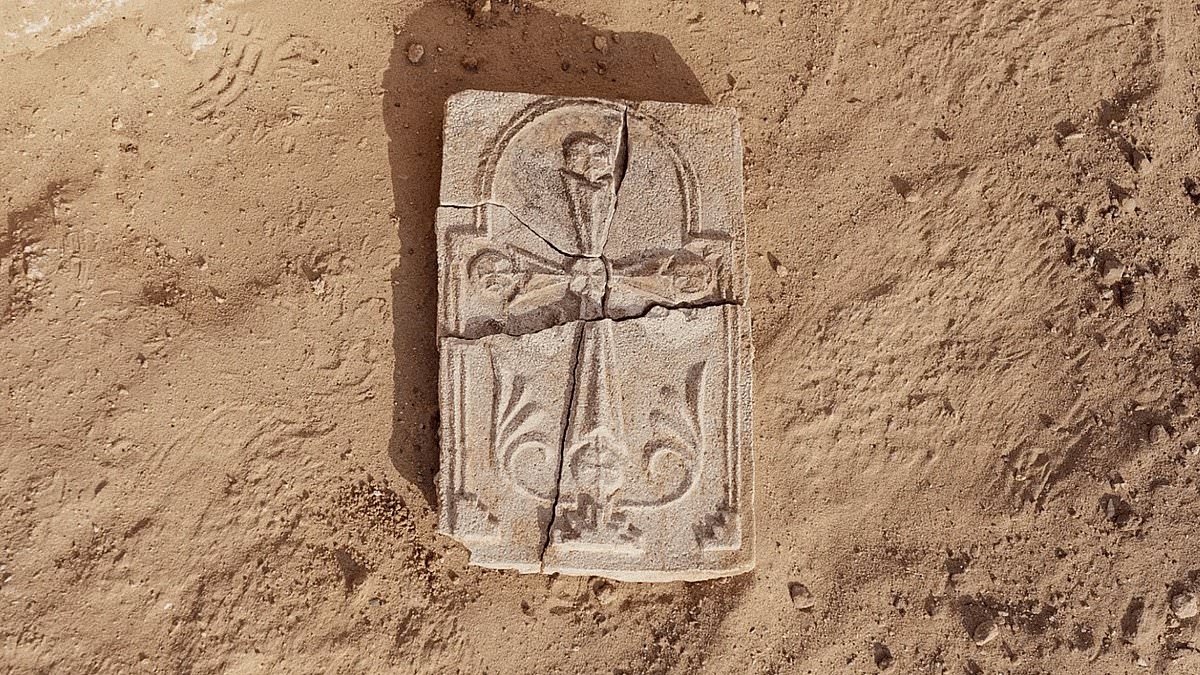

A 1,400-year-old plaque depicting a cross reshapes the understanding of how far east Christianity spread.
Archaeologists at Abu Dhabi’s Sir Bani Yas Island have discovered an artifact displaying a stepped pyramid symbolizing Golgotha, the site of Jesus’ crucifixion, with leaves emerging from its base.
Uncovered among the remnants of a church and monastery, it indicates that a Christian community thrived on the island during the seventh and eighth centuries.
Christianity during this era was generally linked to the Levant, Mesopotamia, and parts of Europe, thus finding an established community on an Arabian Gulf island is unexpected and holds historical importance.
Meanwhile, the area was experiencing significant religious transformations with the rapid rise and spread of Islam across Arabia, while older pagan customs persisted, and Christianity was believed to be diminishing.
However, the presence of a flourishing Christian settlement here challenges that assumption.
Maria Gajewska, lead archaeologist at the site, said: ‘Every element of the cross incorporates regional motifs.
‘It reveals that Christianity in this region not only existed but flourished, visually adapting to its local setting. We had Christian settlements that were not merely surviving but clearly thriving.’

The 1,400-year-old cross was unearthed in Abu Dhabi, suggesting Christianity spread much farther than previously believed

Archaeologists uncovered remains of buildings that stood in the area more than 1,000 years ago
Mohamed Khalifa Al Mubarak, chairman of the Department of Culture and Tourism, described the discovery as ‘a powerful testament to the UAE’s profound and enduring values of coexistence and cultural openness,’ emphasizing the find’s reflection of a history of peaceful religious diversity in the area.
The excavations this season also uncovered pottery, glass artifacts and a small sea-green bottle that may have held oil or rosewater.
The cross is about 10.6 inches long, 6.7 inches wide, and roughly 0.8 inches thick.
Archaeologists believe it could have been an object of veneration and placed on a wall with worshippers kneeling before it.
Hager Al Menhali, an Emirati archaeologist at the department, told The National: The plaster was resting face down and something about it caught my attention.’
She added that a ‘distinct fingerprint on the back,’ speculating it was left by the person who crafted the stucco plaque.
Future studies will include radiocarbon dating and further exploration of the courtyard houses, which could eventually be incorporated into a broader visitor trail.
‘These discoveries deepen our connection to the past and inspire future generations to embrace the spirit of unity and mutual respect that has long defined our community,’ Al Mubarak said.

It was found among the ruins of a church and monastery, suggesting a Christian community flourished on the island during the seventh and eighth centuries
Evidence from the excavation suggested that senior monks may have lived in the courtyard buildings, walking to the church for services or using the spaces for spiritual retreats.
The well-built structures, made of limestone and coral with cisterns for water, indicate a comfortable existence rather than a purely hermitic life.
The Christian community belonged to the Church of the East, a branch that stretched from the Middle East to China.
The Sir Bani Yas discovery offers a rare glimpse into how Christianity not only survived but expanded eastward, linking Arabian Gulf communities into the wider story of the faith’s spread toward India and Asia.
Evidence of a church and monastery on Sir Bani Yas, dating to the seventh and eighth centuries, was first uncovered in the early 1990s,
Another monastery, likely linked to the same church, was discovered on an island in Umm Al Quwain in 2022. Similar sites have also been identified in Kuwait, Iran, and Saudi Arabia.
Archaeologists are still investigating why the Sir Bani Yas settlement declined.
The church is believed to have been fragmenting before the rise of Islam, troubled by internal schisms as rival branches sought independence.
However, evidence suggests that early Christian and Islamic communities in the region communicated and traded peacefully. So far, no external event has been identified as the cause of the site’s abandonment.
What is striking, archaeologists said, is that the buildings appear unusually clean, with little sign of collapse or rubble. This suggested the residents may have left intentionally, planning to return, rather than being forced out by disaster or conflict.


