
Share this @internewscast.com

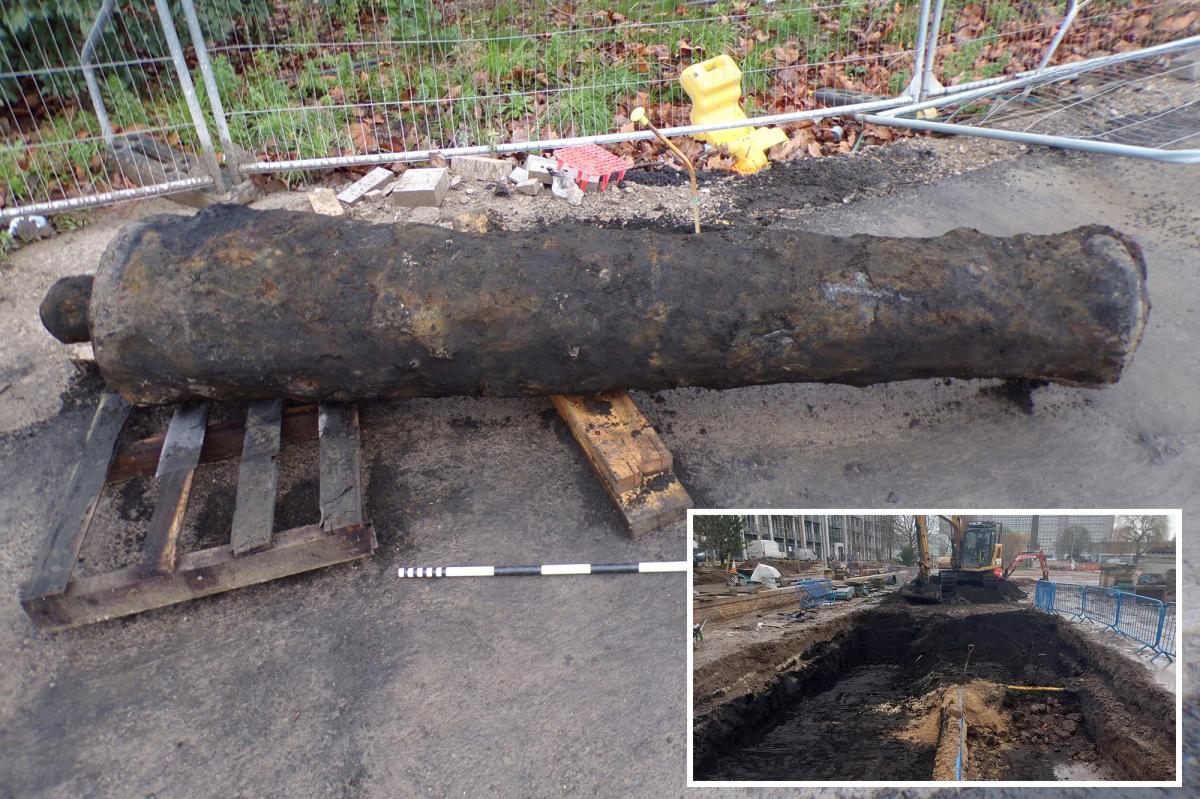
In a remarkable discovery, construction workers in the United Kingdom stumbled upon a centuries-old cannon during their routine operations.
This historical artifact was uncovered in Kingston upon Hull, a city nestled in East Yorkshire, as revealed by Hull City Council earlier this year.
Following the discovery, experts from Humber Field Archaeology, which is part of Hull City Council, were called in to conduct a thorough examination of the find.
The cannon, crafted from cast iron, is believed to hail from the late 17th or early 18th century, shedding light on its historical significance.
Officials reported that the impressive piece measures nearly nine feet in length and weighs more than a ton.
“Preliminary assessments suggest that the cannon was decommissioned, with its muzzle intentionally sealed,” stated the official announcement.
“Archaeologists believe it was likely repurposed as a mooring post, a common practice in the late 19th and early 20th centuries, before being pushed into the dock area prior to it being infilled in the 1930s,” the council noted.
Pictures show the iron cannon heavily encrusted with dirt and corrosion after being unearthed at the site.
The discovery was “very unexpected,” said Peter Connelly, archaeology manager for Humber Field Archaeology.
Connelly told Fox News Digital the contractors “certainly weren’t expecting a cannon to turn up” — and didn’t even realize it was a cannon at first.
“The archaeologists weren’t expecting it because they knew that the deposit being dug into was dock backfill,” he said.
He observed, “This discovery just goes to show that people will deposit anything in a conveniently large hole in the ground when it is being backfilled.”
While such finds are not unheard of, Connelly described the find as “definitely very rare.”
Hull archaeologists previously found a Henry VIII-era cannon in the late 1990s, as well as a fragment of a cannon from just before the English Civil War.
“This new cannon discovery is only the third of its kind in 30 years,” said Connelly.
Archaeologists were instead expecting typical 20th-century “domestic refuse,” he added, as well as the “occasional accidental loss.”
“For example, a complete late 19th century glass decanter was recovered from the dock backfill — somebody was probably quite upset when they lost this,” Connelly recalled.
The archaeologist said the cannon showed clear signs of being deliberately decommissioned before being reused.
“After the dock fell out of use, and as it was being backfilled and converted to a garden, this mooring post no longer had a function and the cannon was tipped with the backfill,” he said.
Researchers will analyze the cannon to see whether it was made in Hull, as the city had its own cannon makers in the late 18th century.
“Further work is still to be carried out on the cannon to focus on when exactly it was cast, where it was made and hopefully find out who made it,” Connelly said.