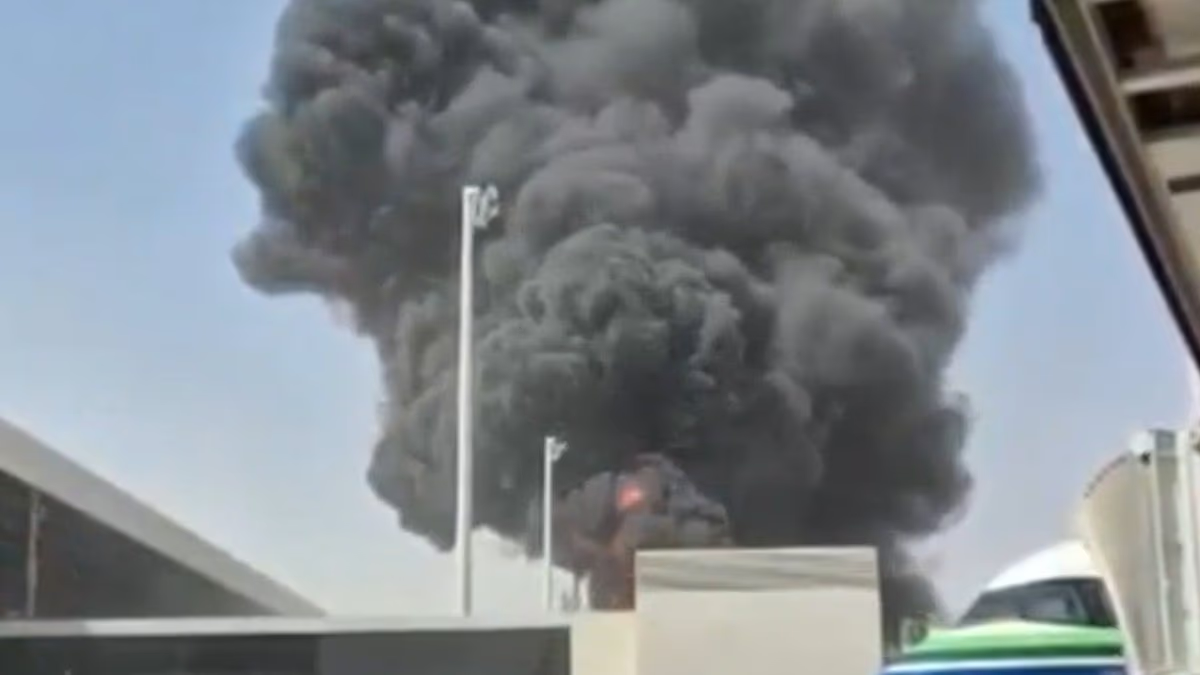

A passenger jet at Riyadh’s King Khalid International Airport was heavily damaged after a cruise missile fired by Yemen’s Houthi rebels struck the facility on Thursday.
The attack marked a sharp escalation in the Houthis’ campaign against Saudi Arabia, with missile strikes aimed at disrupting the kingdom’s airspace and oil infrastructure. Three people have been killed in attacks this week, while the latest barrage left a commercial aircraft badly damaged.
The Houthis claimed responsibility for the strike on Riyadh airport and warned workers to stay away from energy facilities, saying those sites would also be targeted.
Houthi military spokesman Brig Gen Yahya Saree said the group launched two cruise missiles at King Khalid airport. He added that ballistic missiles were fired at Najran airport and the Khamis Mushair air base during the same operation.
The missile aimed at Riyadh airport struck a commercial aircraft operated by Saudi state carrier Saudia Airlines. The plane caught fire while parked near an airport terminal, causing extensive damage.
Airport authorities said no passengers were believed to be aboard the aircraft when it was hit, although they could not immediately rule out injuries linked to the incident.
Images from the scene showed thick black smoke and flames billowing above the airport.
Saudi Arabia’s government media office, civil aviation authority and Saudia Airlines did not respond to emailed requests for comment.

A thick column of black smoke and flames rises above Riyadh airport after the missile strike
Lufthansa and Air India announced that they were suspending flights to Riyadh following the Houthi attacks.
Saudi officials separately reported that debris from an intercepted missile fell on a kindergarten and a medical complex in Riyadh.
The Houthis say their attacks are retaliation for Saudi support of government forces in Yemen’s renewed civil war.
Riyadh, meanwhile, says it is supporting an offensive by Yemen’s UN-recognised government to reclaim territory held by the Houthis.
The conflict, described as an extension of the US-Iran war, has intensified instability across an already volatile region. It also threatens to pull more countries into a difficult mountain campaign, with Syria reportedly considering sending troops to support Saudi Arabia.
Saudi Arabia has sought assistance from allies including Turkey and Pakistan, potentially in logistical or defensive roles, as it attempts to roll back Houthi advances in southwest Yemen near the southern entrance to the Red Sea.
The appeals have become more urgent since Saudi authorities said on Wednesday that three people had died in attacks this week targeting Riyadh airport and Abha airport in the southwest.
YOU MIGHT ALSO LIKE: Zohran Mamdani Calls on Trump to Release Immigrant Shot by ICE Agent as Bronx Protests Erupt
Saudi airports have increasingly become a focus of Houthi attacks. The Saudi-led coalition operating in Yemen said it had intercepted and destroyed two ballistic missiles fired toward Riyadh and another aimed at Khamis Mushayt, home to a major air base.
Data compiled by aviation analytics firm Cirium showed that nearly half of Riyadh airport departures had been cancelled by 3pm GMT. A further 31 cancellations were expected on Friday across Saudi airports.
Flight-tracking service FlightRadar24 reported widespread delays affecting arrivals and departures at King Khalid International Airport on Thursday.
Airport officials advised travellers to contact their airlines and confirm flight details before setting out.
Riyadh is due to host a major meeting of energy policy makers, the WPC Energy Congress, this week.
Several multinational firms based in Riyadh’s King Abdullah Financial District (KAFD) told staff to work from home after loud booms were heard on Thursday morning, five people familiar with the matter said, including some affected staff.
Some diplomats said they had received warnings, and some schools in Riyadh told parents there were orders to shelter in place, though authorities did not issue a public alert.
Yemen’s long-running civil war, which paused with a ceasefire in 2022, has erupted again in recent weeks with the Houthis seizing stretches of the Red Sea coast last month, including along the vital Bab el-Mandeb Strait.
Their threats to shipping and attacks on Saudi cities and infrastructure have drawn the kingdom back in.
This week, Saudi-backed forces launched a counterattack, taking back some areas around the strait.

Houthi fighters participating in an offensive against Saudi-backed Yemeni forces in Taiz province on October 8
However, in a war with several front lines, the Houthis have made gains of their own, surrounding Yemen’s third-largest city, Taiz, by taking territory along its main mountain road to Aden.
The fighting, which pits the Houthis against a coalition of Saudi-backed forces under the internationally recognised government, has led to a humanitarian crisis in the poorest Arab state, displacing 200,000 people since the conflict resumed.
One US and one Syrian defence official said Syria was carefully considering options for military support, including defensive aid to protect Saudi Arabia from attacks, or an offensive deployment to help take the fight to the Houthis.
In response to a request for comment to the Syrian foreign ministry, a diplomat said Syria stood firmly with Saudi Arabia but that its focus was on domestic priorities such as recovery from its own civil war.
NATO-member Turkey said on Wednesday it was sending mainly defensive and technical support to the kingdom to help in the fight against the Houthis. A Turkish official said this was expected to take the form of military equipment, intelligence sharing and weapons systems.


