
Share this @internewscast.com
As widespread shoplifting continues to lead to store closures and significant financial setbacks for retailers across the United States, one major company seems to have found an effective solution.
Costco has largely managed to avoid the wave of retail theft that has troubled chains like Walmart and Target, thanks to its unique store operations.
In its latest annual report, Costco detailed how its approach helps minimize inventory losses.
“By maintaining strict control over entry and exit points and implementing a membership system, we believe our inventory losses are significantly lower compared to traditional retail outlets,” stated the 2025 report.
In contrast to Walmart or Target, Costco requires customers to be members before entering the store.
Patrons must present a paid membership, often accompanied by photo identification, to gain entry. Inside, there is typically one designated entrance and exit, with purchases verified against receipts before customers leave.
These all add up. Fewer entrances mean fewer blind spots. Receipt checks make it much harder to walk out with unpaid items. And because everyone inside has already paid to be there, there’s far fewer anonymous shoppers – a key driver of retail theft.
The contrast comes as US retailers are estimated to have lost more than $47 billion to shoplifting in 2025.

A Costco worker checks a receipt at the store exit in Teterboro, New Jersey, on February 28, 2024 – a small step that makes walking out with unpaid items harder
According to the National Retail Federation, the average number of shoplifting incidents rose 93 percent in 2023 compared with 2019, while dollar losses increased by 90 percent over the same period.
Companies including Target, Walgreens, Whole Foods, and Nordstrom have previously cited retail crime as a factor behind store closures.
Costco has long said shoplifting has been a much smaller problem for them than for competitors. During an earnings call in 2023, then chief financial officer Richard Galanti told investors: ‘Thankfully, it’s not a big issue for us.’
Speaking to Daily Mail after the call, Galanti said Costco’s theft rate sat between 0.1 and 0.2 percent – roughly ten times lower than the retail industry average.
‘Our shrinkage has historically been low,’ he said. ‘And we’ve gotten better with time.’ Shrinkage is an industry term for stock losses, including theft.
While theft has never been a major problem for Costco, losses were more than twice today’s level roughly 30 years ago, showing how the company’s approach has steadily tightened.
Beyond store design, he said Costco’s bulk-buying model also helps. Large items like multi-packs of groceries or household goods are far harder to steal than small, high-value products that are often targeted in other stores.
In the US, Costco membership costs $65 per year for a standard Gold Star or Business membership, or $130 for an Executive one.
Executive members also get 2 percent cashback on most purchases- paid yearly – and can also start shopping an hour earlier.

Bulk items stacked high on both sides of a Costco aisle reflect the retailer’s simple design – fewer frills, fewer blind spots

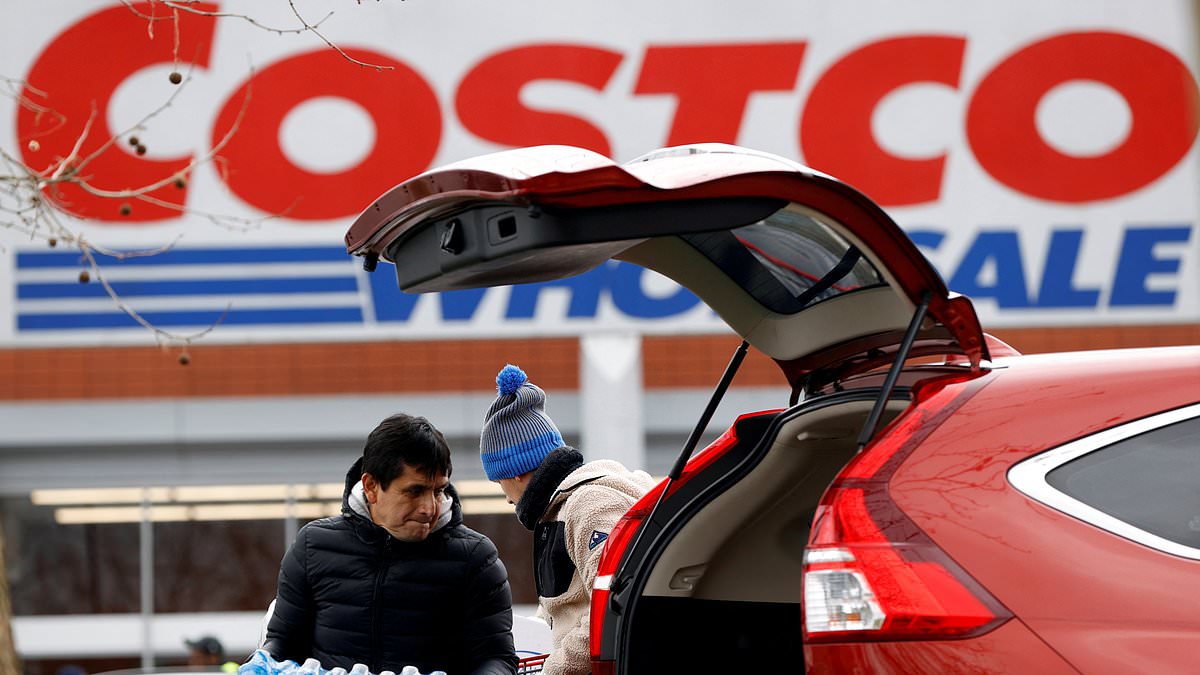
A shopper packs a car with purchases outside Costco, whose focus on large, high-volume items reduces the risk of unpaid goods leaving the store
Those membership fees allow Costco to operate on thin margins while keeping prices low – and investing in security without locking up everyday items.
While Costco experiences low levels of in-store theft, it has not been immune to crime altogether.
In late 2025, the company suffered a high-profile cargo theft involving a hijacked $400,000 shipment of live lobsters.
Financially, the retailer remains on solid footing. In early 2026, Costco shares are up more than 13 percent year to date, rebounding from a dip in 2025 and buoyed by strong January sales growth of 7.1 percent.