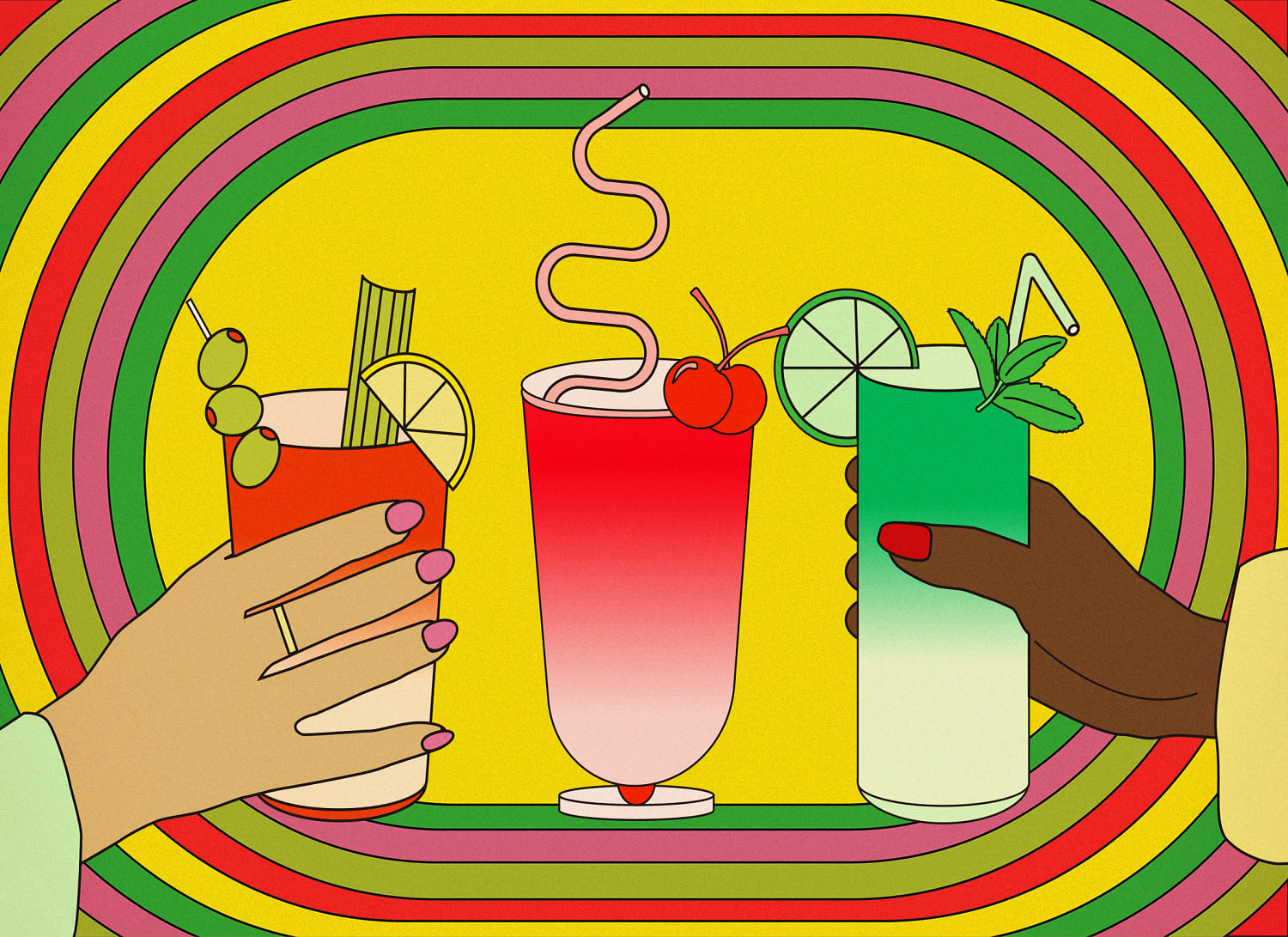
The hottest trend in drinking remains not drinking alcohol at all.
A recent Morning Consult poll shows 21% of drinking-age U.S. adults said they were participating in some form of reduced alcohol consumption for this year’s “Dry January” abstention period, up six percentage points from 2023 and the highest level recorded since the group began polling in 2021.
Much has been made about record-low vice activity among younger adults, especially Gen Z — and this includes lower alcohol consumption. Combined with a graying of America phenomenon that is making older generations more health-conscious, the overall alcohol market is “trending towards non-alcohol consumption and moderation changes in drinking habits,” market research group Nielsen IQ reported in December.
Yet a common experience has emerged among this new cohort of teetotalers, industry experts say: sticker shock at the price of their nonalcoholic beverages.
While nondrinkers may have been aiming for some financial savings along with health goals, “it’s definitely not your wallet” that is going to get relief, said Tia Barrett, general manager at Hav & Mar restaurant in New York’s Chelsea neighborhood.
“The biggest feedback and one thing I always have to explain is the cost of a [nonalcoholic] beverage,” Barrett said.
Price breakdown
The price of a given drink, whether purchased at a bar or brought home from a store, comprises much more than just its ingredients. The largest cost element is labor.
In fact, says Barrett, the work involved in creating a nonalcoholic cocktail served at a bar often exceeds that of creating a regular cocktail, since regular spirits represent a much more stable base to build a flavor profile around, she said.
“With alcohol, you can hide and mask the flaws if something’s a little imbalanced,” she said, “whereas with [nonalcoholic cocktails], if there’s something sweet, there’s no hiding the sweet. It’s not just diluting or shaking or stirring — it’s going to be sweet. So understanding what goes into it is something I wish people could understand. It’s not easy to create something that’s not a lemonade.”
The pricing structure for a nonalcoholic cocktail that mimics the taste of alcohol (as opposed to simply a juice, soda, or tea) has important differences compared with a regular alcoholic beverage, said Dash Lilley, co-founder of Three Spirit, a nonalcoholic distillery.
For one thing, Lilley said, alcoholic drinks are subject to taxes. A 2021 report from the drinking culture website Punch estimated that 10% of a cocktail’s cost in many U.S. cities goes toward various state and local alcohol duties.
But in general, Lilley said, alcoholic drinks are actually cheap to produce thanks to economies of scale and industrial production resources that don’t yet exist, in most cases, for nonalcoholic spirits.
Large beverage companies, he said, “can drive down the cost and produce as cheap a liquid as possible” if taxes were not a factor.
“With nonalcoholic (cocktails), because there isn’t massive infrastructure that can make it, it’s more a niche game; a specialist product to make, and which is often made in smaller batches. It’s more manual, hands-on — and that adds to cost,” Lilley said.
He also said that, with the growing non-alc trend, bars would be leaving money on the table not to create a premium product for which they can charge more.
“If you’re just letting people order a Diet Coke, or a cranberry juice, or a juice-heavy mocktail that you’re only charging $4 or $5 for, you’re missing out on an opportunity to make a drink that’s crafted,” he said. “If you put more love into your nonalcoholic menu, you can charge more and make more and earn more profit.”
Julia Petiprin, owner of Homemaker’s Bar in Cincinnati, said spirit alternatives are oftentimes more expensive than the bar’s regular alcoholic spirits.
“Our cost is right on par — and sometimes higher — than a full-proof cocktail,” she said.
And even in stores, the cost difference between a six-pack of a regular alcoholic drink and the nonalcoholic version of one is minimal: A domestic premium beer six-pack currently retails for about $8.60, while its nonalcoholic equivalent sells for $8.43, according to the Nielsen IQ data.
“Most of the time the price point is relatively similar,” said Kaleigh Theriault, associate director of beverage alcohol thought leadership at NIQ. “And the reason is because a lot are manufactured in the same facilities that alcoholic products are — but then there’s a secondary production process to remove the alcohol, and that’s not necessarily a reduction to produce the cost, which gives a similar price point for consumer.”
Alcohol giants are now fully aware of the opportunity and seeking to capitalize. Last month, White Claw introduced a 0% alcohol seltzer. What distinguishes it from a regular seltzer, according to David Barnett, chief commercial officer with White Claw brewer Mark Anthony Group, is the unique, premium flavor profile that regular White Claw hard seltzer drinkers have come to expect. And since the new product is going to be found in the regular alcohol section, it is going to be priced accordingly, he said.
“Because we are purely focused on marketing this toward the beverage alcohol occasion, and because it will be shelved and placed in beer sections in stores … it will be comparatively and competitively priced,” Barnett said.
Growing consumer base
Further driving up the price is simple demand growth. Nielsen IQ data show sales of nonalcoholic beers, wine and spirits sold in stores and supermarkets — called the “off-premises” market in the industry — climbed 31% over the past year. Within the segment, nonalcoholic spirits are experiencing explosive growth at 94%. For the first time, annual sales have surpassed $500 million, Nielsen said.
Data from the Bureau of Labor Statistics, the same agency that reports on inflation, do not directly capture the cost of ingredients commonly used in mocktails. But under the broader category of “nonalcoholic beverages and beverage materials,” costs have surged more than 20% since 2020, compared with the cost of alcoholic drinks, which have climbed less than 15%.
Lilley, of Three Spirit, said that a more health-conscious consumer is driving the trend — no matter their age.
“The well-being boom is like the eye of Sauron — it’s overlooking everything,” he said. “It’s hard to escape; it’s fashion, it’s powerful … it’s more fashionable to care about tomorrow and to feel good tomorrow than right now.”
Gen Z is leading the way — but they are not alone in easing up on booze. The share of adults ages 18 to 34 who say they drink dropped from 72% in 2001-03 to 62% in 2021-23, Gallup polling results show.
The same data show a decline in binge-drinking among 35-54 year-olds over the past two decades.
‘Damp’ January
Hav & Mar’s Barrett said the share of guests who are doing a completely dry January is actually down this year.
Instead, she said, many seem to be participating in what others have dubbed “damp” January, which involves cutting back but stopping short of cutting off.
That is borne out by additional Morning Consult polling, which found an 18 percentage-point drop in those who said they will not drink alcohol at all this January.
Corban Kell, general manager at Billy Sunday in Chicago, said one of his favorite recent trends is people coming in and having a drink — and then having a nonalcoholic drink after. That also helps dictate the flavor profile of the mocktail.
“Not everyone who drinks N/A has never had a drink — but now it’s a significant portion of N/A drinkers who used to drink,” he said, using shorthand to describe nonalcoholic beverages. As a result, if they can successfully mimic the taste of a regular cocktail, “that’s our biggest success.”