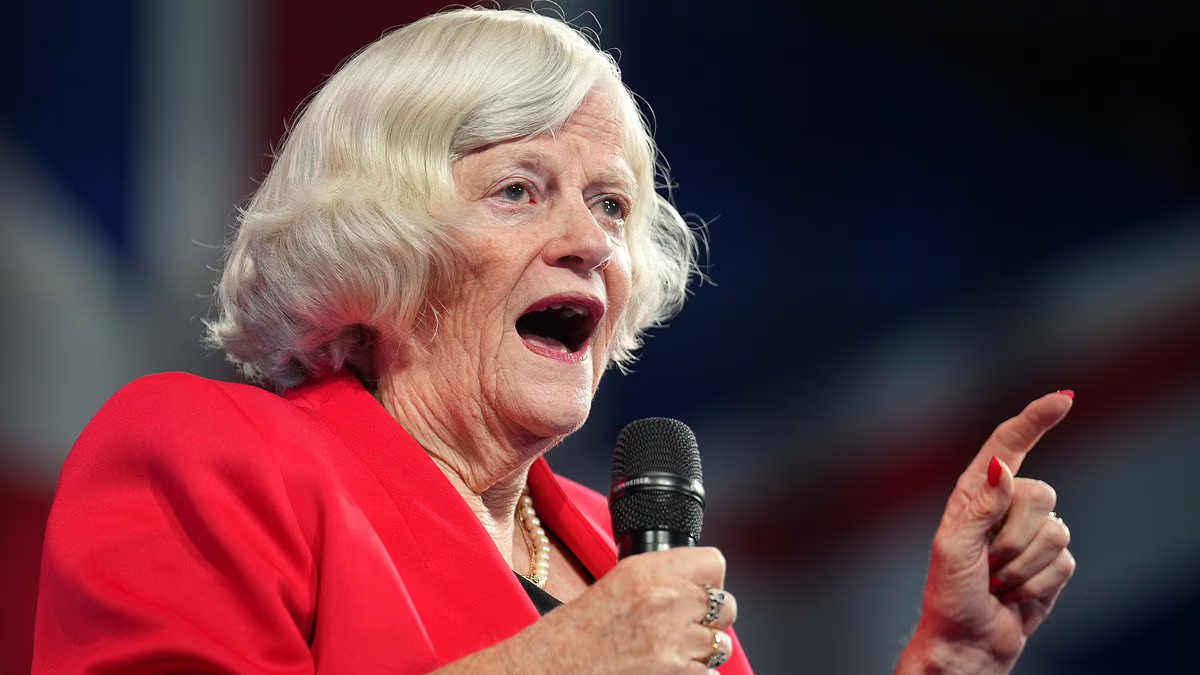

Home Secretary Shabana Mahmood spent an hour fielding questions in the Commons on the murder of Ann Widdecombe. From the press gallery, the overwhelming feeling was one of deep, empty sadness.
Perhaps it was the drained mood that comes at the end of the summer term, sharpened by the heat. Or perhaps age simply makes these moments land more heavily.
Jo Cox, Sir David Amess and now Ann: looking down from the gallery at MPs below, it was impossible not to feel a dreadful question forming — who will be next?
“May she now rest in eternal peace,” Ms Mahmood said.
Coming from a party not always instinctively comfortable with religious language, the line felt striking and oddly moving. Delivered quietly at the close of her opening remarks, it brought an unexpected sting to the eyes.
Florence Eshalomi, the Labour MP for Vauxhall and a churchgoer, offered a similar tribute: “May her gentle soul rest in peace.” One Labour colleague laughed softly at the description, perhaps finding the word “gentle” surprising when applied to Ann. Yet those who knew her would understand it. She could be gentle. Truly.
Her death prompted grief, warmth and, fittingly, flashes of humour. Robert Jenrick, the Reform MP for Newark, remembered arriving in Parliament as its youngest member, only for Ann to inspect him and ask: “Are you here on work experience?”
Richard Tice, Reform MP for Boston, admitted that although she was a foot shorter than him, he always felt he was the one looking up. If Ann rang, he said, he would instinctively stand to attention. She also enjoyed a dram, he added, suggesting a limited-edition “Widders’ Whisky” — fiery on the tongue and “a blend to be treasured to eternity”.

Home Secretary Shabana Mahmood took an hour of Commons questions about Ann Widdecombe’s murder. All I could feel was a hollowing sorrow
As these and other pieces were being said, half-remembered images and sounds flitted across my brow: Ann’s teetering waddle, that Margaret Rutherford bust, her scarlet-varnished forefinger raised mid-oratory.
And the voice. It pinked like a Hillman on bad petrol. Not so much a woman’s larynx as the squawk of a disturbed pheasant, a stick being rattled inside a metal watering can.
She did not just roll her Rs – she played skiffle washboard with them.
In the hunting ban debate years ago she defended foxes from the Tory benches. On all sides sat colleagues, steaming with anger yet powerless in the theatre of the moment.
And then a moment of despair on election night 2017.
We were in a TV studio. After it became clear Theresa May had thrown away her power, London Lefties all around us were crowing about the result.
Ann grabbed hold of me. I felt like a rubber ring in a shipwreck. Such a squeeze. Then off she marched to do battle on air. Responding to her murder, MPs criticised social media for being engines of hatred.
Lee Anderson (Ref, Ashfield) said it was not as simple as that. Sometimes the venom was produced by parliamentarians.
Mr Anderson noted that members of the current Commons had denounced Reform MPs as ‘racists, Nazis, bigots’. What did that do for the political climate? Ms Mahmood said ‘we should show our best selves’.
Mr Jenrick suggested that it had been ‘unwise’ of the Home Office to downgrade security for Nigel Farage.
‘Many will conclude, perhaps unfairly, that it was only because of his political views,’ added Mr Jenrick. Ms Mahmood insisted that the decision was an independent one.
By the way, MPs on all sides defended Speaker Hoyle from accusations, by that little charmer Zia Yusuf, that he has somehow been negligent about MPs’ safety.
Any danger of the session turning too purple was saved by Sir Iain Duncan Smith (Con, Chingford), recalling that in her days as one of John Major’s ministers, Miss Widdecombe was an indignant defender of the pro-EU Maastricht treaty. Yet later she joined Reform!
Lucy Powell, reportedly soon to become deputy PM, insisted she had always ‘admired and respected’ Ann. She concluded: ‘We don’t make them like that any more.’
If that is true, the reason is that politicians have had the verve knocked out of them, not by any fear of violence on their own part as by party managers’ terror of difference.
The gloopy, risk-aversion brigade has been as bad for parliamentary democracy as any mad attacker.


