
A train collision in Spain that claimed at least 68 lives is the latest in a string of deadly railway disasters to strike the country.
Safety concerns have surrounded Spain’s rail network for years. Wednesday’s fatal crash in Toledo province came just one day before train drivers who had voiced concerns about safety procedures were due to begin strike action.
Rail unions had planned a 24-hour strike on Thursday at Renfe, Spain’s state-owned railway operator, calling for safer working conditions.
“Our aim is to change the system and make it safer,” the union said earlier this month.
The union also demanded assurances that trains would be “reliable and safe”, adding: “We are calling for genuine, permanent technical solutions to the safety and reliability problems that have affected our rolling stock for years.”
Wednesday’s crash occurred while memories remained fresh of another collision between high-speed trains in January, which killed 46 people.
Following the January crash in Adamuz, critics blamed socialist Prime Minister Pedro Sanchez and questioned whether his government had invested enough in railway maintenance in a country where rail travel accounts for about 57 per cent of all transport.
Although the cause of Wednesday’s collision has not yet been definitively established, the crash has renewed questions about the condition of Spain’s infrastructure and the reasons behind the number of deadly incidents in recent months.

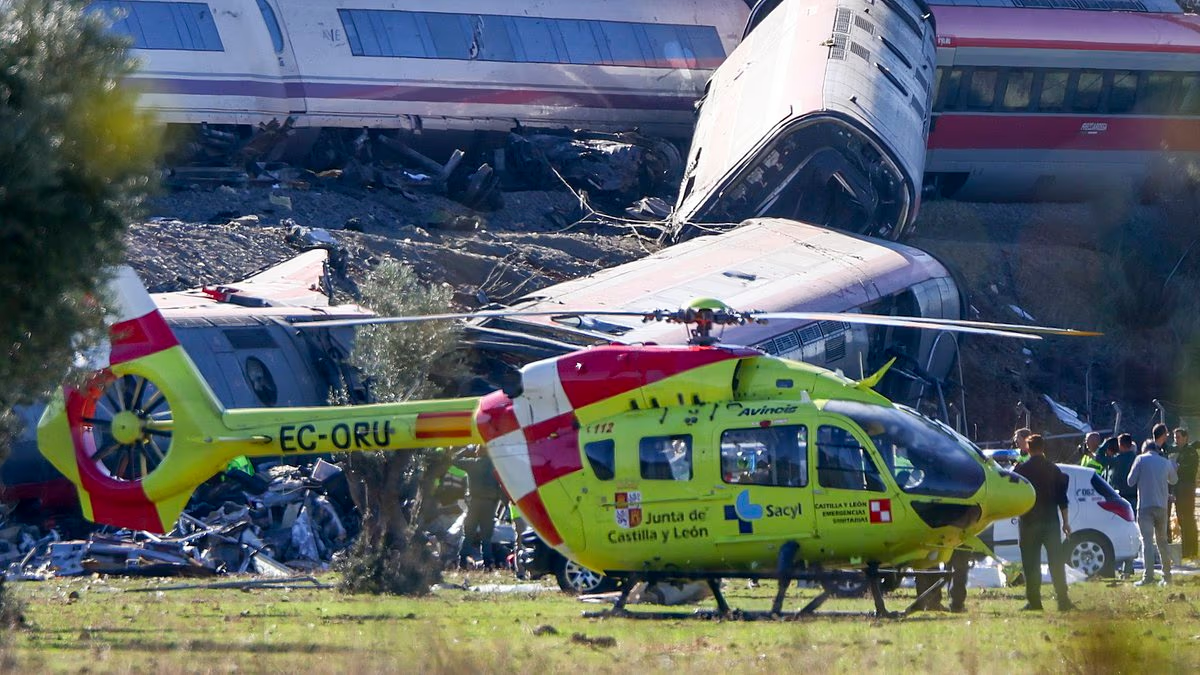
A general view shows the derailed carriages of the two high-speed trains as emergency crews arrive at the scene

Emergency workers at the scene of a collision involving a high-speed Renfe AVE train and an Iryo train about 150km south of Madrid, between Urda and Los Yébenes in Toledo province
Spain has invested heavily in high-speed rail over recent decades. The country’s railway union defines high-speed lines as routes used by trains travelling at 155 miles per hour or more, and the investment has helped make Spain a global leader.
Over more than three decades, Spain has built roughly 2,400 miles of high-speed track for its population of 49 million.
The country only recently opened its high-speed rail network to private operators competing with Renfe.
Carlos Rico, a Spanish railway signalling engineer, told Our News Outlet that private competition had driven up passenger numbers while maintenance levels had remained unchanged.
“In essence, the same amount of maintenance is being carried out as when there was significantly less traffic.”
He said this was “undermining the efficiency of Spain’s railway system and could also affect its safety”.
“People are becoming afraid and losing faith in the rail network. Steps are being taken that should help, but restoring and maintaining such a vast system will take years of intensive work.”
Mr Rico said responsibility for the network lay with Adif, Spain’s state-owned railway infrastructure operator.
“Keeping a network safe when trains regularly travel at 300 kilometres per hour requires major investment, both in the trains and in the infrastructure, especially the tracks.
“Without proper maintenance, 5,000 kilometres of exceptionally high-quality railway can become 5,000 kilometres of infrastructure carrying potentially serious risks.
“For 30 years, Spain’s high-speed railway had recorded only one major accident—the crash in Galicia about a decade ago.
“Yet this year alone, we have already seen two serious accidents, each involving more than 50 deaths. That should lead railway authorities and those responsible for the network to examine carefully what has gone wrong,” he said.
YOU MAY ALSO READ: US MBA Applications Drop 27%, Study Finds

Rail operator Adif said the incident took place between the towns of Mora and Orgaz

An aerial image of the crash site shows dozens of emergency vehicles

About 400 people were initially believed to have been travelling on the two trains involved

A photograph from the scene shows the carriage’s extreme destruction, with what appears to be a section of track driven through it

A passenger rescued from one of the trains involved in the collision arrives in Urda, Spain

Shocking images show passengers evacuating the train after entire carriages were reduced to wreckage

Passengers gather beside the wreckage of the train

A passenger told local media that the carriage was “completely wrecked” moments after the collision
Joan Rodríguez, a spokesperson for Spain’s train workers’ union, also warned that rising passenger numbers had placed additional pressure on the rail infrastructure.
“We are not convinced that opening high-speed passenger services to competition was accompanied by the necessary investment in maintaining the lines,” Rodríguez told Spanish broadcaster TVE.
“I am not saying it was the decisive factor in the crashes, but the increased use of the network is certainly something that must be considered.”
Authorities confirmed that 68 people had died and said dozens more were injured after an Iryo service travelling from Madrid to Seville reportedly stopped near Toledo because of a signalling failure.
Ten minutes later, a Renfe train travelling along the same route hit the stationary locomotive after the central control centre failed to alert it to the disruption and instructed it to continue.
Several carriages from both trains derailed in the collision. Most of the victims were believed to have been in two cars that fell down an embankment at the crash site.
About 544 people were believed to have been travelling on the two high-speed trains, which can reach speeds of up to 300km per hour—around 185mph.
Spain’s Transport Minister Óscar Puente said the crash followed what he described as an “inexplicable” instruction from the central command centre after a safety system failed. He said the train drivers were not responsible.
Puente said the safety system covering a 63-kilometre (39-mile) stretch stopped operating at 8.30am because of a computer malfunction, bringing all trains on that section to a halt.
The central control centre then instructed the Renfe train to resume its journey without imposing a speed restriction. At 8.53am, it collided with the stationary Iryo train.
Puente said the Renfe service should not have been cleared to move while a “stop signal” remained active on the line. Even if it had been allowed to proceed, he said, it should have travelled at a reduced speed.
Officials were still examining the available data to determine the train’s exact speed, but Puente said it may have been travelling at up to 200kph (124mph) on that section of track.
Regional government sources later raised the death toll to “at least” 68. The earlier reported figure had been 64.


