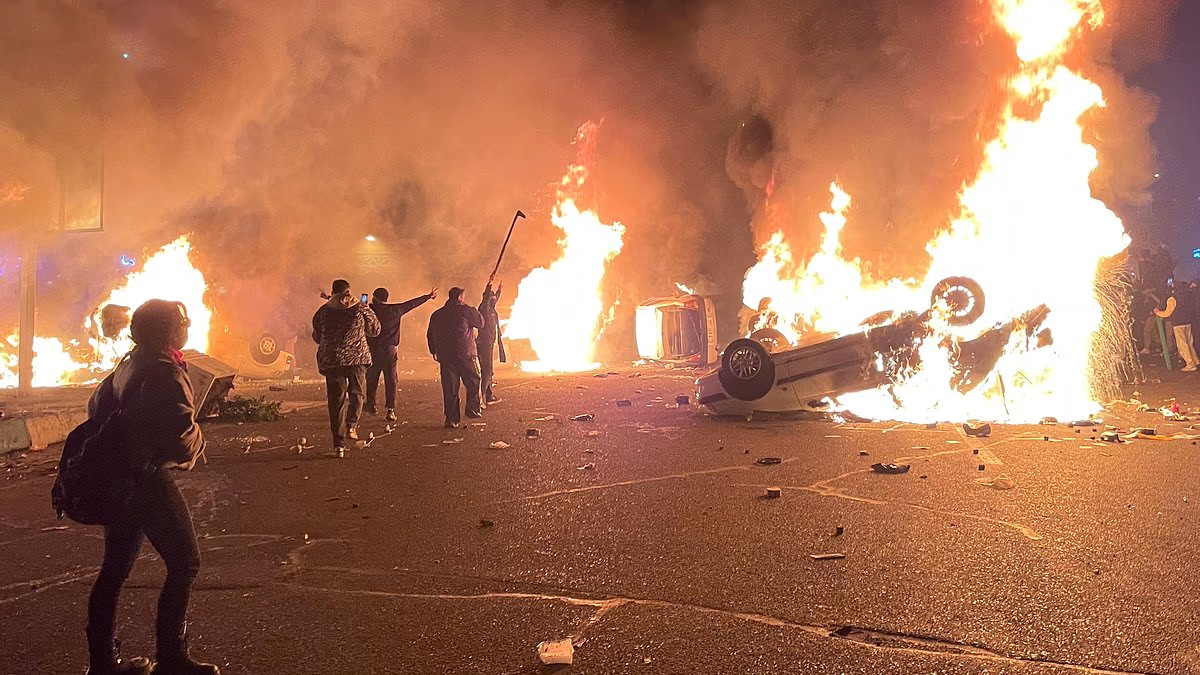

For Iranians who stand against the Islamic Republic, fear can arrive without warning. A knock at the door may come in the dead of night. Some keep improvised weapons beside their beds, though sleep is elusive as pro-regime gangs move through the streets waving flags and blaring loyalist slogans through residential windows.
Morning brings little relief. Instead, there is often news of another arrest before dawn, another execution — with more than 100 believed to have taken place in the past month — and another household left shattered.
Six months after what doctors have described as the largest massacre of protesters in modern history — with estimates suggesting more than 30,000 people may have been killed, most of them over just two days — Iran’s citizens continue to endure conditions of extraordinary hardship and repression.
Machine guns now stand in town squares. Checkpoints break up roads across the country. Regime banners and propaganda have even been hung over cemeteries where its victims lie buried. Meanwhile, the cost of food and medicine climbs daily, and ordinary joys, once taken for granted, seem to have disappeared from public life.
Against that bleak backdrop, the regime last week staged an imposing display of solemn unity during the six-day funeral of Supreme Leader Ali Khamenei, who was assassinated at the start of the Iran war in February.
Foreign journalists were brought in to carry the carefully managed images abroad, part of an effort to present a government still standing firm. Tehran’s message to the West was unmistakable: the January uprising had been crushed, the US-Israeli war had failed to topple the system, and any future peace settlement would only strengthen its grip. Yet the prospect of lasting peace appeared as distant as ever yesterday, as US strikes hit more than 100 targets.
In places where blood had filled the streets in January, vast crowds of pro-regime mourners — perhaps numbering in the millions — formed a dark procession through Tehran and onward toward the holy city of Qom.
The funeral procession then moved through some of Shia Islam’s most sacred shrines in Iraq, in an overtly symbolic bid to project regional power, before returning to Iran’s religious heartland for Thursday’s burial in Mashhad, the country’s second city of faith.

Six months on from the largest slaughter of protesters in modern history, the people of Iran are still suffering in the most abject manner imaginable

Doctors estimate more than 30,000 could have been killed during protests in January, most over two days
Amid the black were red flags of revenge, waved at the Great Satan in Washington and Little Satan in Jerusalem over the killing of Khamenei.
But this morbid, highly staged ceremony aroused only contempt and anger among most Iranians. For them, nothing can ever wash away the sheer loathing they feel for this corrupt, sadistic regime after the horrendous slaughter back in January.
Away from the cortege and the media glare, hunkered down in their houses, a number of these brave souls tell us of another revenge that is brewing – their own.
‘Fear has taken a back seat,’ Avin*, a schoolteacher in her 30s, tells the Daily Mail at great personal risk in a phone call from her home in Iran. After nearly half a century of grotesque misrule and oppression, the people are close to ‘boiling point’, she says.
Six months on from the bloodbath, Avin adds: ‘That sense of dread regarding the threat of being killed has completely lost its deterrent. People realise that if they aren’t killed during uprisings, they are bound to die in a thousand other ways.
‘So, why not die for the revolution, for freedom? Almost everyone is in agreement on this point.’
She adds: ‘We have embarked on a path of no return,’ suggesting that whether the ceasefire has fallen through and US missiles and bombs are once again hitting the country is almost irrelevant.
‘This has nothing to do with what the US or Israel might do. We, the people of Iran, cannot go on living like this, and that event will happen soon – because we can see it within the people themselves.’
What’s more, Avin feels this time the revolt will be bigger even than January as those who stayed at home in that uprising ‘feel ashamed’ and have vowed to put their lives on the line now.
It is a sentiment shared by others we spoke to. ‘We are full of anger,’ Zahra, a fitness instructor in her 20s from a northern coastal city in Iran says. ‘We carry the memories of those who were killed. We carry the pain of their families.
‘We are waiting for the day when those responsible are finally held accountable. That day will come – and many of us believe it is closer than the regime thinks.’
Arash, who lost his cousin and a friend in the massacre, also told us over the phone from Tehran: ‘I promise you the next protest will be even more extensive than the January protests. More people are ready now – especially the family and friends of those who lost loved ones and who didn’t participate last time.’
Avin had always objected to the rule imposed on her people by the Mullahs but her hatred was made intensely personal at a demonstration a few years ago.
Separated from her friends, three regime thugs dragged her down an alley by her rucksack, then one held a gun to her while another sexually assaulted her.
‘It was rape in broad daylight,’ she says. Only when other protesters approached on motorbikes did she manage to flee. Now, each time American or Israeli bombs fall, she thinks of that rapist, prays he has been targeted, and whispers to herself: ‘I hope you’re dead,’
She says: ‘After that ordeal, I turned into someone determined to do whatever it takes to get rid of them.’
‘It felt like the lights of my life had been extinguished by him that day and I know I will not be whole again till they are all gone.’
She is not alone. Mahmood Amiry-Moghaddam, director of Iran Human Rights international non-governmental organisation, says Khamenei’s funeral procession this week was designed to mask deep-seated unrest amid the Iranian people.
‘The authorities know that the vast majority of Iranians do not want this regime,’ he insists. ‘Beyond its systematic repression, it is widely seen as deeply corrupt, incompetent and unable to meet even people’s most basic needs.
‘That is why fear remains the regime’s most important tool for staying in power and executions are its most effective instrument of intimidation.’

The regime laid on a formidable spectacle of sombre defiance with the six-day funeral of assassinated Supreme Leader Ali Khamenei, killed at the start of the Iran war in February

Amid the black were red flags of revenge, waved at the Great Satan in Washington and Little Satan in Jerusalem over the killing of Khamenei
Last month alone his organisation calculated that at least 101 people were executed. It confirmed 360 have been put to death since January, including nine women, while there are more than 400 further reports of executions it has been unable to verify.
And while the longest internet blackout in history imposed after the January bloodbath was lifted in May, a smothering repression persists.
‘I sleep with a hammer by my bed,’ Mehdi, in his 40s, tells us from Tehran. ‘Not just to defend myself but to destroy my phone [and any messages criticising the regime] the moment I hear a knock at the door.’
‘We are terrified about the executions. There are machine guns in the major squares. They are doing everything to intimidate us.
‘At night you can hear the trucks driving through the streets blasting Islamic slogans through loudspeakers. You are lying in your bed and it comes right through the walls of your home.’
The regime has shipped in Islamic militants from Iraq, Afghanistan and African nations including Uganda to help patrol streets, he says.
These were also allegedly used to bolster numbers at the funeral, along with prisoners and civil service workers.
‘Security forces still drive through the streets with armoured vehicles, military equipment and heavy weapons,’ Mehdi adds. ‘Seeing the barrels of machine guns pointed at civilians has become a familiar sight.’
Zahra tells us life in Iran ‘feels like living in an open air prison. Fear follows you everywhere.’
‘In small towns across the country, families know exactly who killed their children. They know who pulled the trigger. They know who gave the orders.
‘Yet those responsible walk freely through our streets while parents visit the graves of sons and daughters they murdered.’
The pain is so intense from the immense loss of life that some have tried to hide the deaths of loved ones to protect relatives.
One family even hid the fact a young man had been killed in the January uprising from his frail, elderly mother. They said he was in prison, rather than dead, fearing the truth would break her.
‘For months she waited for his return – she had no idea he was already dead,’ Zahra says.
‘The cruelty does not end with death. The authorities covered the walls and gates of the cemeteries where victims are buried with slogans praising the Supreme Leader.
‘Imagine visiting your child’s grave and being forced to look at propaganda glorifying the very people you blame for their death.’
Each day Zahra walks past the drains that in January overflowed with the blood of protesters.
‘The blood may have been washed away but my memory of it never will,’ she says. ‘Despite everything, we have not given up.’
Mahsa, in her 30s and from Tehran, adds: ‘You wake up every morning wondering what new disaster awaits. Fear has become part of everyday life.
‘People outside Iran often imagine fear as something dramatic – a knock on the door in the middle of the night. But the reality is worse. The fear never leaves. It follows you to work, to the shops, on to the bus and back into your home.’
Each day prices of medicines and utility bills soar. ‘People are not merely struggling, they are suffocating,’ she says.

It was Pahlavi’s call the protesters answered to take to the streets on January 8 and 9, and whose name they chanted
‘Hanging over everything is a deeper fear: that the worst may still be ahead. Every execution sends a message. Every arrest sends a message. Every checkpoint sends a message. Every armed patrol sends a message.
‘The message is simple: obey, stay silent and be afraid. That is how millions of Iranians are expected to live. Yet fear cannot erase memory – and it cannot extinguish hope forever.’
We speak with one person who had been arrested. Held in a windowless cell, regime interrogators produced reports with printouts of his social media posts, presumably taken from someone else’s phone.
The messages showed support for exiled Crown Prince Reza Pahlavi, who lives in the US but is seen as the leader of the opposition after his father, the last Shah, was forced into exile in the 1979 Islamic Revolution.
It was Pahlavi’s call the protesters answered to take to the streets on January 8 and 9, and whose name they chanted.
As huge numbers of anti-regime individuals do, the arrested man had a ‘dummy’ phone on which he had written only clean messages.
When he showed these to the authorities they were far from convinced and he was sent home to retrieve his real phone. Miraculously he was eventually released.
Many are not so lucky. Arash in Tehran tells us someone he knew who was on leave from the army was shot dead the other week simply for playing music.
‘They were having fun, and the security forces just killed him,’ he says over the phone.
For him, seeing Khamenei’s funeral brought joy. ‘The dictator who ruled Iran for years is gone – and met such an ignominious end… it’s a good feeling,’ he says.
‘The whole experience is almost therapeutic – seeing people wailing and mourning the burial of someone they believed in so deeply, someone they thought was untouchable for decades…they used to boast so loudly, yet now, all of a sudden, everything has collapsed.’
There is more hope, too, from the fact Khamenei’s son and successor, Mojtaba Khamenei, did not even make an appearance at his father’s funeral.
It adds to rumours that the new Supreme Leader, gravely injured in the strike that killed his family, may not have survived, given he has yet to appear publicly since assuming power.
Absent, too, from the funeral were many of the top echelons of the Islamic Revolutionary Guards Corps who rule the country behind the scenes.
‘There’s satisfaction in seeing them so terrified that they don’t even dare attend Khamenei’s funeral,’ says Arash.
For all the slick propaganda professing otherwise, the regime has been hammered. Scores of top-ranking officials and commanders have been assassinated and its weapons of oppression significantly depleted.
While the US-Israeli war has failed in its objective to overthrow them, many experts believe their decline is inevitable given the strength of feeling of the people following the January massacre.
Iranians largely feel betrayed by the international community. But they also sense that they may not need outside help. After decades of misrule, time may finally be on their side.
‘The Iranian people have a boiling point,’ says Avin, who will not rest until the monster who raped her and his cronies fall.
‘Once that threshold is crossed, the major event will unfold. No one knows exactly when but we are certain this event will happen. As each day goes by, we feel its approach more and more strongly.’
* All names have been changed to protect the identities of those we spoke to.


