
As the Supreme Court nears the conclusion of its spring term, attention is focused on several pivotal cases awaiting decisions. The justices are expected to rule on a range of issues, including President Donald Trump’s executive order on birthright citizenship, his dismissal of a Federal Reserve official, immigration policies, restrictions on transgender athletes, and deadlines for mail-in ballots.
Amid the grandeur of the Supreme Court building on 1 First Street NE, with its imposing bronze doors, the most talked-about topic isn’t the legal battles but a more personal matter. It’s encapsulated by the famous question posed by The Clash in their 1981 hit: “Should I stay or should I go?”
Speculation is mounting about potential retirements, with Fox News’ Maria Bartiromo suggesting during an April 15 interview with President Trump that Justice Samuel Alito might step down this summer.
President Trump expressed readiness for various retirement scenarios, indicating that changes could be on the horizon.
“You just read the statistics — it could be two, could be three, could be one,” Trump remarked. “I’m prepared… You mention Alito; he is a great justice.”
Retirement rumors have mostly focused on the court’s senior justices, both appointed by President George H.W. Bush: Justice Samuel Alito, who at 76 is in his twentieth year on the bench, and Justice Clarence Thomas, who has served since 1991 and will soon turn 78.
Similar conjecture swirls perennially around Justice Sonia Sotomayor, an Obama appointee, soon to turn 72, who has managed Type 1 Diabetes since childhood and required medical attention in 2018 for low blood sugar levels.
Publicly, of course, the justices themselves say little about such matters. But it is hardly lost on Alito and Thomas that with the midterm elections fast approaching, this summer may provide the last opportunity to step down under a Republican president and GOP-controlled Senate, nearly guaranteeing their successors would reflect their jurisprudence.

Retirement speculation has centered on the Court’s two oldest members, each appointed by a President Bush

Justice Samuel Alito, now serving, at 76, his twentieth full term on the great mahogany bench (Pictured: President George W Bush and Alito in 2006)

Justice Clarence Thomas will soon to turn 78 (Pictured: President George Bush and Thomas in 1991)
At the same time, Justices Alito and Thomas are said by those familiar with their thinking to harbor a natural desire, if not a sense of duty, to sit on the momentous cases before the Court, to honor their oath and calling, to be in on the action in such a time.
Others have speculated that Thomas, whose ascension to the Court was marred by an unprecedentedly ugly confirmation process, aims to reach an important milestone: If he remains through May 19, 2028, Thomas will become the longest-serving justice in history, eclipsing the 13,358 days served by liberal lion William O Douglas, an FDR appointee.
Retirement soon thereafter would allow President Trump to nominate a successor, although the Senate might be under Democratic control by then, complicating the confirmation process.
Those close to Thomas say he bristles at the idea that he would chase a purely numerical goal, however. ‘He’s at the top of his game, in his element,’ a source close to Thomas told me. ‘I think he believes there is still much work to be done. He plans on serving on the Court for as long as he can.’
If Thomas’s decision-making is guided by remnant bitterness from the ‘high-tech lynching’ he endured in 1991, it may be focused less on the Douglas record than on a remark from his earliest years on the Court. In November 1993, the New York Times’ Neil A Lewis reported that, the year before, Thomas had told a pair of clerks he intended to remain on the Court until 2034.
Why then, they asked. Because that would ensure the justice a tenure equal to his age at the time of his appointment.
‘The liberals made my life miserable for forty-three years,’ Thomas reportedly vowed, ‘and I’m going to make their lives miserable for forty-three years.’
And Thomas, as a Court insider reminded me, ‘is a man of his word.’

Retirement conjecture swirls perennially around Justice Sonya Sotomayor, a Clinton appointee, soon to turn 72

Others have speculated that Thomas, whose ascension to the Court was marred by an unprecedentedly ugly confirmation process, aims to reach an important milestone (Pictured: Thomas sworn in during confirmation hearings in 1991)

James Rosen is chief Washington correspondent at Newsmax and author, most recently, of Scalia: Supreme Court Years, 1986-2001
There are also signs that Alito — despite a recent hospitalization for dehydration — is not considering retirement anytime soon, either.
Some have discerned Alito’s intentions in the fact that he has hired clerks for the Fall 2026 term, which will end in June 2027. The hires do not obligate Alito to serve another term; but they suggest, on their face, a desire to remain on the Court.
‘The past couple of years,’ said a lawyer who knows the justice, ‘he’s been in a better mood.’
It was a reference to Alito’s often dour public persona. I found this myself when, for a biography of Justice Antonin Scalia, I interviewed Alito in chambers last year. When I observed at the outset that he was serving in his twentieth term, he quipped: ‘Don’t remind me.’
It’s no secret that the Supreme Court has not been immune to the decay of good manners and courtesy that has affected society as a whole.
‘I joined the Court that dealt with differences as friends, as we respected each other,’ Justice Thomas told a University of Texas audience on Wednesday. ‘That civility — I don’t know how you bring it back in the current environment, with social media and name-calling and all people accusing each other of various things, and animus.’
The same day, Justice Sotomayor released an apology to Justice Brett Kavanaugh over ‘inappropriate’ and ‘hurtful’ comments she had made at a University of Kansas event the week before, concerning a recent ruling on the scope of immigration agents’ police powers.
Sotomayor had described Kavanaugh, obliquely, as ‘a man whose parents were professionals and probably doesn’t really know any person who works by the hour… There are some people who can’t understand our experiences, even when you tell them.’

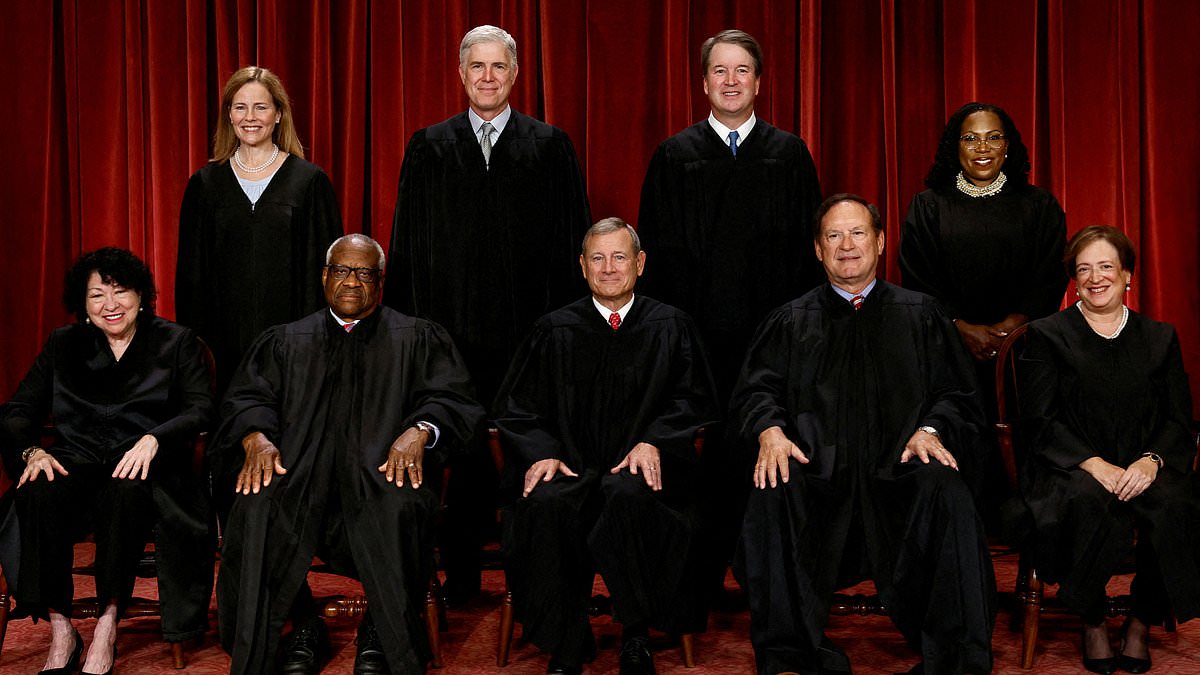
The sharp tone adopted by President Biden’s lone appointee to the Court, Justice Ketanji (pictured, top right) Brown Jackson—who condemned the majority in the birthright citizenship case as ‘an existential threat to the rule of law’—prompted a rebuke from Justice Amy Coney Barrett (top, left)

Scalia: Supreme Court Years, 1986-2001 , by James Rosen
The sharp tone adopted by President Joe Biden’s lone appointee to the Court, Justice Ketanji Brown Jackson — who condemned the majority in the birthright citizenship case as ‘an existential threat to the rule of law’ — prompted a rebuke from Justice Amy Coney Barrett and has ‘raised questions,’ the New York Times’ Adam Liptak reported, ‘about her relationships with her fellow justices, including the other two members of its liberal wing.’
I interviewed Justice Thomas in chambers in July 2017. Twenty-six terms in, he was relaxed, erudite, funny, and contemplative, happy to pose for photos or discuss recent readings on the Ottoman Empire.
After the confirmation ordeal, Thomas found Scalia’s hand outstretched to welcome him. The two swiftly bonded: Brothers for Life.
‘There was a relationship there that has never been written about,’ said Brian Lamb, the C-SPAN founder who knew both men for decades.
‘Nino thought Clarence was a rock,’ agreed the late Judge Larry Silberman, a confidante to both justices. ‘He was impressed by Clarence’s courage.’
Other justices and their clerks caught glimpses of Scalia and Thomas sneaking cigarettes in the lawyers’ lounge or breaking away from the Court’s marshals to attend an afternoon mass. Asked if he ever discerned any evolution or change in Scalia over the quarter-century they served together, the justice’s reply, previously unpublished, was framed in terms that could apply equally to himself.
‘I think [Scalia] and his jurisprudence,’ Thomas said, ‘is, in time, like a fine wine. I think you age with it. You become better.’
Then he turned wistful: ‘I was looking at a picture of us when we — when I first got here, and we were so much younger and thinner, you know?’
With so many momentous cases ahead, not just in the Court’s current term but across the remainder of the Trump era, many of the president’s advisors believe that he and his legacy would best be served by the continued service of both Alito and Thomas, who are regarded by conservatives as the Court’s most principled originalists and most intellectually courageous members.
James Rosen is chief Washington correspondent at Newsmax and author, most recently, of Scalia: Supreme Court Years, 1986-2001.