
Share this @internewscast.com
The Iranian government has embarked on a violent campaign to suppress political opposition and thwart any potential rebellions.
In the past two days, at least four prominent opponents of the regime have faced execution, with an additional 15 political prisoners recently receiving death sentences, as reported by an opposition organization.
The National Council of Resistance of Iran, a coalition of exiled dissidents, has sounded the alarm over a possible impending ‘massacre’ within the nation’s prisons, as the authorities, feeling threatened, seek to eliminate any possibility of widespread dissent.
This harsh crackdown coincides with ongoing bombardments from the United States and Israel targeting Iranian sites.
These events follow the recent death of Supreme Leader Ali Khamenei in an airstrike, who had previously overseen the brutal suppression of thousands of protesters in January. His son, Mojtaba, has since assumed leadership.
In a briefing held on Wednesday, Mohammad Mohaddessin, Chair of the NCRI’s Foreign Affairs Committee, remarked, “These executions were not merely the loss of four lives; they were intended as a stark message from the regime.”
Mr Mohaddessin warned that the killings of Pouya Ghobadi, Babak Alipour, Mohammad Taghavi Sangdehi and Ali Akbar Daneshvarkar – all members of the People’s Mojahedin Organisation of Iran – were the product of the regime trying to ‘exert control.’
‘Why were they executed now? During a very hard external war? Because the regime leadership is extremely concerned about the domestic situation and the possibility of another uprising,’ he said.

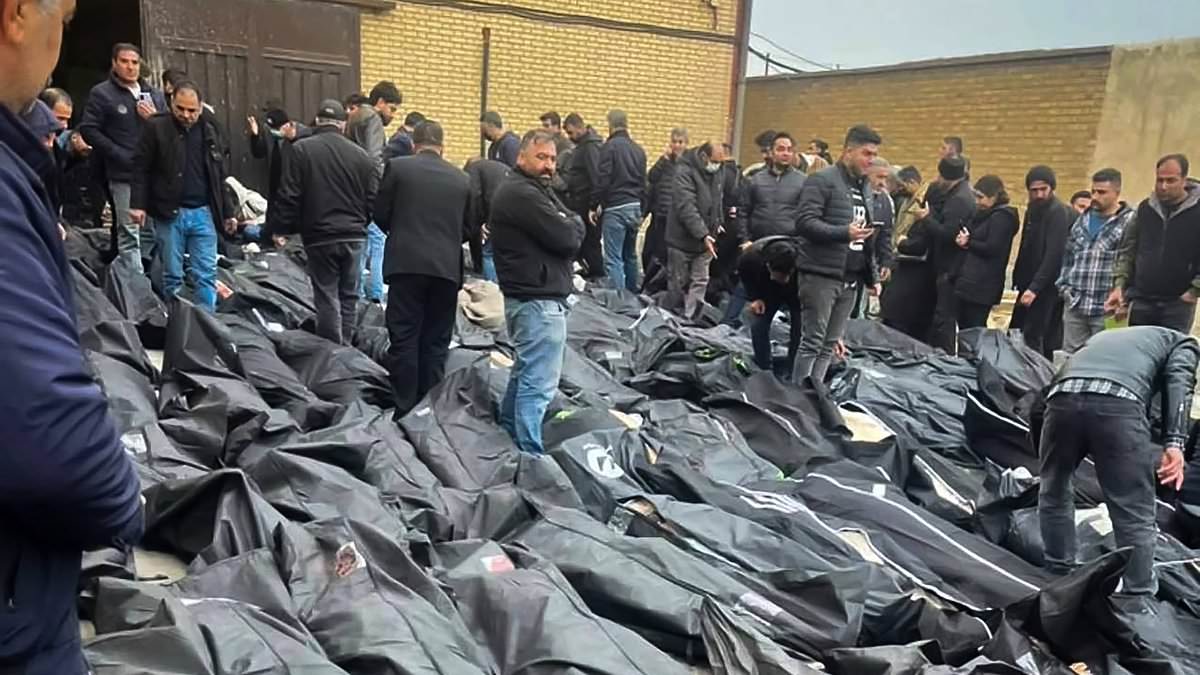
Families and residents gather at the Kahrizak Coroner’s Office, confronting rows of body bags as they search for relatives killed during the regime’s violent crackdown on protests in January

Iranian police special forces stand guard during a funeral procession for Alireza Tangsiri, head of Iran’s Islamic Revolutionary Guard Corps Navy, and others killed in Israeli strikes in late March, in Tehran, Iran, Wednesday, April 1, 2026


Iran’s regime has launched a killing spree in an attempt to clamp down on political dissidents, with four men already executed this week. Babak Alipour (pictured) was killed on Tuesday
‘The regime wants these executions to intimidate, to send a warning.’
Mr Mohaddessin added that scores of prisoners are still at risk of execution and said that a court in Iran has already confirmed the death sentences of 15 other members of the PMOI.
He also warned that the world was witnessing a ‘prelude to a massacre of political prisoners, similar to 1988, when the regime, facing the consequences of its defeat in war with Iraq, carried out mass executions in which 30,000 political prisoners were executed.’
Citing Iranian dissident politician Maryam Rajavi, he added that Tehran’s executions reflect the regime’s ‘fear and desperation’ in the face of an enraged population and growing support for the Resistance Units and the Liberation Army.
‘Carrying out such executions amid an external war is a clear admission that the regime’s principal enemy is the Iranian people and their Resistance.
‘Although the regime seeks to exploit external war to mask its deep and unresolved internal crises, it cannot escape its inevitable overthrow by the people and the Resistance,’ he added.
He also urged the international community to take effective measures to halt executions in Iran.
‘The UN, US, and all defenders of human rights must condemn the executions of PMOI members,’ Mr Mohaddessin urged, saying that ‘the international community must uphold its obligation.’
The NCRI’s warnings come following the hangings of political prisoners Pouya Ghobadi and Babak Alipour on Tuesday.
Their deaths came a day after the deaths of Mohammad Taghavi Sangdehi and Ali Akbar Daneshvarkar.
All four were political prisoners belonging to PMOI and had been sentenced to death over two years ago.
According to NGO Iran Human Rights, their executions were carried out in secret, without their families being notified in advance.


The pair were killed by Iranian authorities on Monday
Alipour, a 34-year-old law graduate, was jailed in 2018 and 2021. He suffered from intestinal infection and prostate disease during his previous incarcerations, which were left untreated for a prolonged period.
He was arrested again on 27 December 2023 and transferred to the notorious Evin Prison, where he was under interrogation for four months.
Ghobadi, 32, was an electrical engineer whose five family members were jailed and executed in the 1980s. He was arrested in February 2018 and 2019. In November 2019, he was jailed in the Greater Tehran Penitentiary. He received a ten-year sentence and was released in February 2022, before being detained again in February 2024.
Sangdehi, 60, was arrested in 2024 and was being held in the Evin prison.
Daneshvarkar, also 60, was an engineer and had spent the last years of his life in Evin prison. He was prosecuted in a joint case alongside several other political prisoners on charges including membership in the PMOI, ‘assembly and collusion against national security,’ and ‘forming illegal groups.’
Amid the Iranian regime’s security crackdown since the start of the war, armed teenagers have been ordered to patrol the streets of Tehran to maintain control.
During the first weeks of the war against the United States and Israel, checkpoints sprang up around the capital, often comprising police or military vehicles, with traffic cones and barriers blocking the roads.
In recent days, following highly publicised airstrikes on their positions, some of the most visible barriers have been removed, but security forces remain a noticeable presence on the streets.
Iranian authorities have confirmed they are recruiting children as young as 12 for paramilitary group patrols, traffic checks and other duties.
‘Around 9 pm, I was feeling suffocated and nostalgic, so I got in the car to drive around town,’ a 28-year-old woman told AFP on condition that her identity be protected.
‘I came across two checkpoints in the north of Tehran, with teenagers aged 13 or 14, weapons in their hands, who were stopping vehicles,’ she added in a message sent to an AFP correspondent abroad.
One of the boys opened the passenger door and sat down next to her.
‘He asked for my mobile phone and checked everything, even my photographs. It was extremely intrusive,’ she added.
Hundreds of Iranian authorities have been arresting people for connecting to the international internet, which remains banned and largely inaccessible, while those caught sending information overseas have been accused of spying.
Another Tehran resident told AFP last week he had been through a checkpoint of military vehicles, then ‘just 100 metres (330 feet) ahead, there are several private cars with teenagers stopping vehicles’.
‘They open car doors without permission, open dashboards and check phones,’ he added.