
Share this @internewscast.com
In a dramatic escalation, oil tankers burst into flames after being hit by explosive-laden Iranian boats, marking a tense moment in the ongoing conflict over global oil supply.
Iran has intensified its efforts to control the world’s oil resources by obstructing the crucial Strait of Hormuz. The nation has been accused of deploying mines targeting commercial ships, further escalating tensions in the region.
On Wednesday, Iran issued a stark warning, suggesting that the world should brace itself for oil prices soaring to $200 per barrel. This caution came in the wake of attacks on three cargo ships navigating the Strait of Hormuz, a critical artery for oil transport.
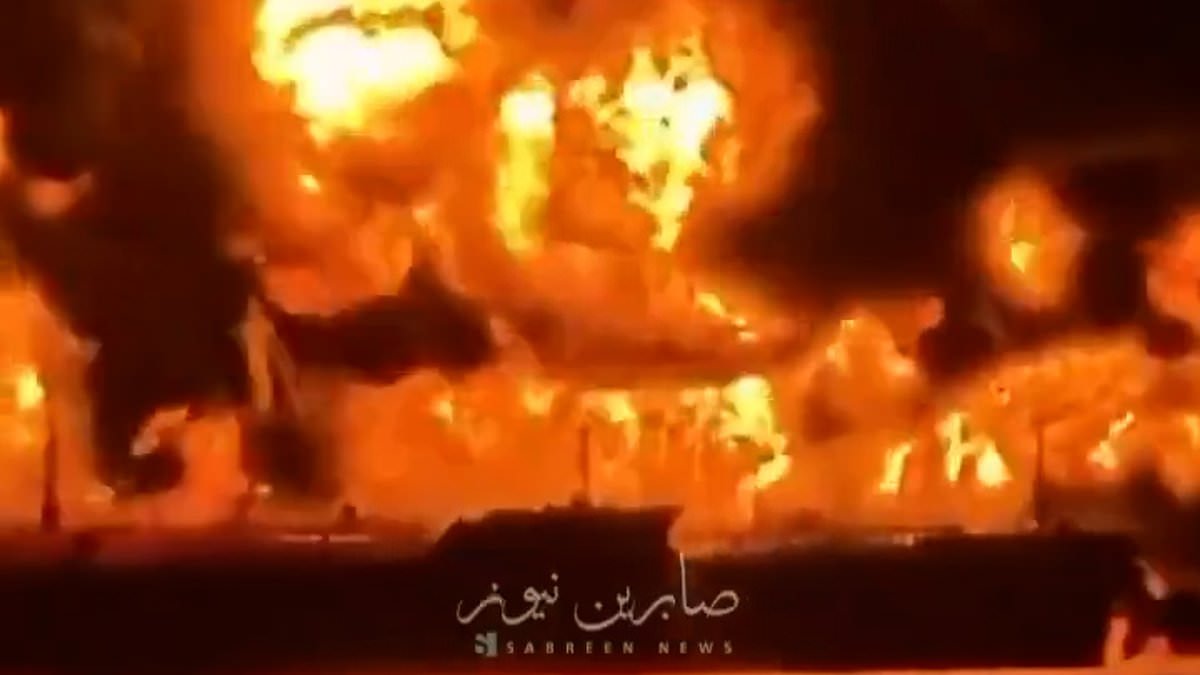
Newly released footage captures the intensity of an Iranian assault, showing a massive orange flash erupting in the water, quickly succeeded by a surge of flames. The scene is both alarming and captivating, as the faint silhouette of a ship emerges, illuminated by the fiery blaze, while thick plumes of black smoke rise ominously into the night sky.
The inferno rapidly engulfs the vessel, with flames leaping hundreds of feet into the air, painting a vivid picture of the destructive power unleashed in these waters.
The oil fire continues to swell as more of the vessel is set ablaze, with flames reaching hundreds of feet into the air in a short time.
The boat was one of several ships carrying Iraqi oil supplies hit by the country’s Middle East neighbour on Wednesday.
The Iranian attack saw one crew member killed and triggered a rapid response from Iraqi authorities.

This is the moment Iraqi oil tankers erupt into flames after being struck by explosive-filled Iranian boats

Footage has now been released of the Iranian strike and sees a huge orange flash in the middle of the water, followed by rapidly spreading flames
Officials rushed to the scene to evacuate crews from the ships as flames engulfed the area.
The vessels were working within Iraqi territorial waters at the time of the strike, according to the country’s director general of the General Company for Ports, Farhan al-Fartousi.
He said: ‘Two foreign tankers carrying Iraqi fuel oil were subjected to unidentified attacks inside territorial waters, causing them to catch fire.’
All oil ports have ‘completely stopped operations’ in the wake of the attack, Iraqi officials announced, but commercial ports will keep working as normal.
It is the latest act of Iranian aggression in a bid to choke the world oil supply and leverage popular opinion in other countries, as fuel prices soar.
Iran has all but cut off access to the Strait of Hormuz, a chokepoint in global trade that ordinarily sees around 20 per cent of all oil pass through daily.
Since the start of the war in the Middle East, however, it has established a domineering presence in the Strait, leading to oil prices hitting a peak of nearly $120 a barrel, before dropping to its price at time of publication of $87.
Ebrahim Zolfaqari, spokesperson for Iran’s military command said in comments directed at the US and its allies: ‘Get ready for oil be $200 a barrel, because the oil price depends on regional security which you have destabilised.’
On Tuesday, Iran said it would not allow ‘one litre of oil’ to be shipped from the Middle East if US and Israeli attacks continue.
An attack on the Thailand-flagged bulk carrier Mayuree Naree from an ‘unknown projectile’, which was reported at 4.35am GMT, happened 11 nautical miles north of Oman and resulted in a fire onboard the ship.
Authorities are searching for three missing crew members from the Mayuree Naree after 20 were rescued by the Omani navy.

Authorities are meanwhile searching for three missing crew members from the Mayuree Naree, pictured, after 20 were rescued by the Omani navy
Earlier, the Japan-flagged container ship One Majesty had sustained minor damage from an unknown projectile 25 nautical miles northwest of Ras Al Khaimah in the United Arab Emirates, two maritime security sources said.
Its crew members are safe and the vessel is sailing towards a safe anchorage, the sources added.
A third vessel, a bulk carrier, was also hit by an unknown projectile approximately 50 miles northwest of Dubai, maritime security firms said.
Iran today confirmed it had attacked the ships, adding: ‘The American aggressors and their partners have no right to pass.’
The projectile had damaged the hull of the Marshall Islands-flagged Star Gwyneth, maritime risk management company Vanguard said, adding that the vessel’s crew were safe.
Earlier, Saudi Arabia’s state oil company warned of ‘catastrophic consequences’ for the world’s oil markets if the Middle East war continues to choke exports.
Amin Nasser, the CEO of Aramco, said: ‘While we have faced disruptions in the past, this one by far is the biggest crisis the region’s oil and gas industry has faced.’
He admitted that while his firm, the world’s single biggest exporter of oil, was meeting most of its customers’ needs for now, this was only possible by tapping into storage facilities outside the Gulf.
Nasser said that these stores cannot be used for ‘an extended period of time, but for the time being, we are capitalising on it.’
The CEO said: ‘There would be catastrophic consequences for the world’s oil markets, and the longer the disruption goes on … the more drastic the consequences for the global economy.’
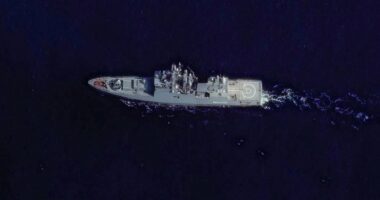
The attacks came shortly after American forces destroyed 16 Iranian minelaying vessels near the Strait of Hormuz.
The White House had earlier warned Iran will be hit ‘at a level never seen before’ if they place mines on the Strait of Hormuz amid concerns the regime could target the key oil waterway.

The price of oil rose rapidly this week, following the closure of the Strait of Hormuz
‘US forces eliminated multiple Iranian naval vessels, March 10, including 16 minelayers near the Strait of Hormuz,’ the US Central Command announced on X, with an accompanying video showing some of the strikes.
The Strait of Hormuz is the only sea passage between the Persian Gulf and the Gulf of Oman.
The minelayers near the Strait of Hormuz were among multiple Iranian vessels taken out by US forces on Tuesday.
The military published the figure and unclassified footage of some of the vessels after Donald Trump warned Iran against laying mines in the critical waterway.