
Israeli President Isaac Herzog has asked opposition leader Gadi Eisenkot to form a government, dealing a significant blow to Benjamin Netanyahu’s bid to remain in power.
Eisenkot pledged on Saturday to work towards creating a new government after Herzog selected him for the task instead of the incumbent prime minister.
“Now is the time to form a national emergency government. I will do everything to ensure we are worthy,” Eisenkot said in his first response to the announcement.
On Friday, the centrist Yashar party leader said Israel was “in a true, tangible, and dangerous state of emergency”.
He accused Netanyahu’s government of posing “the most fundamental” threat to the very existence of Israeli democracy.
Herzog’s decision followed a deadlocked election that left neither candidate with a clear route to power.
Netanyahu, Israel’s longest-serving leader, is fighting to retain office after his religious-nationalist coalition lost its majority in the October 27 election, although it remained the largest bloc in parliament.
Eisenkot, a former military chief, has refused to form an alliance with Arab parties, whose backing would give him enough seats to command a parliamentary majority.

Israeli prime minister Benjamin Netanyahu speaks to supporters at Likud party headquarters in Jerusalem on October 28

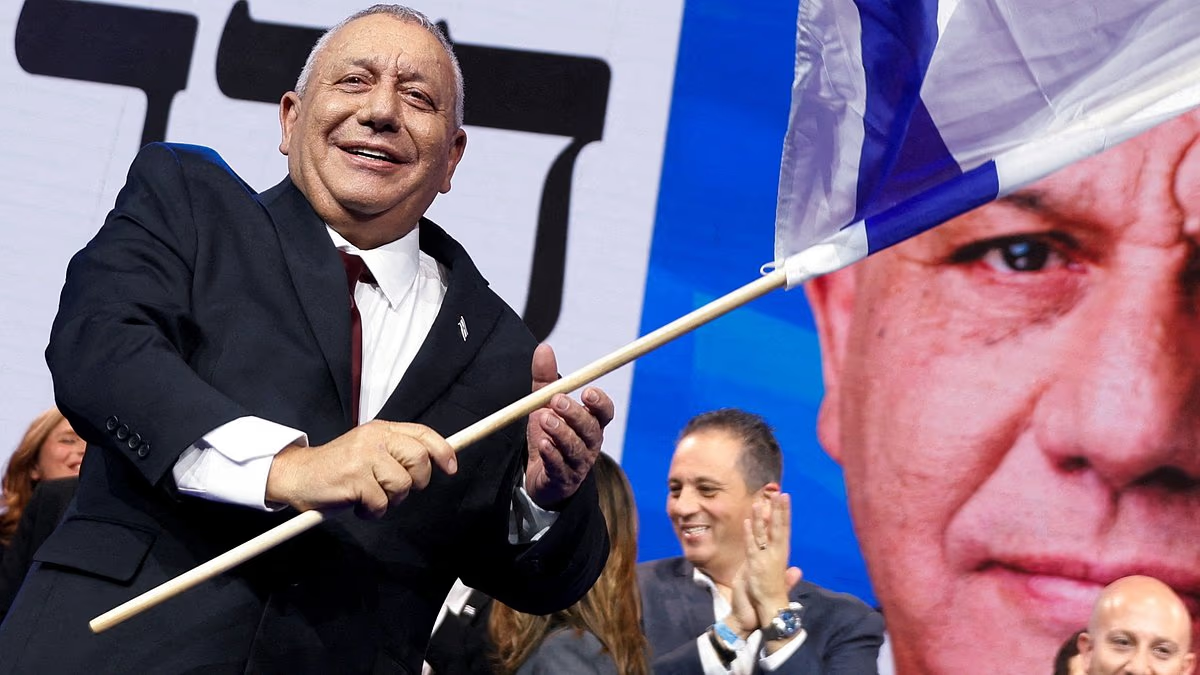
Former military chief Gadi Eisenkot, leader of the Yashar party, waves an Israeli flag following the exit polls at his party headquarters on October 28
However, Arab leaders, angered by what they regard as racist policies pursued by Netanyahu and his far-Right allies, still endorsed Eisenkot as the first candidate to attempt to form a government, giving him the largest number of nominations.
“President Herzog has invited Gadi Eisenkot to the president’s Residence, where he will be tasked with forming the government tomorrow,” a spokesman for President Isaac Herzog said. The largely ceremonial president is responsible for naming a candidate to build a governing coalition after elections.
Eisenkot’s nomination is expected to trigger weeks of difficult negotiations. He has 28 days to assemble a government, with the possibility of a further 14-day extension.
KEEP READING: Harrods Accused of Delaying Payouts to Mohamed Al Fayed Abuse Victims with ‘Crusader’ Tactics
His possible routes to power include forming a minority government that relies on Arab party support for key votes, building a coalition with ultra-Orthodox parties previously rejected by him and his allies, or entering a unity government with Netanyahu.
Analysts say none of the three scenarios is likely. Should Eisenkot fail, another candidate can be given the opportunity to form a government. If that attempt also collapses, parliament can nominate a further candidate.
The process has an overall deadline of roughly 100 days. If no candidate succeeds, another election is held.
Likud won more seats than any other party, taking 27 of the Knesset’s 120 seats. But Netanyahu’s broader religious-nationalist bloc secured only 53 seats, leaving it eight short of the 61 required for a majority.
Eisenkot’s Yashar party finished as the second-largest, with 21 seats. Its coalition of four centre-left to Right-wing Jewish-led parties won 48 seats in total.

Protesters gather at Habima Square to demand the formation of a joint government including Arab parties on November 7
Two parties representing Israel’s Arab minority won a combined 19 seats, an unprecedented result.
Eisenkot, 66, is the son of Moroccan immigrants and would become Israel’s first prime minister from the country’s Mizrahi community, whose Jewish members trace their roots to the Middle East and North Africa.
A reserved figure who generally avoids the media, Eisenkot entered politics only in 2022. He briefly joined Netanyahu’s wartime cabinet after Hamas’s October 7 attack on Israel before returning to the opposition.
While in opposition, he repeatedly criticised Netanyahu’s leadership, including his handling of the military campaign in Gaza, and vowed never to serve in a government led by him.
Eisenkot’s public image is also shaped by the personal toll the conflict has taken on his family: one son and two nephews were killed while fighting in Gaza.
During the election campaign, he emphasised his security credentials and referred to his “Dahiyeh doctrine” of responding to attacks with disproportionate force. He used the approach as a commander during Israel’s 2006 war with Iran-backed Hezbollah in Lebanon.
Eisenkot has also condemned settler violence against Palestinians, which has intensified since 2023 and strained Israel’s relations with Western countries. He opposes Netanyahu’s far-Right coalition partners Itamar Ben-Gvir and Bezalel Smotrich, both of whom have faced sanctions from some Western governments over allegations of inciting violence against Palestinians.


