
Downing Street told reporters on Thursday that Andy Burnham was “negotiating from a position of strength” as talks over his Brexit reset entered their final phase.
That made it difficult not to respond with a hollow laugh yesterday morning, as British officials scrambled to rebut a bruising EU briefing that appeared to put the entire agreement at risk unless the Prime Minister agreed to subsidise European students attending UK universities.
According to the briefing, Britain has six months to find an estimated £500 million a year—or the wider deal could collapse.
The previous Thursday night, negotiators had celebrated after reaching what they believed was a final agreement covering the deal’s three separate strands.
Yet, as has so often happened in Brussels, it turned out that the EU still had another move to make.
When Downing Street officials rejected the claim and insisted the agreement was “done”, their EU counterparts contacted reporters again with a blunt response: “No, we meant what we said.”
In most other settings, such a tactic might be described as a ransom demand. In Brussels, however, this kind of last-minute ambush is regarded as standard negotiating practice.
Theresa May faced similar pressure repeatedly during her tortuous Brexit negotiations, most notably when she was forced to accept the EU’s demand for a £40 billion “divorce payment” before the bloc would even begin discussing future trade arrangements.

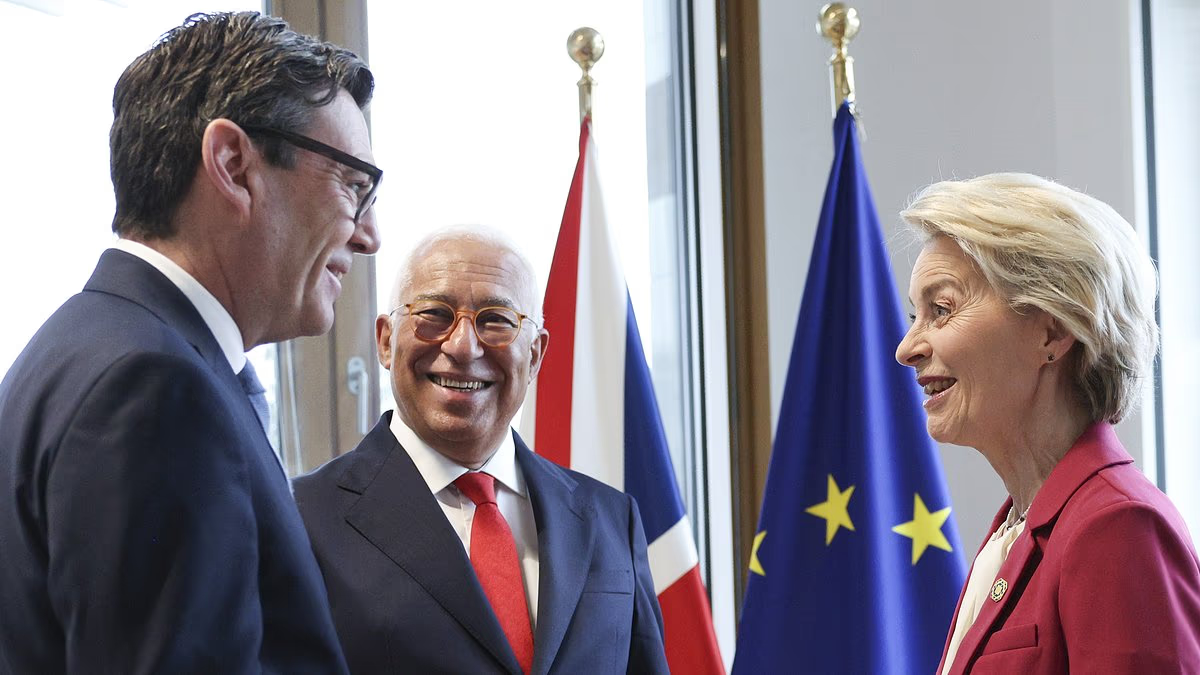
European Council President Antonio Costa, European Commission President Ursula von der Leyen, and British Prime Minister Andy Burnham meet in Brussels on November 20

Mr Burnham greets Ms von der Leyen with a kiss on the cheek in Brussels ahead of the EU-UK Summit at the EU Council
One veteran British official said: “This is what the EU does. You get warm words in public and hardball in private. And the Prime Minister has walked straight into it.”
Even the caterers at the EU’s sprawling Brussels headquarters appeared to join in, serving the Prime Minister fish and chips for lunch as he prepared to sign an agreement confirming that European trawlers will retain access to British fishing grounds until 2038—a concession that secured the EU’s agreement to hold talks in the first place.
Dessert was Belgian waffles.
Negotiations have reached fever pitch in recent days, but the agreement has been under discussion with Brussels ever since Labour came to power in 2024.
The food and farming agreement originated in Labour’s 2024 manifesto, while its broad framework was approved by Keir Starmer last year.
Since then, Labour has made a series of significant concessions, particularly over the EU’s demand to restore a form of free movement for young people.
When Brussels first proposed a “youth mobility scheme”, Labour rejected it, arguing that it was “synonymous with freedom of movement”.
But after the EU made the scheme a condition of closer co-operation, Sir Keir backed down last year.
At the time, the Government said participation would be capped at 50,000 people a year and indicated that successful applicants would be allowed to remain for only 12 months.
IN CASE YOU MISSED IT: Chinese National Caught in LA Counterfeit Goods Smuggling Scheme
Brussels continued to push for more—and secured it. The permitted stay was extended to three years.
An attempt to keep the annual cap at 80,000 was finally abandoned on Thursday afternoon as Mr Burnham sought to push the agreement over the line.
The final limit of 100,000 is twice the number Labour considered acceptable a year ago.
That concession came in the same week the Prime Minister insisted that the Government was focused on creating opportunities for the 1 million British young people currently not in work or education—who will now face renewed competition from overseas.
Even that concession was not enough to secure a guarantee that Britain would be exempt from
the EU’s protectionist “Made in Europe” scheme, which threatens to cause serious damage to British industries including carmaking and steel.
A last-minute French demand to prevent the UK from having any input into future food and farming laws applying here threatened to derail the talks on Thursday evening.
One insider claimed the French had eventually “climbed down from the Himalayas”, but the final agreement still leaves the UK unable to block new laws it opposes.
Business Secretary Jonathan Reynolds said the UK would have “experts in the room” while legislation was being developed, giving it “the ability to have our say”. But he acknowledged: “We won’t have a vote because we’re not members of the EU.”
Mr Burnham said he had personally raised the issue with Emmanuel Macron and rejected suggestions that the arrangement amounted to a democratic “fig leaf”.
Only time will show whether British officials in that room will shape the discussions or merely make the tea. What is already clear is that Parliament will have no further say over a sector that produces roughly two new EU laws every day.
Mr Burnham also appears certain to yield to EU demands for Britain to subsidise university tuition fees—an idea Sir Keir rejected last year.
Brussels initially proposed reducing fees for EU students to about £13,000 a year to cover university costs.
But when British officials finally agreed to the proposal this week, the EU said it now wanted its students to pay the same rate as British students: just under £10,000.
Exasperated British officials rejected the demand, but are expected to capitulate next year rather than risk the EU freezing the entire agreement. The resulting bill for the British taxpayer has been estimated at £485 million a year.
The same pattern applies to Britain’s potential payments into EU cohesion funds. UK officials denied that any contribution had been agreed, yet the published final deal contained a commitment to a “UK financial contribution to reducing economic disparities” within the EU.
The bruising reality of negotiating with Brussels might have prompted some politicians to reconsider their approach. Not Mr Burnham.
EU Council President Antonio Costa pointedly told him that although the UK would be “welcome” to rejoin the EU, it would receive no special treatment.
The Prime Minister pressed on regardless, saying he wanted to spend the next year “brainstorming” ideas for closer relations with Brussels. Good luck with that, as they say.
READ MORE: Cornell Fraternity Members Accused of Student Gang Rape: Messages


