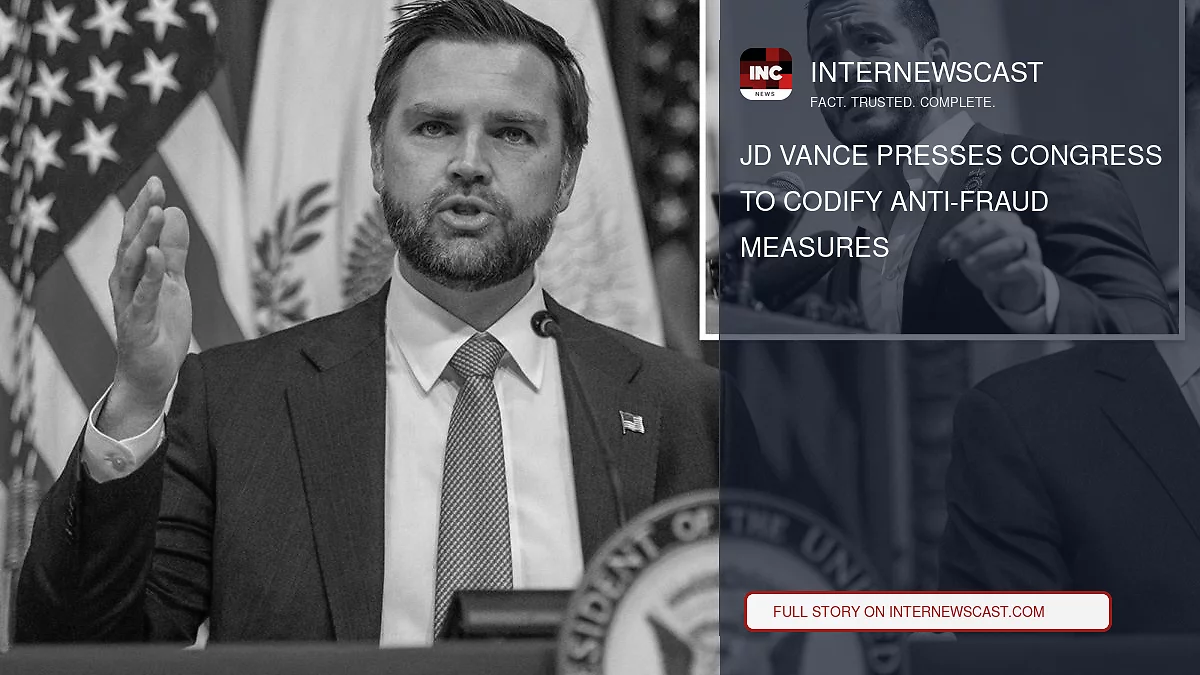

WASHINGTON — Vice President JD Vance urged Congress on Wednesday to lock stronger anti-fraud measures into future legislation, arguing during a White House roundtable that statutory protections are needed to prevent a future Democratic administration from reversing the work of his task force.
Vance told reporters that the White House Anti-Fraud Task Force has identified $230 billion in fraudulent payments distributed through taxpayer-funded benefit programs and has stopped at least $56 billion more from reaching scammers.
Still, the vice president said the administration’s crackdown can only go so far without help from Capitol Hill, noting that the effort “will fundamentally always have a limitation unless our colleagues in the House and the Senate are working with us.”
“We don’t want the next administration, whoever, you know, God forbid you’re gonna have President El-Sayed in three years,” Vance said. “We don’t want him to undo all the incredible work that we’ve been doing.”
Dr. Abdul El-Sayed has criticized Vance’s anti-fraud initiative and has brushed aside concerns that taxpayer dollars are being wasted, misused or lost to fraud.
The roundtable, held in the Indian Treaty Room of the Eisenhower Executive Office Building, was attended only by Republican senators and representatives. Even so, Vance said he hoped Democrats would eventually support legislation that would toughen penalties for fraud and expand data sharing between federal agencies and state governments.
President Trump signed the Republican-backed One Big Beautiful Bill into law in July 2025, narrowing eligibility for non-citizens seeking benefits through the Supplemental Nutrition Assistance Program, or SNAP.
Vance argued Wednesday that the law does not go far enough on its own, claiming that without greater transparency from some states, illegal aliens could continue receiving SNAP benefits.
“If the state of California gives those food stamp benefits to an illegal alien — to a violent criminal — the federal government has no visibility, and sometimes the states themselves have no visibility,” he said.
At least five states — California, Illinois, Minnesota, Maine and Washington State — allow some form of SNAP eligibility to non-citizens, according to the National Immigration Law Center.
“So we need to work with Congress and we need some legislation that would actually force some data sharing between the state governments and the federal governments,” the vice president continued. “And the second is that we would like to see stiffer penalties for fraudsters.”
“We’d like to change those statutes and actually make it harder for people to commit fraud and make sure that when they do commit fraud, they go to jail and they go to jail for a long time,” Vance also said.
The ringleader of the largest COVID relief fraud scheme in the US, known as the Feeding Our Future scam, was sentenced to more than 40 years in prison for bilking taxpayers out of $250 million meant for meals to serve needy kids.
In some cases, though, Vance and White House deputy chief of staff Stephen Miller noted that fraudsters have taken millions of dollars in federal benefits without having to serve jail time.
The House has entered its August recess and the Senate is expected to depart at the end of this week for the rest of the month.
Both chambers will return in September, when deliberations will continue over a government funding bill as well as a budget framework that includes supplemental funding for US military amid the Iran war.
It’s unclear whether either the funding measure or the budget bill will include anti-fraud provisions.